

Weekly market patch notes turn gaming announcements and tech trends into a structured event calendar, linking news to crypto and stock price action. Track catalysts, predefine scenarios, and focus on liquid gaming, crypto, and tech names. Combine sentiment, volume, and volatility to build repeatable, risk-managed event-driven trades.
Patch Summary: Market Signals from Gaming & Tech
- Build a weekly watchlist driven by crypto gaming news today, major game updates, and platform announcements instead of chasing random moves.
- Rank events by likely impact on volumes, spreads, and trend continuation in both tokens and gaming-adjacent tech stocks.
- Use focused tech stock market analysis to connect earnings, product launches, and regulatory news to gaming and metaverse narratives.
- Define pre-event trade plans: entries, invalidation levels, and partial profit targets to avoid impulsive decisions on headlines.
- Apply strict position sizing and hedging rules so one surprise event cannot damage your overall portfolio.
- Run a short post‑event review each week to test hypotheses on how the gaming industry affects crypto prices and refine your playbook.
How Major Gaming Announcements Translate into Price Action
Prep checklist before using gaming news as a trading signal:
- List your core tickers: gaming tokens, gaming‑related layer‑1s, esports names, and hardware/engine stocks.
- Decide your holding horizon for event trades: intraday, swing (few days), or multi‑week.
- Set maximum risk per trade and total event exposure for the week.
- Bookmark 2-3 reliable feeds for crypto gaming news today and official game announcements.
This approach suits traders who already understand basic order types, volatility, and how news can drive short‑term moves. It is not suitable if you have no risk limits, trade with borrowed money you cannot afford to lose, or expect guaranteed profits from every catalyst.
Gaming news moves markets mainly through expectations versus reality. Markets start pricing in a big patch, a new token integration, or a partnership long before launch. The actual announcement then either confirms the hype (trend extension) or disappoints (mean reversion, fade of the move). Understanding which side is crowded tells you whether to look for breakouts or contrarian reversals.
Typical announcement categories and reactions:
- Token utility upgrades: New in‑game sinks, staking, or rewards often support medium‑term demand; watch for sustained volume, not just a one‑day spike.
- Major game releases or expansions: Pre‑release hype favors buy‑the‑rumor; launch bugs, delays, or poor reviews can trigger sell‑the‑news.
- Platform and engine partnerships: When a major studio commits to a blockchain or engine, related tokens and engine stocks can see multi‑week repricing.
- Regulatory or platform policy changes: Restrictions on loot boxes, NFTs, or app‑store terms can hit or boost entire segments at once.
For each category, pre‑define: expected direction, what would invalidate your thesis, and whether you are trading the token, the stock, or both via a pairs or basket approach.
Sentiment Metrics and Data Sources to Monitor Weekly
Prep checklist for your weekly data stack:
- Ensure access to a charting platform with crypto and equities: daily and 4h candles, volume, and volatility indicators.
- Set up watchlists that group gaming tokens, esports/streaming stocks, and broader tech indices.
- Subscribe to at least one best crypto and stock market newsletter that covers both gaming and tech narratives.
- Confirm you can export or screenshot data for your weekly review.
To run an efficient event‑driven system, you need a compact, repeatable set of sentiment metrics instead of too many dashboards. Focus on a few that directly connect news to flows and volatility.
Core metrics and sources:
- Price & volume structure
- Price vs. 20/50‑day moving averages for trend context.
- Spot and futures volume spikes around news days.
- Intraday ranges to quantify volatility expansion or compression.
- Derivatives and positioning
- Funding rates and open interest for top gaming tokens and key layer‑1s.
- Options implied volatility for large gaming and tech stocks ahead of events.
- News & social sentiment
- Curated crypto gaming news today aggregators and official project blogs.
- Social activity: follower growth, engagement spikes around announcements.
- Headline tone: upgrades/downgrades, delays, hacks, or regulatory noise.
- Macro and sector context
- Latest tech trends impacting stock market indexes and sector ETFs.
- Rates, inflation data, and risk‑on/off tone that can amplify or mute gaming catalysts.
Combine these into a one‑page weekly snapshot for each ticker cluster (crypto gaming, pure gaming equities, broader tech), so you can quickly read whether sentiment supports an aggressive or conservative stance into upcoming events.
Weekly Event Calendar: Prioritizing News That Moves Markets
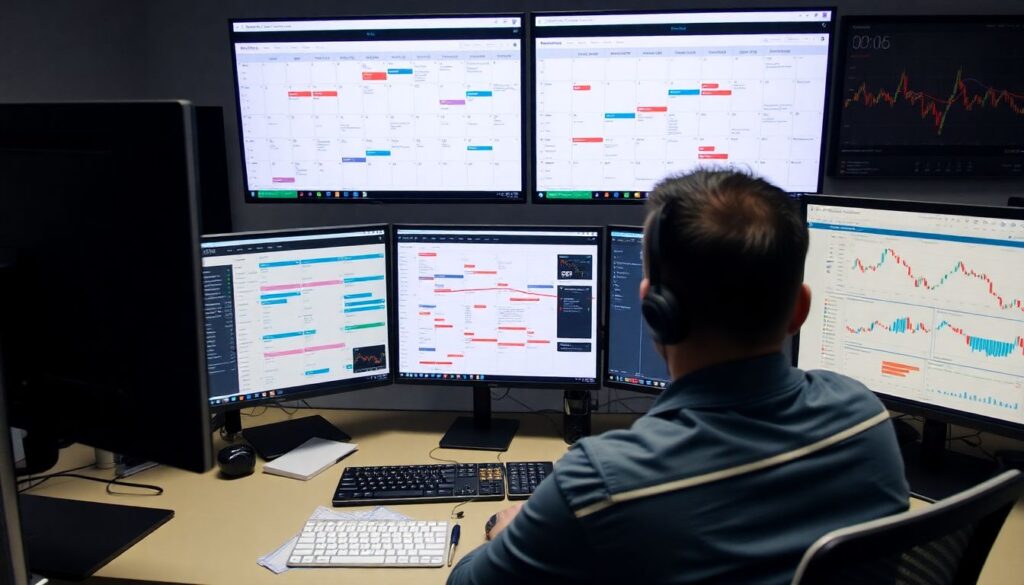
Prep checklist before building your weekly calendar:
- Block 30-45 minutes at the same time each week for calendar building.
- Gather all sources: news feeds, earnings calendars, project roadmaps, and dev blogs.
- Decide how many events you will actively trade this week (e.g., 3-5 max).
- Set a clear rule: no trades outside your predefined event list.
Use this compact table to classify each weekly item before you trade it:
| Signal Type | Primary Source | Expected Market Impact | Trade Priority |
|---|---|---|---|
| Major game launch / expansion | Official studio roadmap, dev blog, trailers | High volatility in related tokens and gaming stocks; potential multi‑day trend | Top tier |
| Tokenomics or utility update | Project governance posts, whitepaper updates | Medium to high; can support sustained repricing if utility clearly improves | Top tier |
| Tech earnings with gaming exposure | Earnings calendar, company guidance, tech stock market analysis | Medium; gap moves, sentiment spillover to peers and sector ETFs | Medium tier |
| Partnerships / integrations | Press releases, conference keynotes | Low to medium; sharp intraday spikes, often fade if details are vague | Selective |
| Regulation / platform policy shifts | Regulator sites, platform announcements | High; can reprice entire verticals, especially for NFTs and in‑game assets | Top tier |
- Collect all potential events for the upcoming week
Scan project roadmaps, official game and studio accounts, and earnings calendars to find anything tied to gaming tokens, major titles, or hardware. Include macro items only if they clearly connect to the latest tech trends impacting stock market sentiment. - Filter to events with clear, tradable timing
Keep only events with a specific date and, ideally, a rough time window (earnings, launch day, patch deployment, conference keynote). Drop vague promises like “Q2 release” that cannot be traded precisely. - Tag each event by impact and confidence
For each event, assign impact (high/medium/low) and your confidence level in the likely direction. Use recent examples of how this project trades news: does it typically overreact, underreact, or follow through on hype? - Map events to tradeable instruments
Connect every event to a specific token, stock, or basket. For example, a console GPU announcement may affect both a chipmaker stock and a metaverse token index. Note ticker, main exchange, liquidity, and normal spread. - Define pre‑event scenarios and invalidation
For each high‑priority event, outline two to three basic plays such as “breakout continuation on strong metrics” or “fade overhype on weak user numbers.” Attach invalidation levels (price or volatility conditions that cancel the trade idea). - Limit your weekly focus list
From the full calendar, choose a small set of A‑tier events (for example, three major items) and a few B‑tier backups. If a trade is not on this list, you skip it, no matter how loud the headline appears during the week.
Actionable Trade Setups for Crypto and Gaming-Adjacent Stocks
Prep checklist before deploying event setups:
- Confirm spreads and liquidity on your planned tickers at normal and high‑volatility times.
- Pre‑enter alerts for key levels instead of staring at every one‑minute candle.
- Write down at least one setup per event: breakout, mean‑reversion, or relative‑value.
- Set conservative leverage caps or avoid leverage entirely for initial tests.
Use this checklist to validate that a planned trade setup is robust before execution:
- Clear catalyst link: The trade is directly tied to a specific, dated gaming or tech event, not vague sentiment.
- Defined entry trigger: You know exactly what must happen to enter (e.g., “4h close above pre‑event range high with volume > 2x average”).
- Pre‑set stop level: The stop is based on structure (support/resistance, ATR) rather than an arbitrary percentage.
- Risk/reward mapped: At least 2:1 potential based on realistic post‑event ranges, not best‑case fantasies.
- Timeframe alignment: Entry trigger, stop, and targets all use the same timeframe (e.g., 1h or 4h), avoiding noise from mixed signals.
- Liquidity check passed: Daily dollar volume and average spread support your position size without heavy slippage.
- No overlapping exposure: You avoid stacking highly correlated trades on multiple gaming tokens or tech names for the same event.
- Plan for both surprise and base case: You have a plan if the announcement is neutral, better, or worse than expected.
- Example scenario documented: One short line describes the core idea, such as “Long gaming index ETF if large chipmaker beats earnings and guides up on AI/gaming demand.”
Risk Controls, Position Sizing and Hedging for Event Trades
Prep checklist for risk management before the week starts:
- Set a hard cap on total event‑trade risk as a fraction of your overall portfolio.
- Choose a fixed maximum loss per trade and stick to it across all catalysts.
- Decide which instruments you will use for hedging (index ETFs, futures, or staying partly in cash).
- List red‑flag conditions that cancel all new event trades (e.g., exchange outages, extreme macro shocks).
Common mistakes to avoid when sizing and managing event‑driven trades:
- Oversizing on “can’t miss” events: Treat every trade as uncertain; do not escalate size just because coverage is loud.
- Ignoring gap risk around earnings or launches: Size smaller when overnight gaps are likely, especially in thin gaming tokens.
- Using leverage to “catch up” after losses: Increasing leverage after a drawdown usually compounds errors; reduce size instead.
- Hedging with highly correlated assets: A gaming token is not meaningfully hedged by another similar token; prefer broader crypto or tech indices.
- Skipping maximum daily loss limits: Without a daily or weekly loss cap, a single chaotic news day can damage long‑term capital.
- Trading every small headline: Spreading risk across many low‑impact events dilutes focus and increases transaction costs.
- No plan for volatility spikes: Wide spreads and slippage are common right after news; avoid placing stops exactly at obvious levels.
- Holding illiquid names through major news without understanding halt rules or listing risks on specific venues.
Post-Event Review: Metrics to Validate Your Hypotheses
Prep checklist for your end‑of‑week review:
- Export charts and key metrics (price, volume, volatility) for all traded events.
- Note whether each trade followed its written plan or deviated due to emotions.
- Summarize the main ways how gaming industry affects crypto prices in your actual trades this week.
- Archive your weekly patch notes so you can compare patterns over time.
If you cannot trade live events or want safer alternatives, consider these options:
- Paper trading or very small size: Run the full weekly patch process but execute on a demo account or micro size until your rules prove consistent.
- Event‑aware investing: Use the same calendar to adjust long‑term positions or rebalance sector exposure instead of taking short‑term trades.
- Basket and index approaches: Trade sector ETFs, gaming indices, or diversified token baskets instead of single names to reduce idiosyncratic risk.
- Curated research consumption: Focus on reading a high‑quality best crypto and stock market newsletter and long‑form tech stock market analysis to inform slower‑paced decisions.
Practical Clarifications on Event-Driven Trading
How many events should I focus on each week?
Most intermediate traders benefit from focusing on a small number of high‑quality catalysts, such as three to five well‑researched events. This keeps your attention sharp and reduces the urge to chase every minor gaming headline.
How do I avoid overreacting to unexpected news?
Use your weekly calendar as a filter and decide in advance which types of surprise news you are allowed to trade. If a headline is not in your predefined playbook, observe it for learning but skip trading it in real time.
Can I use this process if I only trade stocks and not crypto?
Yes. The same framework works for gaming, hardware, platform, and tech stocks. Simply replace on‑chain data and token‑specific signals with traditional equity metrics, while still tracking how gaming catalysts and tech trends shape sector flows.
What timeframes work best for event-based setups?
For most traders, the 1h to 4h timeframe balances detail and noise around events. You can refine entries on lower timeframes but base your plan, stops, and targets on a consistent higher timeframe chart.
How do I handle conflicting signals between news and charts?

When sentiment and price action diverge, prioritize your risk rules. If price action contradicts your thesis, either pass on the trade or size smaller. Treat the conflict as a signal that uncertainty is high, not as a reason to double down.
Should I trade before or after the announcement?

That depends on your edge and risk tolerance. Pre‑event trades bet on expectations and usually need tighter risk controls; post‑event trades wait for confirmation in price and volume but may offer less reward. Document which style fits you better over several weeks.
How do broader tech trends affect gaming and crypto trades?
Macro tech sentiment can amplify or mute gaming catalysts. When the latest tech trends impacting stock market indices are strongly risk‑on, positive gaming news tends to get more follow‑through; in risk‑off weeks, even strong news can fade quickly.