

Why gaming money suddenly feels very “real” in 2025

If you earn money from Twitch, YouTube, Kick, Trovo, esports, or even random sponsor deals on Discord, you’re not “just playing games” anymore. For tax purposes, you’re a business.
Whether you pulled in $500 from Twitch subs or $500,000 from prize pools, taxes for streamers and esports players now work under the same basic rules as any other self‑employed creator.
And since it’s 2025, the rules, the tracking tools, and especially the IRS attention on digital income are way more serious than they were even 2–3 years ago.
This guide breaks down what you actually need to know, in plain English, with examples and current trends.
—
Are you “just a gamer” or officially a business?
From a tax perspective, the line is simple:
– If you expect to make a profit and you treat your gaming like work (stream schedule, sponsors, growth), you’re running a business.
– If you very occasionally get a random tournament prize or gift with no real intent to profit, it might still be taxable income, but you’re probably not a “business” in the formal sense.
For most people reading a twitch streamer tax guide in 2025, the tax man sees you as self‑employed.
That means:
– You’re responsible for reporting all your gaming income
– You pay income tax + self‑employment tax
– You can deduct business expenses that are ordinary and necessary
And no, “it went straight to my PayPal” or “I left it on the platform” doesn’t mean it’s not taxable. If you earned the money, it’s income.
—
Where your money comes from (and why each source matters)
Main income sources for streamers
Modern taxes for streamers cover more income types than ever, because platforms keep adding features:
– Subscriptions (Twitch, YouTube, Kick memberships)
– Ad revenue (YouTube AdSense, Twitch ads, in‑stream ads on Kick)
– Bits, Super Chats, Super Thanks, “gifts”
– Donations via StreamElements, Streamlabs, Ko‑fi, PayPal, Patreon
– Affiliate links (Amazon, game keys, gear shops)
– Sponsorships and brand deals (flat fees, performance bonuses)
Tax reality: Almost all of this is taxable income, even if:
– It’s called a “donation”
– It gets paid out as “gifts” or “tips”
– It stays in your creator balance for months
If viewers are giving you money because you stream or create content, it’s not a charity donation. It’s income for your content business.
—
Income sources for esports players
Esports player taxes revolve around a slightly different mix:
– Tournament winnings (online and LAN)
– Team salaries or stipends
– Performance bonuses
– Appearance fees, showmatches, show events
– Sponsorship deals (personal brand or through team)
– Prize gear with real market value (PCs, GPUs, gaming chairs, phones, etc.)
Even non‑cash prizes can be taxable. If you win a $3,000 PC, your tax authority may treat that as $3,000 of income (often at “fair market value”).
—
Technical block: How income is usually reported (U.S. focus)
> This block is about formal reporting. Numbers may differ by country, but the logic is similar.
– 1099‑NEC / 1099‑K (U.S.)
– Platforms, teams, and sponsors may send you 1099 forms if you cross certain thresholds.
– Since 2024–2025, payment processors (PayPal, Stripe, Cash App) are gradually tightening Form 1099‑K thresholds. Currently, the IRS’s targeted federal threshold is $5,000 in total payments, but some states use $600 or other limits. Check the current year because this keeps changing.
– Not getting a form does not mean you don’t owe tax.
– Self‑employment income
– Reported on Schedule C (U.S. individual return, Form 1040).
– You list gross income, then business expenses, to get your net profit.
– Tournament winnings
– Often reported on a 1099‑MISC or lumped in with other contractor payments.
– International events may withhold tax at source (e.g., 30% U.S. withholding for non‑residents) unless treaty rules apply.
Always download your platform payout summaries; they’re often more complete than the forms you receive.
—
Self‑employed taxes for gamers: what that actually means
If you’re a gaming earner, you’re usually considered self‑employed.
That means:
– You run a one‑person business, even if you don’t have an LLC
– You pay income tax on your profit (revenue minus expenses)
– You also pay self‑employment tax (U.S.: covers Social Security and Medicare, roughly 15.3% on net earnings up to a certain cap, plus possible extras)
So if you net $20,000 after expenses, part of that bill will be regular income tax, and another chunk will be self‑employment tax.
In many countries outside the U.S., the idea is the same:
– You’re treated as a freelancer / contractor
– You may owe social contributions or similar mandatory payments
– You often have to make advance or quarterly payments
—
Modern trend: tax authorities now understand streamers
In 2018, many tax agents barely knew what Twitch was.
In 2025, that’s over.
Key trends:
– Automatic data sharing: Platforms, processors, and marketplaces increasingly report payments directly to tax offices.
– Digital economy task forces: The IRS, EU tax agencies, and others now have specialist teams focusing on content creators, esports, and influencers.
– Lower thresholds over time: Governments are pushing to minimize “unreported creator income” by lowering 1099‑K or similar reporting thresholds, or by using bank data analytics.
If you’re still thinking, “they’ll never notice my $8k a year from streaming,” that mindset is now risky.
—
How to file taxes as a streamer without losing your mind
Let’s walk through a simple workflow you can reuse every year.
1. Track every income stream
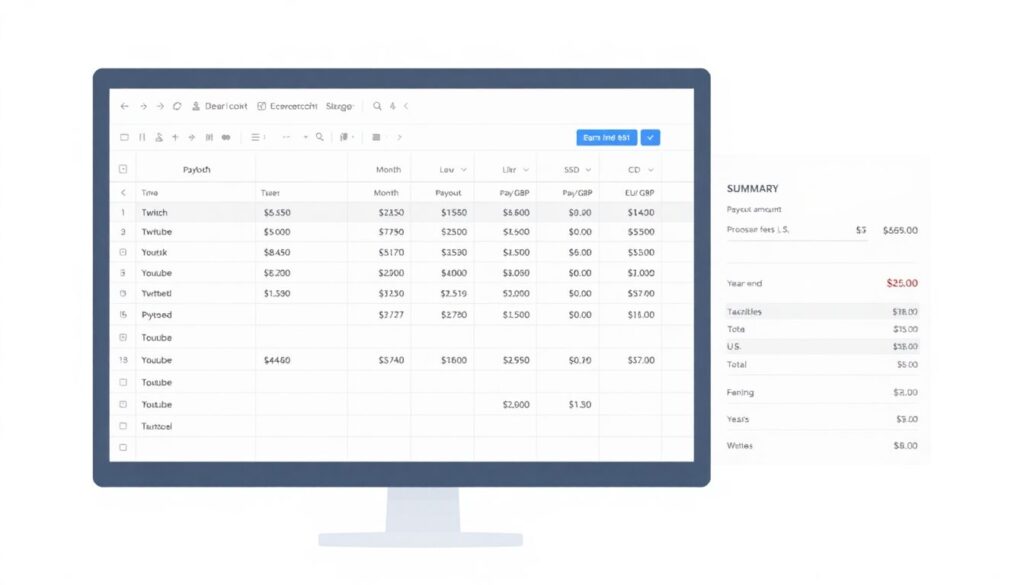
Start with a spreadsheet or a basic accounting tool. For each platform or source:
– Platform name (Twitch, YouTube, Kick, etc.)
– Month
– Payout amount
– Fees (processor fees if visible)
– Currency (if you earn in EUR/GBP and live in the U.S., note it)
At year‑end, sum everything up. The number is often higher than you expect because:
– Micro‑payments accumulate
– Old affiliate links still earn
– Off‑platform tips add up silently
—
2. Track your business expenses consistently
If you’re paying esports player taxes or streamer taxes, your biggest weapon is legit deductions.
Common deductible expenses (if used for business):
– PC, laptop, capture card, mic, camera, lights
– Headsets, controllers, mice, keyboards, chairs
– Games and DLC (if you stream/play them as part of content)
– Internet bill (business portion)
– Rent & utilities (home office portion, if you qualify)
– Design work: overlays, emotes, logos
– Video editing, thumbnail design, mods, coaches
– Travel to LAN events, tournaments, conventions
– Entry fees to tournaments you play as part of your career
Be honest: if you buy a game and never show it on stream, it’s harder to justify. But if your content relies on the gear or game, that’s much easier to defend as a business expense.
—
Technical block: how deductions really work (U.S. example)
> Numbers and rules vary by country, but this is the typical U.S. logic.
– You report gross revenue on Schedule C.
– You list categories of expenses, such as:
– Advertising (graphics, social media ads)
– Contract labor (editors, mods you pay, coaches)
– Legal & professional fees (tax pro)
– Utilities (portion of internet, electricity)
– Depreciation (for expensive gear lasting multiple years)
– The difference = net profit → that flows into your main tax return.
You don’t “get back” the full price of your gear. Instead, those costs reduce your taxable profit, which then reduces the tax bill.
—
Real‑world scenarios
Scenario 1: Part‑time Twitch streamer
Alex streams 4 nights a week while working a regular job.
– Twitch subs + bits: $6,000
– YouTube VOD ads: $1,200
– Sponsorships: $800
– Streamlabs / PayPal tips: $2,000
Total gross income: $10,000
Expenses:
– New PC (used 80% for streaming, 20% personal): $2,000
– Mic + camera: $400
– Stream overlays and logo: $300
– Internet bill (50% business use): $600 of $1,200 annual cost
– Game purchases used on stream: $300
Total expenses (business portion): $3,600
Net profit for the year: $6,400
Alex will:
– Pay income tax on $6,400 of self‑employment income (plus their salary income)
– Pay self‑employment tax on $6,400
– Possibly make estimated quarterly payments next year if the tax bill was high
Even though streaming is “part‑time,” tax law still treats it as a business.
—
Scenario 2: Esports player on a team
Mia is a Valorant player signed to an org:
– Team salary: $40,000
– Prize winnings: $12,000
– Brand deal (personal): $8,000
Total gross: $60,000
If the team treats her as an employee, she might receive:
– A regular paycheck with taxes withheld
– A year‑end W‑2 (U.S.) or local equivalent
But many teams still treat players as contractors:
– She gets 1099‑NEC forms for salary & brand deal
– Tournament organizers issue 1099‑MISC or similar
– No tax is pre‑withheld, so she must pay quarterly estimates
Expenses:
– High‑end PC and monitors (partly business)
– Local travel to bootcamps and small LANs
– Coaching, aim trainers, VOD review tools
– Possibly a portion of rent if she has a dedicated practice room
Her taxable position and cash‑flow planning are very different depending on whether she’s an employee or a contractor, even if the income is the same.
—
2025 trends every gaming earner should pay attention to
1. Platforms are tightening reporting

Twitch, YouTube, and major payment processors now:
– Ask for tax forms earlier and more aggressively
– Withhold payouts in some regions until documentation is complete
– Report more data to tax authorities by default
Reading a modern twitch streamer tax guide, you’ll notice there’s less “grey area” than there used to be; platforms no longer want the risk of facilitating undeclared income.
—
2. Cross‑border earnings are getting more complex
Esports and streaming are global by nature. Typical 2025 pain points:
– A creator in Germany earning from U.S. platforms in USD
– A Brazilian player flying to a U.S. Major and getting 30% tax withheld at source
– A UK streamer with EU sponsors sending Euros via Wise or Revolut
Governments are coordinating more:
– Tax treaties matter more (to avoid double taxation)
– Some countries now require declaring foreign accounts and balances
– Currency conversion for tax purposes must be consistent (use official yearly or monthly averages where required)
If you regularly play international tournaments or work with overseas sponsors, this is the moment to at least consult a pro once and then maintain the system on your own.
—
3. AI tools for bookkeeping (and why they’re not magic)
2025 also means you have better tools:
– Banking apps that auto‑tag “potential business expenses”
– Integrations that pull Twitch/YouTube/Kick payouts into one dashboard
– AI‑assisted bookkeeping that guesses categories for your expenses
These are great for organization, but:
– They don’t decide what’s legally deductible—that’s still your responsibility.
– Mis‑tagging things (e.g., personal purchases as business) can bite you in an audit.
Use the tools, but understand the basics yourself.
—
Common mistakes that hurt streamers and esports players
– Mixing personal and business money in one account
→ Much harder to prove what’s deductible later.
– Ignoring estimated taxes
→ In the U.S., if you expect to owe more than $1,000 in tax from self‑employment, you’re generally supposed to pay quarterly. Many countries have similar rules with prepayments.
– Not tracking small expenses
→ $20 here and $15 there, over 12 months, can easily reach $1,000–$2,000 of extra deductions you miss.
– Assuming “no form = no tax”
→ You must report income whether or not you receive a 1099, a local equivalent, or any official document.
– Treating every purchase as a “business write‑off”
→ If it’s mostly personal, you can’t fully deduct it. Be reasonable and proportion expenses honestly.
—
Practical checklist for the 2025 gaming earner
– Open a separate bank account for streaming/esports income and expenses
– Track every income source monthly (platforms + sponsors + tips)
– Keep receipts and invoices (digital is fine) for all gear and services
– Learn your country’s rules on:
– Self‑employment / freelancer taxes
– Home office rules
– Social contributions
– VAT / sales tax if applicable
– Mark your calendar for:
– Annual filing deadline
– Quarterly/advance payment due dates
– Consider a one‑time session with a tax pro who understands creator income; build a template you can reuse each year
—
Final thoughts: treat your gaming like a real business
By 2025, “I didn’t know” doesn’t work as an excuse. Governments recognize this world now, and the tools to track income from streaming and esports already exist.
If you:
– Treat your streaming or competitive play as a business
– Keep clean records
– Understand the basics of esports player taxes and self employment rules
– Ask for help on the complicated parts (international events, big sponsorships, forming an LLC or company)
…you’ll be ahead of most creators.
You don’t have to become a tax expert. You just need a simple, repeatable system for earning, tracking, deducting, and filing. Do that, and your gaming income can grow without turning tax season into a horror game every year.