

Why gamers are secretly built for investing

If you’ve ever spent nights optimizing a build, grinding ranked, or flipping loot on a marketplace — you already understand more about money than you think.
The gap isn’t *skills*. It’s translation.
You know:
– how to manage scarce resources
– how to think in probabilities
– how to plan around patches and meta shifts
Investing is the same game, just with real money and longer matches.
This guide breaks down foundational investing concepts every gamer should understand, in plain language, with practical steps you can use this week. Think of it as “investing for gamers”: no fluff, no get-rich-quick nonsense, just stuff that works.
—
Concept #1: Your “economic engine” is your XP farm
In games, you don’t worry about late-game items if your early XP and gold income sucks. Same in real life: before thinking about complex strategies, you need a simple economic engine:
1. You earn.
2. You spend less than you earn.
3. You invest the difference.
4. Compounding does the hard work.
Short, but brutal: if step 2 fails, everything else is just theory.
Practical build: the 50/30/20 baseline
As a starting “build”:
– 50% income → essentials (rent, food, transport)
– 30% → fun (games, hobbies, going out)
– 20% → investing & savings
Can’t hit 20% right now? Hit something. Even 5–10% is fine as a start. In most long-term investment strategies for beginners, consistency beats amount.
> Technical detail: Why starting small still works
> If you invest $100/month at 8% average annual return (US stock market historical average is ~9–10% before inflation), after 30 years you get ~$150,000.
> Total money you put in: $36,000.
> Compounding (the “XP bonus”) did the rest.
—
Concept #2: Risk = difficulty level, not a coin flip
Most people think risk is “will I lose all my money?”
For gamers, better analogy: risk = difficulty setting.
– Easy mode: low risk, low rewards (cash, savings accounts, government bonds)
– Normal mode: diversified stock index funds
– Nightmare mode: leverage, options, meme coins, random penny stocks
The mistake beginners make: they jump into nightmare mode before they even finish the tutorial.
Stock market basics for beginners (in gamer terms)
Think of a stock as:
– owning a small shard of a company
– that shard can pay you:
– dividends (like passive gold)
– price growth (value of your shard going up)
A stock market index (like the S&P 500 in the US) is:
– a bundle of hundreds of top companies
– bought together as one single asset (ETF or index fund)
– if one company goes boom, others balance it out
Historically:
– S&P 500: ~10% average yearly return before inflation since 1920s
– After inflation: closer to ~7% real return
That’s why many pros say: if you don’t want to make investing your full-time hobby, just buy broad index funds regularly.
> Technical detail: Volatility vs risk
> Volatility = how much price jumps around short-term.
> Risk (real one) = chance you don’t meet long-term goals.
> Stocks are volatile in 1–3 year windows, but historically low-risk for 15–20+ year horizons if broadly diversified.
—
Concept #3: Time horizon – are you playing ranked or ARAM?
Gamers understand game modes. Investing has them too: they’re called time horizons.
– Short-term mode: money you need in 1–3 years
Example: new PC build, moving to another city
– Mid-term mode: 3–10 years
Example: first house, big career shift, long travel
– Long-term mode: 10+ years
Example: financial independence, retirement
Big rule:
**Money needed in the next 3–5 years → keep low risk.
Money for 10+ years → you can use stocks and ride volatility.**
This is the heart of how to start investing as a beginner: match your investments to your time horizon, not to your emotions.
—
Concept #4: Diversification – not putting all points into one stat
You’d never put all talent points into movement speed and ignore HP, damage, skills, everything. That’s asking to get one-shot.
Same with investing.
Diversification = spreading your money across:
– many companies
– many sectors (tech, healthcare, energy, etc.)
– sometimes many countries
In practice, for normal humans, this usually means:
– index funds / ETFs that hold hundreds or thousands of stocks
– maybe a small percentage in bonds or cash for stability
> Simple diversified “starter build” (not personal advice, just structure example):
> – 80–90%: global or US stock index ETF
> – 10–20%: bond ETF or high-yield savings for stability
> Adjust stock % down if you’re very risk-averse or close to needing the money.
Investing for gamers doesn’t need to be a stock-picking minigame. Your *main* build can be boring, and you still “win the campaign”.
—
Concept #5: Compounding – your real endgame boss
Compounding is literally the most broken mechanic in real life.
It’s interest on interest. Gains on old gains. Like stacking buffs.
Let’s put numbers on it.
Say you invest $200/month into a broad stock index:
– Average real return (after inflation): 7% per year
– Period: 35 years
End result: ~$360,000 in today’s money.
Your own contributions: $84,000.
Everything else is compounding.
Delay start by just 10 years (invest for 25, not 35 years):
– Same $200/month at 7%
– You end up with ~$157,000
You just lost over $200,000 by waiting 10 years.
That’s why the first rule of long term investment strategies for beginners is basically:
Start. Small is fine. But start.
—
Concept #6: Speculation vs investing – ranked grind vs casino
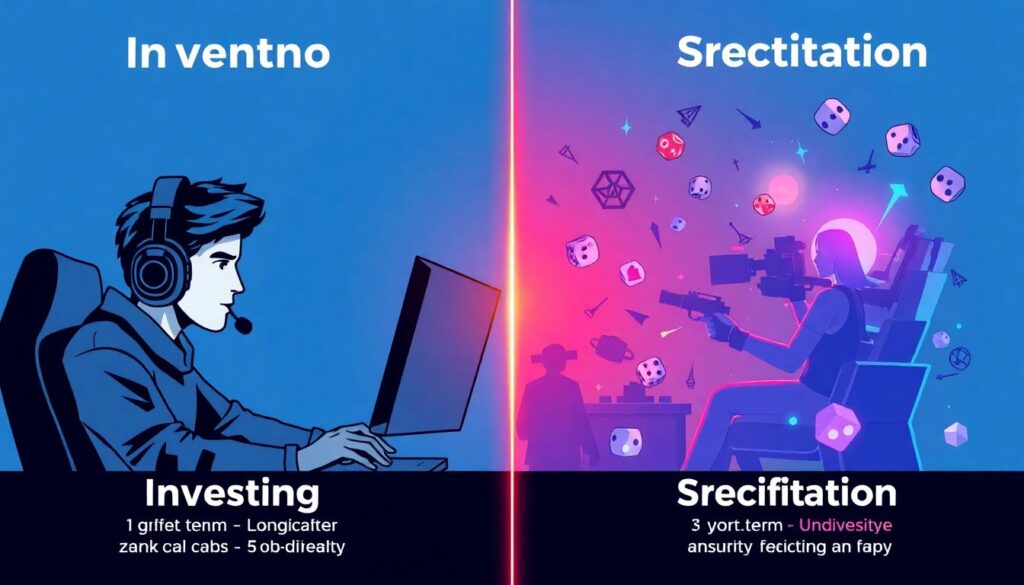
In games, you know the difference between:
– grinding ranked with a solid comp
– yolo-queuing unranked with randoms
Investing has the same split:
– Investing
– Long-term (5–10+ years)
– Diversified
– Based on fundamentals (actual business, real cash flows)
– Boring most days
– Speculation
– Short-term
– Concentrated bets
– Based on narratives, hype, or pure guessing
– Emotionally intense
You can speculate, just like you can play ARAM all night — but you don’t confuse it with your ranked climb.
A practical approach:
– 80–90% of your money: boring, diversified, long-term investing
– 10–20%: “fun money” for individual stocks, crypto, or hype plays
If it goes to zero, your life doesn’t break.
> Technical detail: Expected value mindset
> Even if a speculative trade has high upside, its expected value can be neutral or negative if probability is low.
> In investing, we care less about “what if it 10x’s?” and more about:
> – What’s the realistic probability?
> – Can I survive if it fails?
—
Concept #7: Fees and friction – the hidden debuffs
In many games, you have invisible debuffs: reduced XP, gold tax, durability loss. In investing, the debuff is fees.
Even small ones hurt a lot over time.
Example:
– You invest $10,000
– Get 8% gross return annually for 30 years
– Two scenarios:
– Low-fee fund: 0.1% annual fee → net 7.9%
– High-fee fund: 1.5% annual fee → net 6.5%
After 30 years:
– Low fee: ~$100,600
– High fee: ~$66,200
Same market. Same investor. Just different fee levels. You lose ~34,000 for nothing.
So when you look at best investing apps for beginners, don’t just look at UI and shiny features. Check:
– trading commissions (0 is now standard in many apps)
– fund expense ratios (ETFs with 0.03–0.20% are common)
– hidden spreads and “payment for order flow” impact (harder to see, but lower is better)
—
Concept #8: Volatility = tilt; your job is tilt control
Gamers know tilt. You lose a few matches, you start forcing plays, rage queuing, flaming, making dumb decisions.
Markets do the same to your brain:
– portfolio drops 20–30%
– red numbers in the app
– doomsday headlines everywhere
Common emotional reactions:
– panic sell at the bottom
– then buy back only when it “feels safe” (which is usually near the top)
In long-term data, the average investor underperforms the average investment because of behavior — not because of bad choices on paper.
> Technical detail: Dalbar studies
> Long-term studies (e.g., Dalbar in the US) show:
> – S&P 500 ~9–10% annual returns historically
> – Average equity fund investor: often 3–5%
> Gap = buying high, selling low, market timing, emotional decisions.
Tilt control tools:
– pre-commitment: “If market drops 30%, I will not sell my index funds.”
– rules: only check portfolio once a month or quarter
– automation: automatic investing on a schedule (see next concept)
—
Concept #9: Automation – set your build and let it farm
Manual investing is like manual gold farming. Works, but it’s dumb if you can automate.
If you’re figuring out how to start investing as a beginner and keep it simple:
1. Open an account with a low-fee broker or investing app.
2. Pick one or two broad index ETFs (for example: global stocks, or US + international).
3. Set up an automatic monthly buy for a fixed amount on a fixed date.
This is called dollar-cost averaging (DCA):
– same amount every month
– you buy more shares when prices are low, fewer when prices are high
– you stop overthinking “is now a good time?”
Real-world effect:
– You avoid sitting in cash “waiting for the crash”
– You reduce the impact of bad timing
– You tie investing to your *habit system*, not your mood
This is why a lot of long term investment strategies for beginners recommend DCA as a core mechanic.
—
Concept #10: Liquidity – how fast you can “recall to base”
Not all assets are equal when it comes to getting your money back.
– Cash: instant recall
– Stocks / ETFs: usually 1–3 business days to settle after sale
– Real estate, private equity, collectibles: could take months
For your emergency fund:
– Keep it highly liquid (cash or savings account)
– Aim for 3–6 months of essential expenses
That way, if life hits you with an unexpected boss fight (job loss, medical bills, family problems), you don’t have to:
– break long-term investments at a loss
– go into high-interest debt
Emergency fund = your defensive items. You don’t push high ground with no armor.
—
Concept #11: Research – don’t confuse patch notes with marketing
As a gamer, you know:
– dev blogs, balance notes, and stats are signal
– trailers, marketing, hype are noise
Investing’s the same:
– Signal: financial statements, business models, unit economics, competitive advantages
– Noise: TikTok “experts”, Discord groups, random YouTube hype, “this coin will 100x”
If you want to go beyond index funds and actually pick individual stocks, use a structured checklist:
– What does this company actually do, in one sentence?
– How do they make money? Who pays them, and why?
– Are revenues and profits growing over the last 3–5 years?
– Is there real free cash flow, or just accounting tricks?
– What could kill this business? Tech change? Regulation? Competition?
> Technical detail: Very basic stock valuation sanity check
> – Price-to-Earnings (P/E) ratio: price per share ÷ earnings per share
> – If P/E is:
> – 10–20: often seen as “normal” depending on sector & growth
> – 40–80+: growth expectations are sky-high; more risk if growth slows
> Doesn’t mean low P/E = buy or high P/E = avoid, but it’s your first “is this insane?” filter.
For most people, the cleanest path is:
– 90% of your energy → career, skills, side income
– 10% → learning stock market basics for beginners just enough to not get scammed, then default to index funds
—
Concept #12: Choosing tools – apps, platforms, and friction
Modern platforms made investing ridiculously accessible. You can literally invest from your phone between matches.
When comparing the best investing apps for beginners, focus on:
– Costs
– $0 commissions on stock/ETF trades
– Low ETF expense ratios (ideally under 0.2% per year)
– User experience
– Simple enough that you won’t avoid using it
– But not turning investing into a casino with confetti and dopamine spam
– Available assets
– Broad index ETFs
– Retirement accounts if your country supports them (401(k), IRA in the US, ISA in the UK, etc.)
– Regulation & safety
– Is the broker regulated in your country?
– Is there some form of investor protection/insurance?
Don’t over-optimize day one. Pick something credible, low-fee, and easy enough to use regularly.
—
Concept #13: Income vs growth – DPS vs scaling
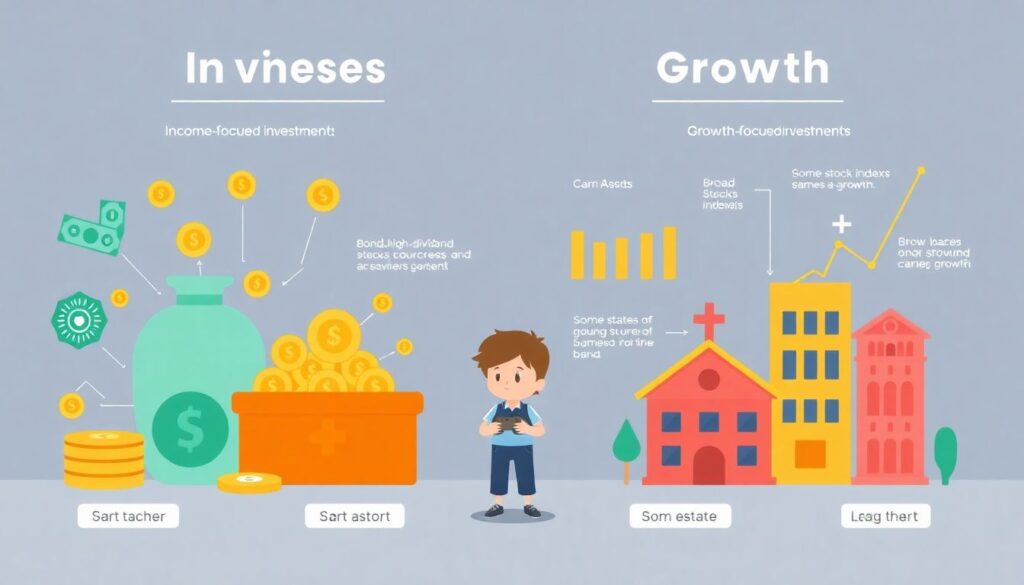
Some investments pay you regular cash (dividends, bond coupons, interest).
Others mostly give price growth.
Rough split:
– Income-focused: bonds, high-dividend stocks, REITs, savings accounts
– Growth-focused: broad stock indexes, growth stocks, some real estate
For young gamers starting out:
– You usually don’t need a ton of income right now.
– You want maximum growth so future you has options.
So many long term investment strategies for beginners lean growth-heavy early on, then gradually add more income and stability as you age or approach big goals.
—
Concept #14: Taxes – the system rules of the game
Every multiplayer game has rules. You don’t have to like them, but ignoring them gets you banned or punished.
Same with taxes.
Details differ by country, but general ideas:
– You often pay tax on:
– Dividends (cash paid out by companies)
– Capital gains (profit when you sell above your buy price)
– Many countries have:
– Tax-advantaged accounts for retirement or long-term investing
– Contribution limits per year
– Penalties for early withdrawal
Practical implication:
– Before you invest, google: “tax-advantaged investing accounts [your country]”
– If possible, put long-term investments inside those accounts first
– This can literally add tens of thousands to your end result without changing your risk or effort
—
Putting it all together: a simple “gamer-friendly” blueprint
Here’s how to start investing as a beginner if you’re a gamer and want something actionable, not theoretical:
1. Fix the XP farm
– Track your monthly income and expenses for 1–2 months.
– Find a percentage you can auto-invest (even 5–10% is fine).
2. Build your safety layer
– Aim for 3–6 months of essential expenses in cash/savings.
– Keep this separate from your investing account.
3. Pick your core investment
– Choose 1–2 broad, low-fee stock index ETFs (global or US + world ex-US).
– If you’re very cautious, add 10–20% bonds.
4. Automate your DCA
– Set up monthly auto-invest on payday.
– Treat it like a subscription to “Future You”.
5. Define your rules
– Time horizon: “Money here is for 10+ years.”
– Behavior: “I don’t sell because of news or short-term drops.”
– Speculation: “Max 10–20% of my portfolio is for fun/hype trades.”
6. Review rarely, tweak slowly
– Once or twice a year: check if allocation still matches your goals and risk tolerance.
– Rebalance only if you drift too far from your target percentages.
—
Final thought: play the long game
Gamers are already good at:
– learning complex systems
– optimizing builds
– thinking in probabilities
– grinding long-term goals
Investing is just another system.
You don’t need to become a Wall Street wizard. You just need:
– a basic understanding of these foundational concepts
– a simple, boring, automated plan
– enough discipline not to blow yourself up chasing “insane plays”
Treat your finances like a long campaign, not a single match.
Make the decisions that your “New Game+” self will thank you for.