
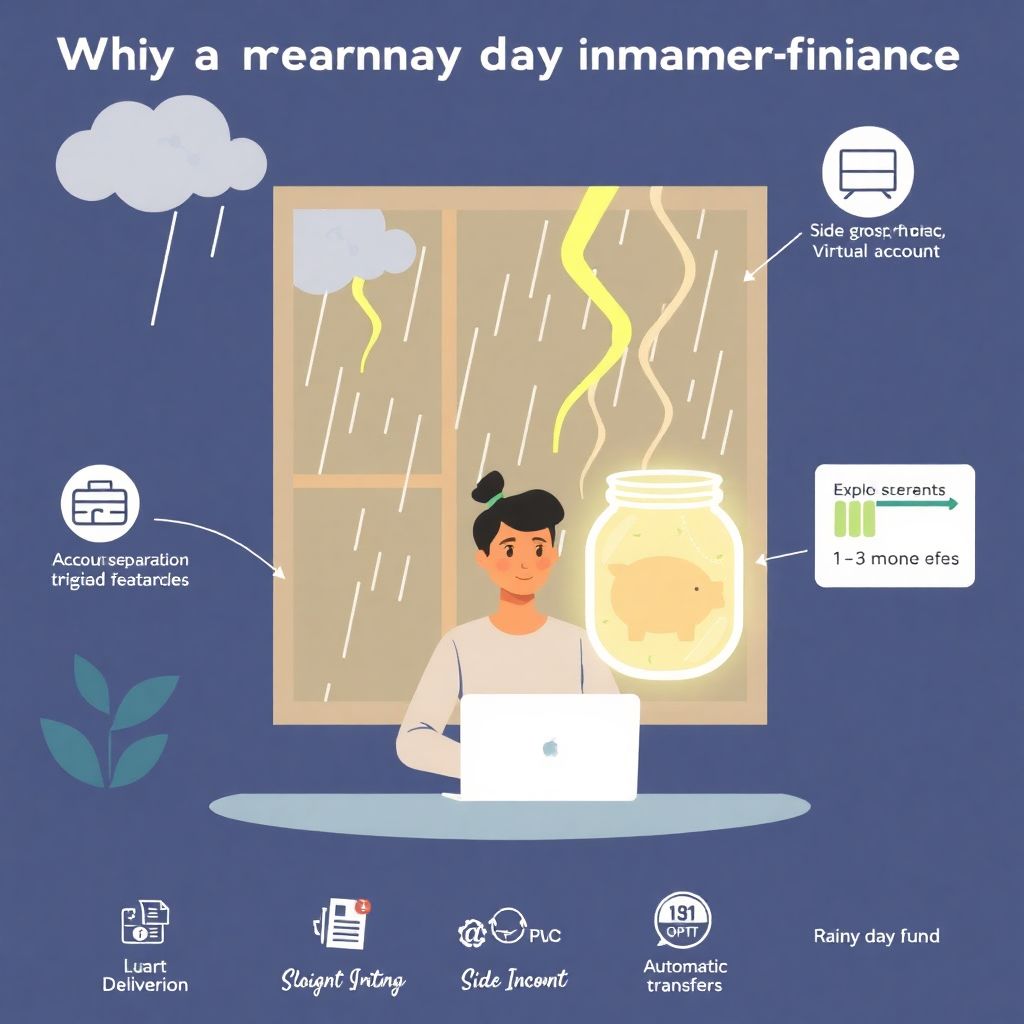
Why a rainy day fund matters more than ever
Most people don’t go broke because of “big dreams”; they go broke because the car dies, a tooth cracks, or the company suddenly “restructures.” That’s where a rainy day fund steps in: a small, liquid buffer (typically 1–3 months of basic expenses) that keeps temporary trouble from turning into long‑term debt.
According to the U.S. Federal Reserve’s 2023 household well‑being report, roughly 37–40% of adults would struggle to cover a $400 emergency without borrowing or selling something. Similar patterns show up in the UK, EU, and many emerging markets. At the same time, global gig‑economy revenue is projected by various research firms (e.g., Mastercard, Statista) to pass $450–500 billion annually by the late 2020s. In other words: lots of people have fragile finances, and a fast‑growing ecosystem of side gigs and freelancing is sitting right next to them, underused or misused.
—
Think “system,” not “side hustle chaos”
Before chasing gigs, treat your rainy day fund as a mini financial system:
input (income from side work) → processing (allocation rules) → output (cash buffer).
A simple architecture looks like this:
– Target: 1–3 months of critical expenses (rent, food, transport, insurance, minimum debt payments).
– Timeline: 6–18 months to hit that target, depending on income and risk tolerance.
– Rule: 100% of side‑gig profit goes to the rainy day fund until the target is met.
This removes ambiguity. You’re not doing side jobs “to have more money sometime.” You’re building a dedicated shock absorber with a clear completion point. Psychologically, that finish line matters; people quit less when the project feels finite.
—
Choosing side gigs with “emergency‑fund math” in mind
A common rookie move is to chase what looks fun or glamorous instead of what has the highest probability of producing cash fast with low overhead. When your goal is a rainy day fund, you need boring, repeatable, and monetizable skills.
Good criteria:
– Low startup cost (ideally under $100)
– Short skill ramp (weeks, not years)
– Clear marketplace demand (visible job posts or clients already paying for it)
– Flexible hours so you can stack gigs around your main job
That’s why the best side hustles to make extra cash at the beginning are usually simple services: delivery, tutoring, basic design, copyediting, virtual assistance, no‑code website setup, data entry, or local services like pet sitting and cleaning. They’re not always glamorous, but they generally satisfy the core requirement for your fund: fast, predictable inflows.
—
Freelancing basics: from zero to first invoice

Many people get stuck on how to start freelancing with no experience because they imagine they need a polished portfolio right away. What you actually need is evidence that you can solve one concrete problem for someone willing to pay.
Here’s a practical sequence:
1. Select a narrow service
Not “marketing,” but “write product descriptions for Etsy shops” or “clean up Excel sheets for small businesses.”
2. Do 2–3 “proof of concept” jobs
Help friends, colleagues, or local businesses for a small fee or in exchange for testimonials. Get before/after examples.
3. Package and publish
Put your offer and samples on a simple landing page or a profile on platforms like Upwork, Fiverr, or regional freelance markets.
4. Volume of outreach, not overthinking
In the first 30 days, your job is to send proposals and pitches, not endlessly tweak your profile. Aim for 5–10 targeted proposals a day.
Once the first few clients are in, you can optimize pricing and positioning. Until then, frictionless execution beats perfectionism.
—
Side‑income strategy: active first, passive later
Another frequent error: people start with complex schemes that promise “money while you sleep” long before they’ve mastered straightforward, active income. Building a rainy day fund is a sprint, not a 20‑year retirement plan, so you want income that responds quickly to added effort.
Only after your emergency cash buffer is in place does it make sense to test ways to earn passive income online such as digital products, niche content, or small automated services. These can be powerful long‑term, but they’re slower to validate and often require more upfront work with uncertain payoff.
—
Common beginner mistakes that slow down the fund
Newcomers to side gigs and freelancing repeat the same patterns that sabotage their rainy day fund.
Typical pitfalls include:
– No separation of accounts
Mixing gig money with everyday spending makes it easy to “accidentally” consume your fund.
– Price dumping
Charging unsustainably low rates, then burning out before the fund is built.
– Shiny object syndrome
Jumping to a new side hustle every month, never staying long enough to reach real profitability.
– Ignoring taxes and fees
Forgetting that payment processors, platforms, and the tax office all want a cut.
A lean setup is best: one dedicated savings account for the fund, one checking account for side‑gig inflows and expenses, and a simple spreadsheet or budgeting app to track progress.
—
Turning freelance income into an actual rainy day fund
Earning more doesn’t automatically equal saving more. The conversion mechanism from extra income to actual reserves has to be explicit.
A robust approach:
– Automate the transfer
As soon as side‑gig income hits your operational account, a fixed percentage (ideally 70–100% during the build phase) is auto‑moved to your rainy day fund account.
– Define “done” in numbers
For example: “Fund equals $3,000 or two months of essentials, whichever is higher.”
– Lock the rules
You only draw from this fund when there is a genuine, time‑sensitive need that affects your baseline functioning (work, housing, health).
This “rules‑before‑feelings” structure shields your fund from impulse purchases and lifestyle creep.
—
How much is enough? Economic and risk considerations

The size of your buffer should reflect your personal risk profile and labor‑market conditions. Someone with a stable government job, low fixed costs, and family support can rationally choose a smaller buffer than a freelancer in a volatile industry with dependents.
Key variables to consider:
– Job security and sector volatility
– Local unemployment rate and re‑hire times
– Debt obligations and interest rates
– Health‑care costs and insurance gaps
In a high‑inflation environment, holding too much idle cash has an opportunity cost, but under‑saving leaves you exposed to expensive credit card debt. For most workers in developed economies, 1–3 months of core expenses in a rainy day fund plus another 3–6 months in a broader emergency fund or flexible investments strikes a reasonable balance between safety and inflation drag.
—
Industry‑level impact: how side gigs change the labor market
As more people use side gigs to stabilize their personal finances, the effect accumulates at the macro level. The gig economy isn’t just a collection of odd jobs; it’s a parallel labor infrastructure with its own pricing mechanisms, risk allocation, and bargaining dynamics.
Several trends stand out:
– Risk redistribution
Income volatility shifts from employers to individuals. A rainy day fund becomes a de‑facto self‑insurance mechanism for gig workers.
– Wage pressure and flexibility premiums
Traditional employers in some sectors must offer higher wages or more flexibility to compete with independent work, especially in tech, design, and logistics.
– Financial‑services innovation
Banks and fintechs are designing products specifically for irregular income: dynamic credit scoring, income‑smoothing tools, and micro‑savings linked to gig platforms.
Regulators are still catching up with this structure, which means we’re likely to see new rules on worker classification, social protection, and tax treatment over the next decade, all of which will affect how attractive freelance side gigs remain as a buffer‑building tool.
—
Forecasts: where side gigs and safety nets are heading
Data from consulting firms and labor‑market surveys suggests the number of people engaging in independent work at least once a month will continue to rise through the 2030s. Automation and AI will eliminate some low‑skill tasks but simultaneously expand demand for human‑in‑the‑loop roles, specialized services, and hyper‑niche expertise.
Expect:
– More platform fragmentation (specialized marketplaces for specific industries or tasks)
– Increased cross‑border freelancing, as currency and wage differentials remain significant
– Growing integration with benefits: pooled insurance, retirement saving options, and portable ratings or credentials across platforms
If these forecasts hold, then how to make extra money freelancing will be less about “finding any gig” and more about strategically positioning your skills in ecosystems that offer both earnings and resilience.
—
From one‑off projects to a predictable buffer
Random one‑off gigs can kick‑start your rainy day fund, but predictability requires systems: recurring clients, repeatable services, and clear financial rules. Over time, the best side gigs to build an emergency fund are the ones you can turn on and off depending on need, without a long setup phase.
A simple operational checklist:
– One or two proven services that you can sell on demand
– A short list of previous clients you can reach out to when you want extra work
– An automated pipeline that routes extra income straight into your rainy day account
– A review every 3–6 months to assess whether your fund size still matches your risk level and cost of living
Side gigs and freelancing are powerful tools, but only if you deliberately convert that extra effort into financial resilience instead of allowing it to disappear into everyday spending. Once your rainy day fund is in place, you’ll feel the difference every time life throws a surprise your way—and you realize you can just pay it and move on.