
Why crypto beginners keep hearing about futures and perpetuals
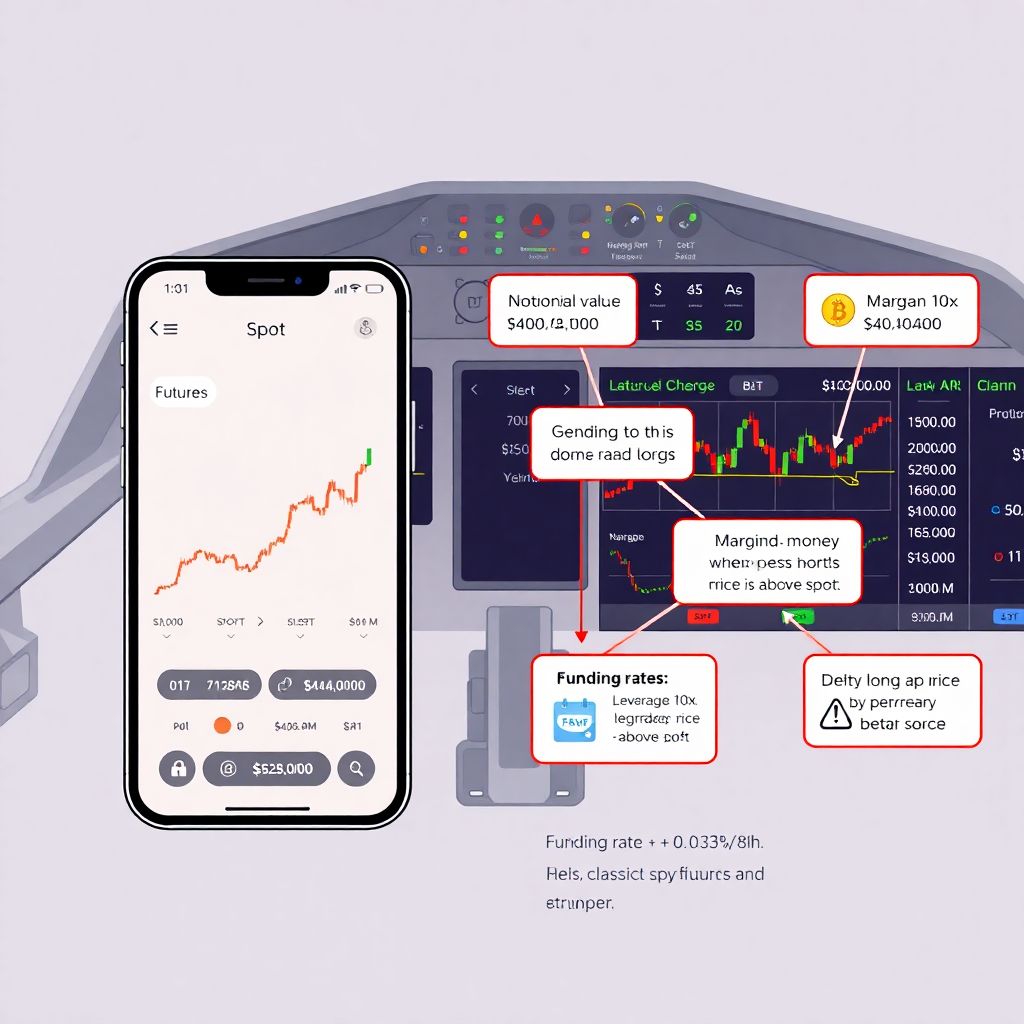
If you’re just getting into crypto and open any big exchange, you’ll see buttons like “Futures”, “Perpetual”, “USDT-M”, “Coin-M” and a pile of numbers that look more like a cockpit than an app. A lot of newcomers assume this is some advanced casino mode and just skip it. In reality, both futures and perpetual contracts are simply structured ways to bet on the price of Bitcoin, Ether and other coins — with rules, math and risk controls. Understanding what are perpetual futures in cryptocurrency, and how they differ from classical futures, is the first step before you risk a single cent. Let’s walk through this calmly, with real examples and without academic jargon overload.
—
Spot vs futures: two different ways to “own” crypto
Before talking about advanced stuff like crypto futures trading strategies for beginners, you need a clean mental model of what you’re actually trading. On a normal spot market, you buy 0.1 BTC, it lands in your balance, and you either hold it or send it somewhere. If Bitcoin goes from $40,000 to $44,000, you made 10% on your position, no leverage, no extra layers. Futures change only one key thing: you are no longer buying the coin itself — you’re entering a contract whose value tracks the coin’s price. That subtle shift unlocks powerful tools like short selling and leverage, but also adds ways to blow up an account if you treat it like a casino.
—
Classic futures in crypto: contracts with an expiry date
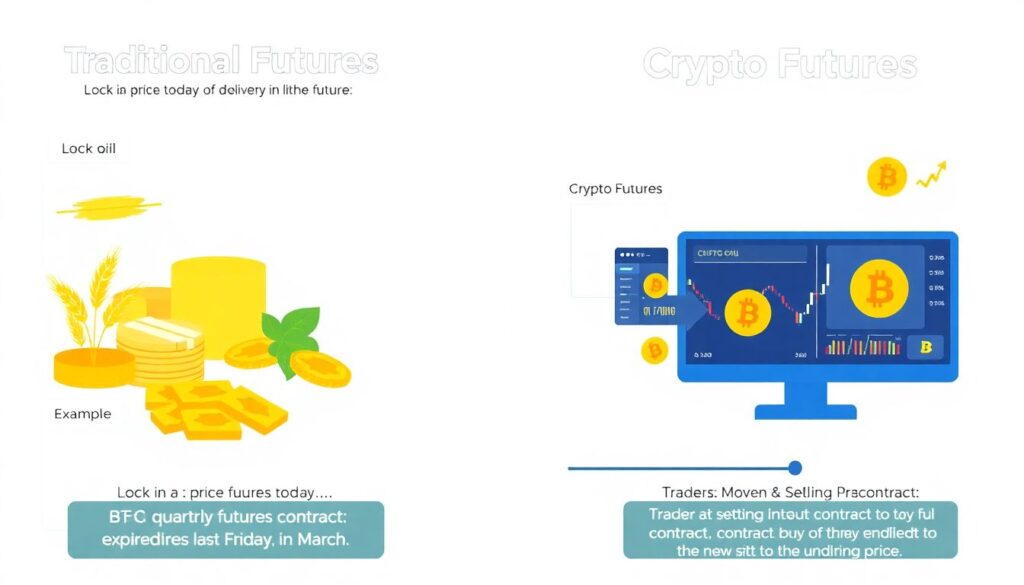
Traditional futures came from commodities: wheat, oil, gold. You lock in a price today for delivery in the future. Crypto copied this idea. A BTC quarterly futures contract might expire on the last Friday of March. Until that date, traders can buy and sell the contract; at expiry it “settles” to the spot price, and your profit or loss is realized. If you bought BTC futures at $30,000 and at expiry Bitcoin is $33,000, your contract settles with a $3,000 profit per BTC contract (minus fees). If the price drops to $27,000, you lose $3,000 per BTC contract.
Unlike spot, you can usually open both long and short positions easily. You might short 1 BTC futures contract at $40,000 because you think the market will drop. If BTC does fall to $35,000, you can close the short and pocket $5,000. No need to own any Bitcoin beforehand — that’s the key attraction of futures for hedging.
—
Technical detail: how margin and leverage work in futures
Think of this as the “engine room” part:
– Notional value:
If you open 1 BTC futures contract at $40,000, the notional value is $40,000.
– Leverage:
With 10x leverage, you only need 1/10 of that as collateral (margin). For a $40,000 position, that’s $4,000 of your own capital.
– Liquidation:
If the market moves against you enough that your remaining equity can’t cover the minimum margin, the exchange will liquidate (force-close) your position. On many platforms, a 10% move against you at 10x leverage can be enough to wipe you out, depending on maintenance margin and fees.
So leverage does not magically multiply your money; it multiplies your sensitivity to price movements, both positive and negative.
—
What are perpetual futures in cryptocurrency, in plain English?
In classic futures, contracts have an expiry date. Perpetual contracts (or “perps”) remove the expiry completely. You can hold the position theoretically forever, as long as you have enough collateral. That’s why beginners asking how to trade perpetual futures crypto often confuse them with margin trading — they feel similar because both let you keep a leveraged position open without an obvious end date.
Perpetuals became the dominant product on many derivatives platforms. For example, on some days, more than 80% of derivatives volume on large exchanges comes from perpetual futures, not dated contracts. Popular BTC perpetual markets often clear tens of billions of dollars in volume per day.
But without an expiry date, how does the contract stay close to the real spot price? That’s where one of the most misunderstood mechanisms comes in: funding rates.
—
Technical detail: funding rates and price anchoring
Perpetual prices must not drift too far from spot; otherwise the contract would become detached from reality. Exchanges solve this with a funding mechanism:
– Every 8 hours (typical interval, varies by exchange), a small payment is exchanged between longs and shorts.
– If the perp price is trading above spot, longs pay shorts a fee (positive funding rate).
– If the perp price is trading below spot, shorts pay longs (negative funding rate).
Example with numbers:
– Spot BTC: $40,000
– BTC perpetual: $40,400 (1% higher)
– Funding rate: +0.03% per 8 hours
If you are long 1 BTC perpetual worth $40,400, you will pay 0.03% of the notional every 8 hours (about $12.12) to shorts, for as long as the funding is positive. This encorages traders to short the perp and long spot, pulling the perp price back toward spot.
For short-term traders, funding is often a small detail. For long-term holders of perpetual positions, it can add up significantly, almost like an invisible interest rate.
—
Perpetuals vs classic futures: comparing key approaches
Both products try to solve the same core problem: how to let people bet on future prices with leverage and without needing the underlying coins. But they do it in different ways.
1. Time horizon approach
– Classic futures: You implicitly pick a time horizon through expiry (e.g., March, June). Hedgers like this because they often have a real-world date to match: miners expecting BTC inflows next quarter, funds rolling exposure every three months.
– Perpetuals: You focus on the direction and leverage, not on dates. Day traders, scalpers and swing traders love this: they can hold positions for hours, days or weeks with no contract rollover.
2. Price convergence mechanism
– Classic futures: At expiry, the contract is forced to converge to the spot index; after that, it simply ceases to exist.
– Perpetuals: No expiry, so they use dynamic funding payments to push the perpetual price toward spot continuously.
3. Operational complexity
– Classic futures: You must manage rollovers. If you want a long-term exposure, you close March futures and open June, and that transaction has costs and slippage.
– Perpetuals: You avoid rollovers completely; you just manage margin, liquidations and funding. Less calendar micromanagement, more focus on risk.
4. Cost structure
– Classic futures: Main costs are trading fees and any basis you pay when you roll contracts (difference between old and new expiry).
– Perpetuals: You pay trading fees plus ongoing funding, which can flip between positive and negative. In bullish markets, longs often pay; in bearish markets, shorts often pay.
For a typical beginner, perpetuals feel simpler because they remove the expiry date. But they can quietly drain your account through funding if you don’t track it, especially in strongly trending markets.
—
Real-world use cases: traders vs hedgers vs gamblers
Not all users of futures and perps have the same goals. Let’s compare a few realistic profiles and how they might approach crypto futures trading for beginners.
1. The spot-only investor who wants downside protection
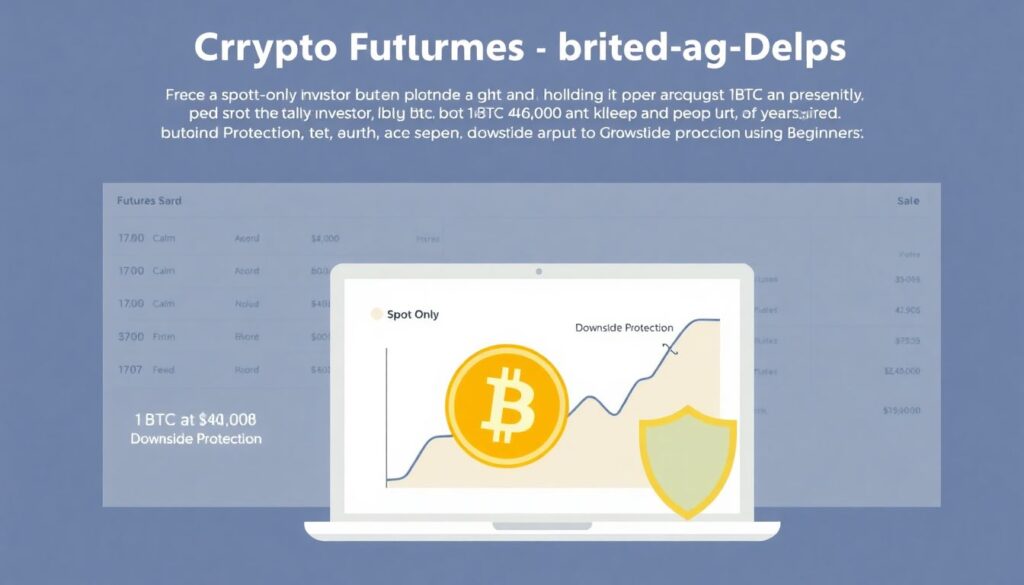
Imagine you bought 1 BTC at $40,000 and want to keep it for years, but you’re afraid of a short-term crash. You don’t want to sell your spot coins because of tax reasons or just emotional attachment. A classic hedge: open a short position in BTC futures equal to 1 BTC notional. If BTC falls to $30,000, your spot loses $10,000, but your short futures position gains roughly $10,000. You’ve “locked in” your dollar value temporarily. This is where classic quarterly futures shine: you hedge until a specific date, then reassess.
2. The short-term trader hunting volatility
Another trader doesn’t care about owning BTC on-chain. They just want to profit from 2–5% daily swings. Perpetuals are almost tailor-made for this. They can open a 5x leveraged long for a few hours, close it the same day, and funding costs will be negligible. For this person, rolling dated futures is a waste of time — perps are simpler.
3. The overconfident beginner using 50x leverage
This is the scenario exchanges love but risk managers hate. Someone deposits $500, notices that 50x leverage allows a $25,000 position, and goes all‑in because “BTC only needs to move 2% for me to double my money”. They ignore that a 2% move against them can trigger liquidation very quickly. Whether you use perpetuals or classic futures, excessive leverage is the fastest way to turn learning into a painful lesson.
—
How to trade perpetual futures crypto without blowing up: a structured approach
If you want to actually survive more than a week, you need a simple framework rather than random button‑pressing. A basic approach for beginners might look like this:
1. Start in simulation or with tiny size
Many of the best crypto exchanges for futures trading offer testnets or demo modes. Use them. If there’s no demo, treat $50–$100 as your “tuition fee” and trade absurdly small sizes so you can watch how PnL, funding and margin behave in real time.
2. Cap your leverage hard
For beginners, anything above 3x–5x is usually unnecessary. You’ll still feel the moves, trust me. At 3x leverage, a 10% move against you hurts but is survivable if you sized sensibly. At 20x, the same move is almost certainly a margin call.
3. Use clear invalidation, not vibes
Before you open a trade, mark a price level where the idea is simply wrong. That’s your stop-loss level, not something you “adjust later”. For example, if BTC is at $40,000 and you go long because you think $39,000 is solid support, you might set a hard stop just below, say at $38,800. If price breaks that, your original thesis is wrong, not “early”.
4. Size positions based on risk, not on greed
Say you have a $1,000 account and are willing to risk 2% per trade ($20). If your stop-loss is 5% away from your entry in non‑leveraged terms, the maximum position size is:
– $20 / 0.05 = $400 notional
– With 3x leverage, you need about $133 margin for that trade
This is how professionals think: start from acceptable loss, then calculate position, not the other way around.
5. Track funding like a recurring bill
If you plan to hold a perpetual position for days, check the current funding rate and history. A 0.03% rate every 8 hours sounds tiny, but over a month it can exceed 2–3% of your notional. In strongly bullish markets, some altcoin perps have seen daily funding above 0.2%–0.3%, which can erode your edge completely if you ignore it.
—
Technical detail: isolated vs cross margin on futures accounts
On most derivatives exchanges you’ll see two margin modes:
– Cross margin: All positions share one margin pool. If one trade goes badly, it can eat into the collateral of other trades. This can prevent immediate liquidation on a single position, but it also means a bad trade can nuke your whole account.
– Isolated margin: Each position has its own margin bucket. If the position is liquidated, losses are limited to the margin allocated to that specific trade.
For beginners, isolated margin is usually safer because it prevents “one mistake” from automatically snowballing into a total wipe-out.
—
Choosing where to trade: what matters beyond the brand name
People often ask for a list of the best crypto exchanges for futures trading, but a more helpful way is to think in terms of criteria. Different traders value different things:
– Liquidity and depth
Tighter spreads and deeper order books reduce slippage, especially on larger trades. BTC and ETH perps on major exchanges typically have the best liquidity; obscure altcoin futures might have huge slippage, making them unsuitable for beginners.
– Risk controls and clarity
Look at how the platform displays liquidation prices, margin usage and funding. A clean interface that clearly shows “liquidation at $X” is not cosmetic; it’s a risk management tool.
– Regulation and access
Some large derivatives platforms block users from certain countries, while others are regulated in multiple jurisdictions. Where you live will heavily influence what choices you actually have — and where your legal protection, if any, comes from.
– Fees and funding environment
Maker/taker fees, withdrawal fees and typical funding rates all matter. A 0.02% fee per trade sounds tiny, but if you’re scalping frequently, it adds up fast. For lower-frequency beginners, the main hidden cost is usually funding on longer-held positions.
Your ideal venue is not just “the one with biggest brand recognition”, but the one whose rules, interface and limitations you truly understand.
—
Basic crypto futures trading strategies for beginners
Once you understand the machinery, you can start exploring simple ways to use it. We’re not talking about fancy quant stuff, just baseline structures that don’t require a PhD.
1. Directional swing trades with moderate leverage
You identify support and resistance levels on higher timeframes (4h, daily). When price pulls back to a strong support in an uptrend, you open a small leveraged long with a tight stop below support. Your goal is to catch a move back toward resistance. This is where perps are very handy: no need to think about expiry, just focus on your invalidation level.
2. Hedging a spot portfolio during high uncertainty
Suppose you hold a mix of BTC and ETH spot but worry about a macro news event (FOMC meeting, ETF decision). Instead of panic‑selling, you short BTC and/or ETH futures for a portion of your portfolio size. If the market dumps, the short position cushions the drawdown. If the market pumps, your hedge loses money, but your spot gains more. This approach uses futures as insurance rather than as a lottery ticket.
3. Funding rate plays (advanced for later)
Some experienced traders watch funding rates and open positions mainly to capture these payments: for example, going short perps when funding is massively positive and hedging with spot or dated futures. This is not where beginners should start, but it shows how, over time, you can move from being the one who pays funding blindly to the one who gets paid because you understand the mechanics better.
—
Perpetuals vs classic futures: which approach fits which beginner?
Let’s summarize the “best fit” rather than picking a universal winner.
– If you are mainly an investor who just wants occasional protection:
Dated futures are often cleaner. You know exactly until when your hedge lasts, and you avoid juggling long-term funding. You enter a short BTC futures position for the next quarter and sleep better.
– If you are a short-term trader doing intraday or weekly moves:
Perpetuals are usually more convenient. No rollovers, straightforward instruments, and funding is relatively minor over short holding periods. You just need discipline around leverage and stops.
– If you are a complete beginner exploring both:
Start with very low leverage perps on highly liquid pairs (BTC, ETH), in isolated margin mode. Once you can consistently track your risk, then experiment with small dated futures hedges to feel the difference.
In other words: the “right” product is less about theory and more about whether its structure matches your time horizon, temperament and level of attention.
—
Final thoughts: treating futures as tools, not a casino
Perpetual and classic futures are just instruments. They aren’t inherently evil or magical; they simply amplify whatever mindset you bring. Used carefully, they let long‑term holders hedge downside, traders express views with smaller capital, and arbitrageurs keep markets efficient. Used recklessly, they vaporize accounts fast, regardless of how good your “gut feeling” is.
If you remember only a few things, make it these: futures are contracts, not coins; leverage multiplies risk, not intelligence; funding in perpetuals is real money leaving or entering your balance every few hours. Approach crypto futures trading for beginners as a long-term skill to build, not a one‑night jackpot attempt, and you’ll already be miles ahead of most newcomers who open 50x longs because of a random tweet.