

Why “Real Utility” Matters More Than Hype
Crypto without real-world use is like a shiny car without an engine: looks cool, goes nowhere. If you want to spot high-quality crypto projects with real utility, you have to look past the logo, the memes and the price chart. The goal is to figure out whether this thing is solving an actual problem for actual users — or just recycling buzzwords.
In this article, we’ll walk through a practical, semi-nerdy but still conversational guide to evaluating legit crypto projects and avoiding scams, with a focus on real-world usage. We’ll cover tools, a step‑by‑step method, and what to do when something feels off. I’ll also share a few unconventional checks that most people skip but that can save you money and nerves.
Necessary Tools: Your “Crypto Research Lab”
Digital Tools You’ll Actually Use
You don’t need a PhD or a Bloomberg terminal. A short toolkit goes a long way:
1. Block explorers
Etherscan, Solscan, BscScan and similar tools let you see what’s really happening on-chain: how many people use the token, who holds it, how often it moves. Think of them as X‑ray glasses for crypto.
2. Analytics platforms
CoinGecko, CoinMarketCap, Token Terminal, DeFiLlama, Dune Analytics. These help you spot traction: revenue, fees, TVL, active users, and historical trends. Great for comparing projects that claim similar utilities.
3. Code & security resources
GitHub (public repositories), audit reports from firms like Trail of Bits, OpenZeppelin, CertiK, or Quantstamp. Also bug bounty platforms like Immunefi. This is where you verify whether the tech is actually being built and tested.
4. Community spaces
Telegram, Discord, X (Twitter), Reddit. Not for signals to “ape in”, but to feel the project’s culture: is it thoughtful builders or get-rich-quick spam?
5. AI assistants & note apps
Use AI (including me) and simple note tools (Notion, Obsidian, Google Docs) to structure research and standardize how you compare the best crypto projects with real world utility. Treat it like your own recurring research template.
Mental Tools: Filters in Your Head
Apart from apps, you need a few mental habits.
Curiosity, skepticism, and basic numeracy beat most paid “alpha groups”. If you can read a simple chart, ask “what problem does this solve?” and resist FOMO for 48 hours, you’re already ahead of a large chunk of the market.
Step-by-Step Process: How to Research Crypto Projects Before Investing
Step 1. Start With the Problem, Not the Token
Flip your usual process. Don’t ask, “Is this token going to 10x?” Ask:
– What problem in the real world does this project tackle?
– Who suffers from that problem today and how do they solve it without crypto?
– Does a blockchain-based solution clearly beat the non-crypto alternative on cost, speed, access, or censorship resistance?
If the “problem” is vague (e.g., “we revolutionize finance with AI and Web3”) and they can’t name a clear user, it’s probably not among the top real utility crypto coins to buy now, no matter what influencers say.
Short rule: if you can’t explain in one or two sentences why anyone normal (not a speculator) would use this product, the project fails Test #1.
Step 2. Track Real Usage, Not Just Market Cap
Market cap is just price × supply. Usage is harder to fake. To find high quality cryptocurrency projects to invest in, look for evidence that people actually do things with the protocol:
– Transactions that make sense (not just bots sending dust back and forth).
– Unique active addresses over time: growing steadily is better than one spike.
– Revenue or fees: are people paying to use the protocol?
– Integrations: is the project used as infrastructure by other projects or businesses?
On DeFiLlama or Token Terminal, check whether fees and user counts are trending up for months, not days. If usage collapses the moment incentives stop, you’re looking at a temporary farm, not a durable utility.
Step 3. Examine Token–Utility Fit
A project can be useful and still have a terrible token. To identify high-quality crypto projects with real utility, you must ask:
1. Does the token actually do something in the system (payments, collateral, staking for security, governance with real consequences)?
2. If I removed the token and used stablecoins instead, would anything break?
If the answer to (2) is “no, nothing breaks”, then the token exists mainly for fundraising. That doesn’t automatically kill the investment case, but it means you’re not buying “utility”, you’re buying “speculation on narrative”.
Nonstandard trick: imagine the project had to survive with NO token for 12 months. Would users still show up? If yes, utility is real. If not, the token is the life support machine.
Step 4. Study the Team and Their “Trajectory”
Credentials matter, but patterns matter more. Look for:
– Reputation trail: have they shipped anything meaningful before, inside or outside crypto?
– Consistency: is their narrative and roadmap roughly the same from month to month, or do they pivot buzzwords every quarter?
– Skin in the game: are vesting schedules long? Are founders transparent about allocations and lockups?
An underrated method:
> Search the founders on LinkedIn and then search their names + “scam”, “rug pull”, “lawsuit”, “Ponzi” in several languages, not just English. Grifters often hop jurisdictions and chains.
If the team is anonymous, that’s not an automatic red flag (Bitcoin itself is pseudonymous). But then security and decentralization standards must be higher to compensate: more audits, more open-source, more community power.
Step 5. Dive Into the Code — Even If You’re Not a Developer
You don’t need to read Solidity fluently to see some basic signals on GitHub:
1. Is there a public repo at all? Pure marketing sites with no code: big caution sign.
2. Commit history: is development active over months, or was everything pushed in a single weekend?
3. Contributors: more than one or two people? A larger, steady contributor base suggests a healthier project.
Non-programmer hack:
– Sort repositories by “last updated”. Active core repos updated frequently suggest ongoing work.
– Look for issues and pull requests; active discussion there is a good sign of real engineering.
Combine this with audit reports. A serious team:
– publishes full audit PDFs,
– lists discovered issues,
– and notes how they fixed them.
“We are audited by XYZ” with no links is marketing, not security.
Step 6. Use Your Own “Utility Drill-Down” Checklist
Here’s a short, pragmatic flow to keep you consistent:
1. Who are the real users?
2. What is the non-crypto alternative?
3. Why is this better than that alternative?
4. Are users willing to pay for it (with time, money, or dependency)?
5. Does the token have a non-cosmetic role?
6. Does usage hold up without heavy rewards?
If you can answer all six clearly and positively, you’re likely in the realm of how to research crypto projects before investing in a structured way, not just guessing.
Necessary Tools for Identifying “Top Real Utility” Coins
Quantitative Lenses: Numbers That Actually Matter
For investors who want to find high quality cryptocurrency projects to invest in, a few metrics matter more than price:
– Protocol revenue (not just trading volume). Revenue suggests real demand.
– Retention: do users keep coming back month after month?
– Unit economics: is the protocol subsidizing usage heavily, or is it approaching break-even on its own?
You can think of this like early‑stage startup analysis. Projects with better unit economics and retention are the quiet candidates for the top real utility crypto coins to buy now, often long before hype catches up.
Qualitative Lenses: Narrative, Design and Friction
Just as important:
– User experience: if using the app feels like filing taxes, mainstream users won’t come. Good UX is a moat.
– Clarity of docs: well-written documentation and FAQs show the team respects users and developers.
– Regulatory sensitivity: some projects design themselves to be resilient to future regulation (e.g., clear separation of protocol & interface, on-chain transparency). That’s boring today but gold later.
Ask: could my non-crypto friend use this if I walked them through it once? If the answer is “yes, and they’d see the value,” that’s a huge green flag.
Unconventional Checks Most People Ignore
“Invisible Usage” Test: Follow Integrations, Not Influencers
A clever way to find the best crypto projects with real world utility is to ignore price talk for a while and follow developers instead. Look for:
– SDKs and APIs that other teams choose to integrate,
– Projects cited in technical blog posts, hackathons, and dev conferences,
– Protocols that are silently used under the hood by wallets, games, or DeFi products.
Infra‑level projects often don’t trend on social media, but they sit at the center of the “plumbing” — and that’s where consistent utility lives.
“Replace One Piece of the World” Heuristic
Ask yourself: if this project succeeds wildly, what specific process or industry behavior disappears or changes?
– A remittance protocol might replace Western Union for a niche corridor.
– A real‑world asset protocol might replace small local bond brokers for certain investors.
– A decentralized storage system might quietly replace parts of traditional cloud storage for cost-sensitive users.
If you can’t name what it replaces, the project might be subtracting nothing and simply adding complexity. Real utility leaves a visible dent.
“Cost of Switching Back” Thought Experiment
Imagine a business that adopts this crypto project. Then regulators clamp down or fees spike, and they have to abandon it.
– Is switching back to Web2 painful because they’d lose something unique (settlement speed, censorship resistance, global access)?
– Or is it a mild inconvenience at best?
If going back is painless, the utility is probably thin. Good projects create meaningful dependency — not via lock-in tricks, but because they genuinely do something better.
Troubleshooting: Red Flags and What to Do When Something Feels Off
Common Red Flags (and How to React)
When you evaluate a project using this framework, you’ll run into recurring warning signs. A few big ones:
1. Utility claims that never get concrete
If every explanation devolves into buzzwords and future tense (“will unlock”, “will revolutionize”), press pause. Ask for a demo, live product, or case study. If you only get more adjectives, walk away.
2. Tokenomics that scream “exit liquidity”
Short vesting schedules for insiders, huge pre‑mine, unclear allocation to community or development — each by itself is a yellow flag, together they’re brutal.
Your move: treat such tokens as highly speculative trades at best, not long-term bets.
3. User numbers that collapse without incentives
If 90% of activity coincides exactly with airdrops, farming seasons or referral bonuses, and then vanishes, utility is likely superficial.
What to do: wait and watch. If usage stabilizes at a healthy level after incentives decline, reconsider. If not, you saved yourself money.
4. Opaque or shallow governance
“DAO” in branding but decision-making run by a small multisig with no transparency is a recurring pattern.
Response: read past proposals; if governance is performative, the claims of decentralization are mostly cosmetic.
What If You Still Can’t Decide?
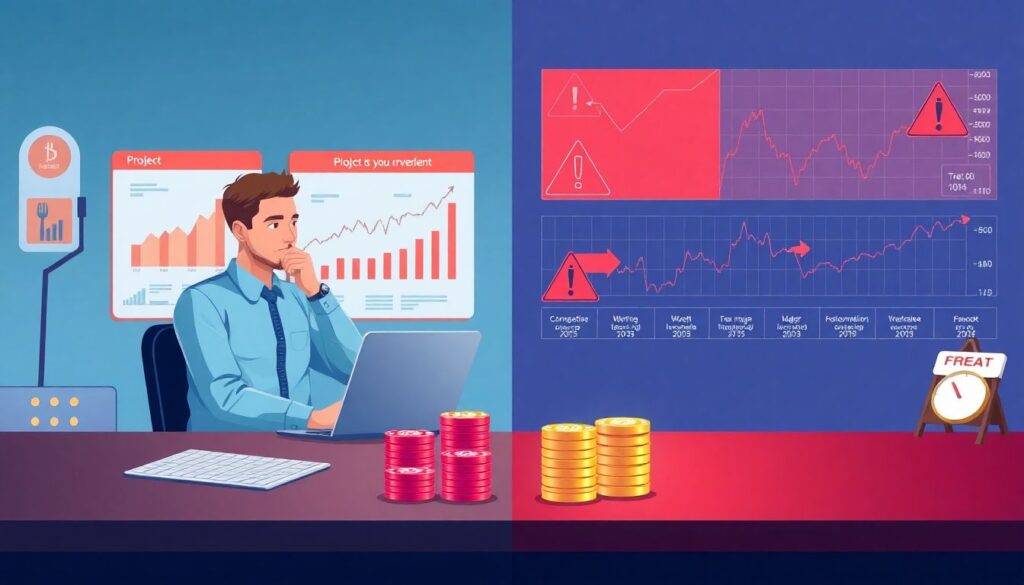
Sometimes a project looks partly great, partly worrying. In that case:
– Size your bets to your conviction: the less certain you are, the smaller the position. No need to force binary decisions.
– Time your entry on fundamentals, not hype: watch for milestones (mainnet launch, major integration, organic usage upticks) rather than random price pumps.
– Use “watchlists” generously: not buying is also a decision. Track 20–30 interesting projects; only invest when the story and data line up.
Think of this as debugging your own investment thesis. If something doesn’t compile logically, don’t deploy capital yet.
Putting It All Together: A Simple 5-Question Filter
A Quick Pre-Investment Checklist
Before you put a single dollar into any token, run this lean filter:
1. What problem does this solve, and for whom, in concrete terms?
2. Can I see real, recurring usage that isn’t entirely bribe-driven?
3. Would users still care if there was no price chart and no airdrops?
4. Does the token play a necessary role, or is it bolted on?
5. Is the team acting like long-term builders or short-term narrators?
If you can answer “yes” to real usage, necessary token role, and long-term behavior, the project is at least worth deeper work. You’re no longer guessing how to find high quality cryptocurrency projects to invest in — you’re systematically filtering.
Final Thoughts: Treat Crypto Like Experimental Infrastructure
Crypto is still an evolving lab, not a finished supermarket shelf. The safest way to navigate is to treat every project like an experiment:
– Test the product yourself with small amounts.
– Talk to other users rather than only reading threads and shills.
– Keep notes, update your views, and be willing to admit when a thesis died.
If you consistently focus on real users, measurable traction and undeniable improvements over the status quo, you’ll naturally gravitate toward the best crypto projects with real world utility, and away from empty shells. Over time, this mindset does more for your portfolio — and your nerves — than any “secret signal group” ever will.