

Why gamers are perfectly built for investing in 2025
If you’ve spent years grinding ranks, managing in‑game economies and theorycrafting builds, you’re already closer to an investor than you think. You understand risk, you optimize resources, you track meta‑shifts. This article is a practical, no‑nonsense guide to turning that gamer mindset into a gamer‑friendly investment journey that actually fits your lifestyle.
We’ll walk through what to invest in, how to invest money from gaming income, where crypto fits in, and how to avoid the classic traps that wipe out new investors. Think of this as a beginner investing guide for gamers that doesn’t talk down to you and doesn’t assume you’re a finance nerd.
—
Quick glossary: turning finance jargon into gamer terms
First, some key concepts in plain language. Treat these like tooltips.
– Asset – Anything that can hold or grow value.
Gamer analogy: your CS2 skins, rare mounts, or a maxed account.
– Portfolio – The full set of assets you own.
Analogy: your combined game library + inventories + currencies across all titles.
– Risk – Probability of losing money or getting less than you hoped.
Analogy: queueing ranked with a weird off‑meta comp.
– Volatility – How wildly the price of something jumps up and down.
Analogy: a hero that’s OP one patch and garbage the next.
– Diversification – Spreading money across different assets so one bad pick doesn’t ruin you.
Analogy: not maining only one champion or only one weapon class.
– Passive income – Money that comes in with minimal day‑to‑day effort after initial setup.
Analogy: garrison missions, auto‑battlers, idle games – once configured, they farm for you.
Once you see investing as just another resource management game, the whole thing becomes way less intimidating.
—
From gold farming to real investing: a bit of history
Back in the 2000s, most games had closed economies. You could grind gold in WoW or farm ISK in EVE, but the value stayed inside the game. Real‑money trading existed, but it was shady, against ToS, and felt like buying boosts from boosters in dark Discord corners.
Then came a few big shifts:
1. Microtransactions and skins (late 2000s–2010s)
Items in CS:GO, Dota 2, TF2 showed gamers what marketplaces and price discovery feel like. You saw knife prices jump, you learned that rarity + demand = higher value.
2. Crypto and NFTs (2017–2022)
Suddenly you could “own” game‑like items on‑chain. Many projects crashed or rug‑pulled, but the idea that digital stuff can be traded globally like stocks stuck in people’s heads.
3. Creator and esports economy (2020–2025)
Streamers, pros, coaches, and even modders started making real money: Twitch, YouTube, tournament winnings, skin trading, game boosting, coaching platforms. For the first time, a lot of gamers seriously asked:
“Okay, I’m finally earning. What do I do with this money so I’m not broke when the hype dies?”
That question is exactly where a gamer‑friendly investment journey begins.
—
Step 1: Think like a game designer, not just a player
The biggest mistake new investors make is treating investing like a casino. For gamers, the right analogy is game design: you’re designing a system that will reward you over months and years, not minutes.
Here’s a simple mental model:
– Short term = reaction time, mechanical skill
– Long term = macro, map awareness, economy control
Investing is mostly long‑term macro. Your goal is not to time every tick of the chart; it’s to choose a strategy that lets you survive patches, nerfs, and meta shifts.
A gamer‑friendly system usually has:
– Clear rules you understand (what you invest in, how often, how much)
– Automated actions where possible (auto‑invest, recurring transfers)
– A feedback loop (you review what’s working every few months)
If it feels like a messy ranked session with randoms screaming in voice chat, the system is wrong.
—
Step 2: Map your “income streams” like in‑game economies
By 2025, gamers can earn money from a surprising number of sources:
– Salary from a non‑gaming job
– Streaming (Twitch, Kick, YouTube)
– Tournament winnings / esports salary
– Coaching, boosting, VOD reviews
– Content: guides, overlays, mods, tools
– Marketplace trading: skins, cards, in‑game items
To build a stable journey, separate your flows:
– Core income – You rely on this to live (rent, food, bills).
– Variable income – Sponsorship spikes, donations, skin trades, tournament wins.
Then decide:
– What % of core income can you invest consistently every month?
– What % of variable income will always be invested when it arrives?
Even something like:
– 10–15% of salary every month, plus
– 30–50% of any “bonus” gaming money
…already puts you far ahead of most people.
This is the foundation of how to invest money from gaming income without constantly guessing.
—
Step 3: Simple text diagram of your money flow
Let’s sketch a gamer‑friendly money pipeline using text description.
Imagine this layout:
Income sources on the left → Filters in the middle → Investments on the right.
Text diagram:
– Salary → [Essentials] → [Invest 10–15%] → Long‑term portfolio
– Streaming / esports → [Split: 50% spend / 50% invest] → Growth assets
– One‑off windfalls (big sponsor, major win) → [Treat as bonus loot] → High‑risk / experiments
Or more visually:
INCOME
├─ Core job income
│ └─ 10–15% → Auto‑invest every month
├─ Gaming income (streams, tournaments, skins)
│ └─ 30–50% → Manual transfer to investment account
└─ Windfalls (sponsorships, big donations)
└─ 70% invest / 30% fun money
The exact percentages don’t matter as much as the rule. Once the rule exists, you don’t make a new decision every time; you just execute, like following a build order.
—
Step 4: Picking your “asset classes” like roles in a team comp
You wouldn’t queue into a MOBA with five ADCs and no tanks. Same logic here: each type of asset plays a role in your portfolio comp.
1. Low‑risk: your tank line
These don’t do crazy damage, but they keep you alive.
– Cash buffer (3–6 months of expenses)
– Government bonds or high‑grade bond funds
– High‑yield savings accounts
Role: protect you from IRL game over when life crits you with sudden bills.
2. Medium‑risk: your all‑round carries
This is where most of your long‑term growth comes from.
– Broad stock index funds/ETFs (e.g., global or S&P 500 equivalents)
– Region or sector funds if you want a bit more flavor
– Some blue‑chip individual stocks if you’re willing to research
For many people, this becomes the core of crypto and stock investing for gamers – and it doesn’t need to be complex.
3. High‑risk: your glass cannons
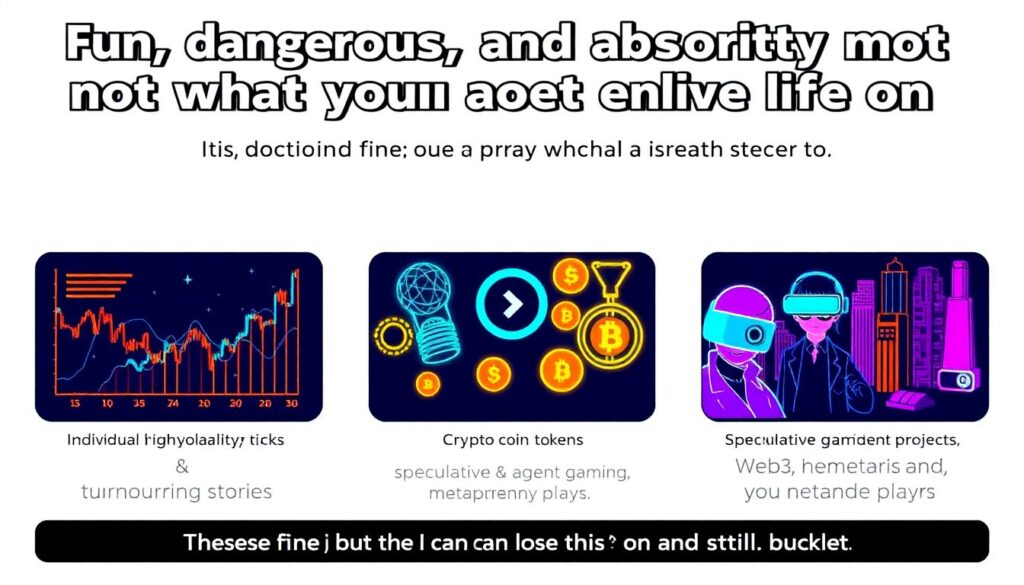
Fun, dangerous, and absolutely not what you build your entire life on.
– Individual high‑volatility stocks (hype tech, turnaround stories)
– Crypto coins and tokens
– Speculative gaming‑adjacent projects, Web3, metaverse plays
These are fine, but they belong in the “I can lose this and still sleep” section, not in your rent money.
—
Investing vs trading: two very different games
A lot of gamers confuse “investing” with “trading crypto on 5x leverage at 3 a.m.”. They’re not the same game at all.
– Investing = Long‑term, months to years, you care about the underlying project, company, or index.
– Trading = Short‑term, hours to days, you’re mostly playing the psychology and momentum of other players.
In gamer terms:
– Investing is like leveling an account over a whole season.
– Trading is like trying to win a single chaotic ARAM with RNG comps.
You can do both, but:
1. Build your stable, boring, long‑term portfolio first.
2. Only then experiment with a limited “trading bankroll” that you’re mentally prepared to lose.
—
Step 5: Tools – best investment apps for gamers in 2025
In 2025, the best investment apps for gamers share a few traits:
– Clear UI – You shouldn’t need a PhD to find your portfolio or returns.
– Low or zero commissions on stock ETFs.
– Recurring auto‑invest – so you can dump a fixed amount in every month without thinking.
– At least basic access to stocks, ETFs, and maybe crypto.
Many brokers and fintech apps now even use achievements, progress bars, and streaks, which accidentally turns them into “investment games”. That’s fine, as long as the app doesn’t push you into gambling behavior with pop‑ups and confetti for risky trades.
Red flag: if the app feels like a lootbox store, it’s probably designed to farm you, not help you.
—
Passive income ideas for gamers (that aren’t scams)
Gamers love the idea of AFK money, but “passive income” in the real world usually means “do upfront work, then let systems run for you.”
Here are a few grounded passive income ideas for gamers:
– Set up monthly contributions into broad stock index ETFs and reinvest dividends.
– Build evergreen gaming content (guides, tutorials, tools) that keeps getting views and ad revenue.
– Create assets once (overlay packs, mod packs, stream graphics) and sell them repeatedly.
Less passive, but still semi‑automated:
– Coaching packages with pre‑recorded lessons plus a few live sessions.
– Game‑adjacent SaaS tools: stat trackers, lineup planners, scrim organizers.
The key is the same as in idle games: frontload effort, then systematize.
—
Comparing investing to other common gamer “money plans”
Let’s compare three approaches many gamers fall into:
1. “All in on gear and skins” build
– Pros: Immediate fun, boosts content quality, can support career (better PC = better stream).
– Cons: No compounding. Gear loses value, skins are risky and illiquid, no long‑term wealth.
2. “All in on crypto” build
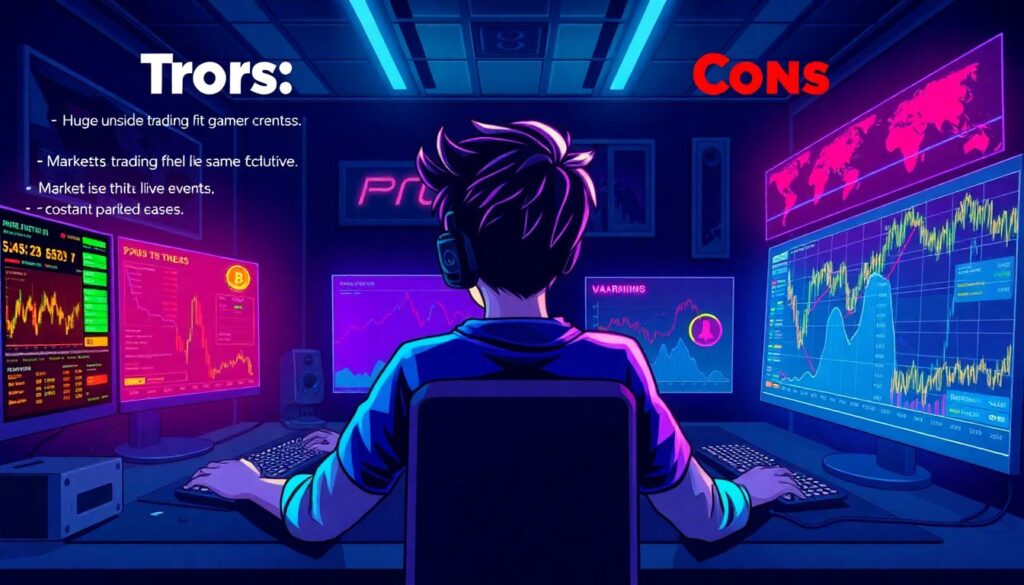
– Pros: Huge upside in rare cases; fits gamer culture; 24/7 markets feel like live events.
– Cons: Extreme volatility, constant mental load, high chance of FOMO buys and panic sells.
3. “Balanced portfolio + fun money” build
– Pros: Core wealth compounds in diversified assets; you still keep a “casino” bucket for risky plays and skins.
– Cons: Less exciting in the short term; requires some patience and discipline.
For most people, the third build is the only one that doesn’t eventually feel like an IRL wipe.
—
Text diagram: building your “three‑bucket” system
Here’s another diagram in words that often works well for gamers.
Imagine three vertical bars (buckets):
1. Safety bucket – Cash + low‑risk assets
2. Growth bucket – Stock ETFs, some solid companies
3. Speculation bucket – Crypto, hype stocks, NFTs, risky plays
Text description:
– You first fill the Safety bucket until you have a few months of living expenses.
– Then you start funneling most new money into the Growth bucket every month.
– A smaller fixed slice (say 5–10%) of new money goes to Speculation if you want that chaos.
Flow:
Income → Safety (until full) → Growth (default) + Speculation (small %).
This setup lets you:
– Survive bad patches (Safety)
– Progress account level (Growth)
– Still have dopamine from high‑risk experiments (Speculation)
—
How to invest money from gaming income without burning out
If your cash flow is irregular (tournaments, subs, donos), consistency is harder but not impossible.
A practical approach:
– Every time you get paid from gaming, skim a fixed percentage off the top immediately (e.g., 30%).
– Move it to a separate “investing” account the same day.
– Once a month, invest the accumulated total into your chosen ETFs/stocks.
To make it even easier:
– Automate what you can (scheduled transfers from your main account).
– Keep your “fun money” in a different account so you see clearly what’s safe to blow on games and gadgets.
This turns each income spike into a “loot drop” where a portion is automatically converted into long‑term power, just like crafting materials you don’t waste on low‑tier gear.
—
Crypto and stock investing for gamers: how to blend them
For a lot of gamers, the realistic mix in 2025 looks like this:
– Base layer: stocks / index funds
60–80% of your invested money, focused on diversified stock ETFs and maybe a bond fund. This is your “main build”.
– Side layer: crypto
5–20% if you really believe in the space and understand the risks. Blue‑chip coins only (BTC, ETH, plus maybe one or two others you’ve researched deeply).
– Solo queue chaos: degen plays
Whatever’s left in your “speculation bucket” for small bets on new tokens, niche coins, or gaming‑related Web3 projects. Accept emotionally that any individual bet can go to zero.
Rules that help:
– No leverage until you’re very experienced and even then, tiny.
– No borrowing money to buy crypto or stocks.
– No all‑in on one project because your favorite streamer shilled it.
If you treat crypto as one role in your comp instead of the entire roster, you can enjoy upside without nuking your whole run.
—
Risk management: your IRL “defensive cooldowns”

Even the best portfolio can’t save you if real life aggro hits too hard.
Core defensive tools:
– Emergency fund – At least 3–6 months of living costs in cash or instant‑access accounts.
– Health insurance – Depending on your country, this can be the difference between a small annoyance and total financial wipe.
– Skill diversification – Don’t rely entirely on one game, one platform, or one sponsor for income.
For full‑time gamers/creators, this matters even more. A meta shift, a ban, a platform policy change in 2025 can destroy a channel in weeks. Your investment journey is partly a hedge against these unpredictable “patch notes”.
—
Beginner investing guide for gamers: a minimalist starting build
Here’s a straightforward starter build that works for a lot of people:
– Build a 3–6 month emergency fund.
– Open a low‑fee brokerage account or investment app with access to global stock ETFs.
– Pick 1–2 broad index funds (like “world stock” + maybe “home country stock”).
– Set a monthly auto‑invest amount (even $50–$100 is fine to start).
– Decide a small % for fun/speculative plays (e.g., 5–10%) and cap it.
To keep yourself sane:
– Only check your long‑term portfolio once a month or once a quarter.
– Don’t jump in and out based on daily or weekly moves.
– Remember that a 30–50% drawdown in high‑risk assets like crypto has happened many times before and will happen again.
This is boring by design. The excitement should come from your games and projects, not from panic‑selling candles.
—
Common traps gamers fall into (and how to dodge them)
A short list of hazards that specifically target gamer brains:
– “Skill issue” mindset – Thinking you can out‑play the market with raw mechanics; overtrading and chasing every pump.
– Influencer FOMO – Copying portfolios of streamers without knowing their real risk tolerance or side deals.
– Lootbox brain – Treating each trade as a pack opening rather than part of a long‑term plan.
– Tilt – Doubling down on bad trades to “make it back”, like queueing “one more ranked” at 3 a.m.
Counter‑play:
– Pre‑define your strategy and written rules before you deploy real money.
– Use small position sizes for anything experimental.
– Stop trading when emotional, just like muting the client when tilted.
—
Putting it all together: your gamer‑friendly investment journey
To wrap it into a single, coherent flow:
– Treat investing as a long‑term macro game, not a casino.
– Separate your income streams and set fixed rules for what percentage gets invested.
– Build three buckets: Safety, Growth, Speculation.
– Use simple tools: a solid broker/app, auto‑invest into a couple of broad ETFs.
– Layer in crypto or high‑risk plays as a small part of the build, not the whole thing.
– Rebalance occasionally and update your plan like patch notes, not like mid‑fight keybind changes.
The goal isn’t to turn you into a full‑time trader; it’s to make sure that as your skill, audience, and earnings grow, your money starts working as hard as you do. In other words, you’re not just grinding this season – you’re building a save file that still matters ten years and many patches from now.