
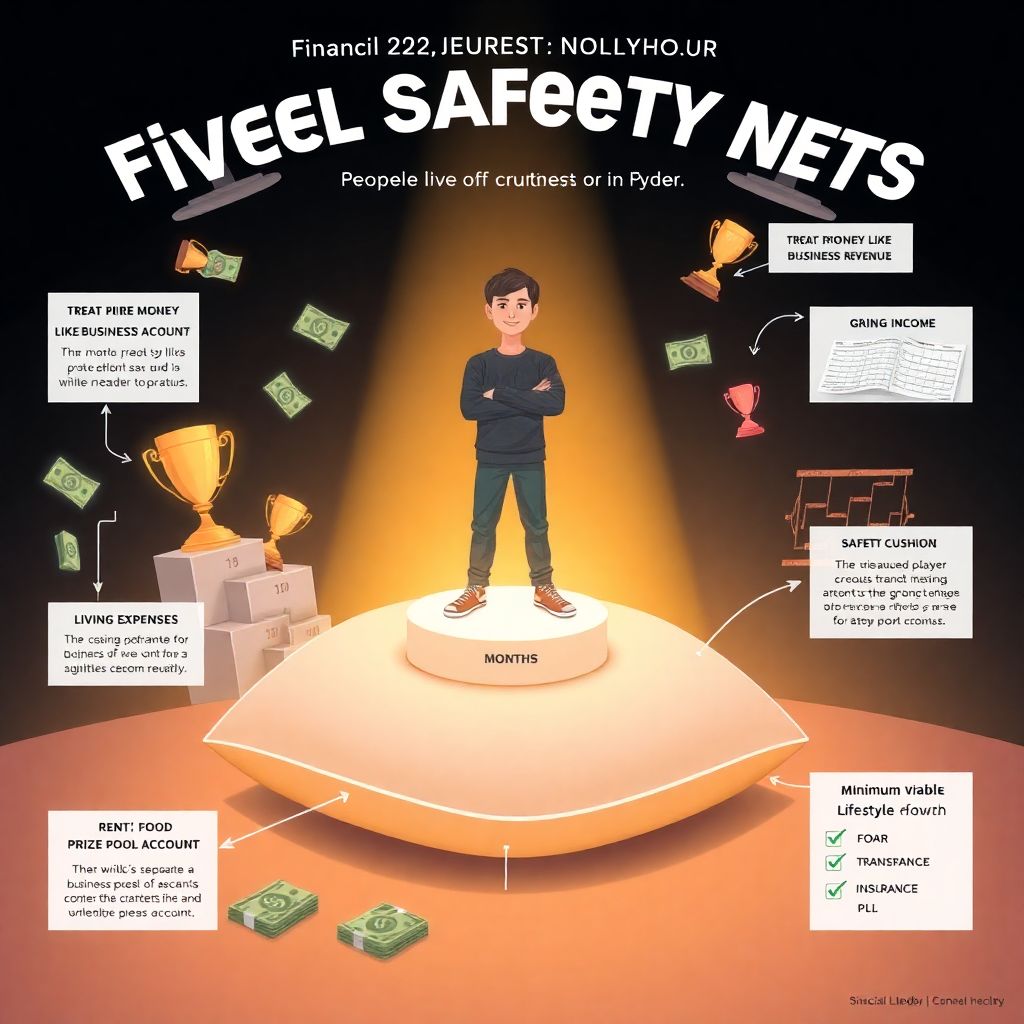
Why prize-pool money needs a safety net
When your main income comes from prize pools, grants, contests or tournaments, you already know the emotional roller coaster of one month looking golden and the next month feeling like a desert. That’s exactly why learning how to build a financial cushion for unpredictable prize pools is less about “being good with money” and more about staying calm enough to keep competing, creating и improving. A solid buffer doesn’t kill your hunger to win; it protects it. You can take creative risks, skip a bad deal, or say no to a stressful event because you’re not desperate for the next payout. Think of your cushion as your silent sponsor: it doesn’t show up in the credits, but it quietly finances your ability to stay in the game long enough to hit your real peak.
Step one: treat your prize money like business revenue
Separate “you” from “your prize pool”
Most people who live off competitions or variable fees throw all income into one personal account and then wonder where it went. Simple fix: create a basic “prize pool account” and run your career through it like a tiny company. Every transfer from organizers, platforms or sponsors lands there first. From this account you decide what goes to living expenses, what funds training, and what becomes your safety cushion. This alone is already financial planning for variable income: instead of reacting emotionally to every big win or dry spell, you force all money to pass through a small, rational system that you control with a few clear rules, even if you hate spreadsheets.
Define your minimum viable lifestyle
Before talking about best ways to save money for financial security, you need one boring number: the true monthly minimum you need to avoid panic. Rent, food, basic transport, gear maintenance, medical insurance, platform fees, maybe a small “sanity” budget for social life. No luxury, no wish list, just what keeps you functioning and able to compete. Add it up honestly. Many prize-based earners guess this number and are off by hundreds. This minimum is the anchor from which you’ll calculate targets for your cushion and decide whether this month is actually “great” or just emotionally exciting but financially average. Once you see the real cost of staying in the game, your later choices about saving become way more grounded.
How big should your safety cushion be?
Find your “comfort months” number
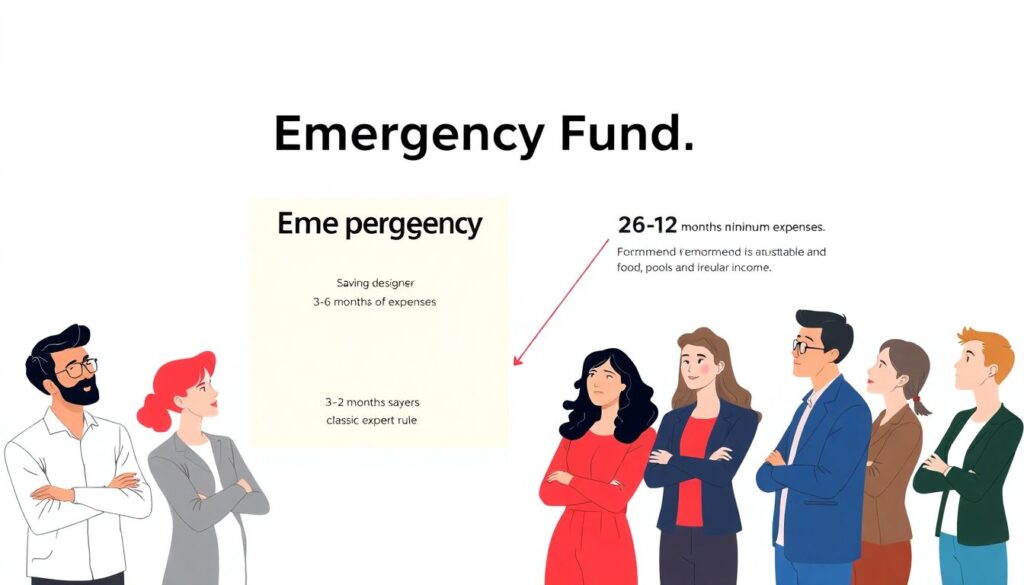
The classic expert rule on how to build an emergency fund is “3–6 months of expenses.” For unstable prize pools, that’s usually too modest. A lot of financial coaches who work with freelancers and tournament players advise 6–12 months of your minimum expenses as the target. So when you ask “how much should I have in my savings cushion?”, think in months, not just in dollars. If your lean monthly cost is $1,500 and your risk level is high (few stable sponsors, irregular events), a serious, confidence-boosting cushion might be $9,000–$18,000. The number can feel huge at first, but you’re not trying to build it in one season; you’re building it one payout at a time, with a clear endpoint that stops you from hoarding forever.
The staircase approach to goals
Many pros burn out because their only financial goal is “save more.” That’s vague and unmotivating. Use a staircase: first step is 1 month of costs, second is 3 months, then 6, then maybe 9 or 12. Celebrate each level quietly by giving yourself a small, pre-agreed reward that doesn’t ruin the progress. Behavioral economists support this step-based method because our brains stay more engaged when big goals are broken into visible milestones. Expert planners also advise writing your current “months of cushion” number somewhere you see it weekly. That way, every time prize money arrives, your brain quickly compares: “Do I want a new gadget, or to move from 2 to 3 months of safety?” That tiny pause can radically shift your choices over a year.
Budgeting on unstable prize money without losing your mind
Use a “last month’s money” rule
One of the most practical budgeting tips for irregular income sounds almost too simple: live this month on last month’s money. That means you don’t make spending decisions based on unpredictable future prizes; you only spend what actually arrived during the previous month. If last month’s prize pool was strong, you have more to work with; if it was weak, you tighten your belt immediately, not six weeks later when your account unexpectedly hits zero. Personal finance experts love this method because it creates a built-in delay between earning and spending, smoothing the volatility of contest-based cash flows. Over time, as your cushion grows, that delay gets easier and you stop feeling like every event outcome is a life-or-death financial moment.
Give every dollar a “job” before it escapes
Here’s where the best ways to save money for financial security turn into simple habits. As soon as prize money lands, you pre-assign percentages: for example, 50% to living expenses, 30% to your cushion and investments, 10% to training and equipment, 10% to pure fun. The exact numbers will change depending on your stage of career, but the idea stays: money never sits “unemployed.” Popular budgeting coaches call this “zero-based budgeting”: when your money arrives, you decide its entire mission in advance, so there’s no vague “extra” that magically disappears. This is especially powerful when a big, rare prize hits your account; instead of blowing it on a celebration week, you automatically feed your future stability.
Inspiring real-world examples
From tournament swings to calm consistency
Take a mid-level esports player who lived from tournament to tournament. Some months he cleared $8,000, others he survived on $600 plus small stream donations. A mentor pushed him toward financial planning for variable income: separate accounts, last-month’s-money rule, and a hard commitment that every prize above his baseline would partly go into a safety fund. Within two years he hit 8 months of cushion. The fascinating part: once the fear of “what if I wash out next season?” eased, his performance metrics improved. He skipped low-value events that exhausted him, doubled down on key leagues, and negotiated one better sponsor deal because he was no longer negotiating from panic. His ranking rose not because of a new training technique, but because his brain had room to focus again.
Creative grant hunter who stopped chasing every call
Another case: a digital artist living on unpredictable grants and prize-based residencies. She constantly applied to everything, from tiny local competitions to big international calls, just to stay afloat. After working with a financial coach, she set a clear target of 9 months of living costs and started channeling 40% of every major payout into her cushion. Once she crossed 6 months of safety, she consciously dropped low-paying, high-effort competitions. Instead, she invested time in a flagship project that had real long-term potential. Within a year, that project landed her a stable fellowship plus stronger visibility. The financial buffer didn’t just reduce stress; it gave her the freedom to be selective, which then amplified her reputation and income quality.
Expert-backed strategies to grow your cushion faster
Turn peaks into automatic protection
Financial advisors who work with athletes and freelancers often recommend a “peak skim” rule: decide in advance that any income above your average gets skimmed aggressively into savings. For instance, if your 6‑month average monthly prize inflow is $3,000 and one epic month brings $10,000, you might automatically send $4,000–$5,000 straight to your cushion the day it arrives. This expert move prevents “lifestyle creep,” where one big win suddenly becomes your new ridiculous normal. Over a couple of peak seasons, this habit alone can fully fund your emergency reserves without you ever feeling like you’re grinding painfully for it. You still celebrate wins, but you let the numbers, not your mood, decide what celebration you can actually afford.
Develop small, steady income streams on the side
Another classic expert recommendation: pair your volatile prize pools with at least one semi-stable side stream. Coaching beginners, creating online courses, streaming with modest but regular subscriptions, selling training materials, or offering consulting in your niche all count. The idea isn’t to replace competition, but to create a base layer so that your cushion doesn’t have to cover every tiny dip. Even $500–$700 a month of reliable side income can dramatically slow down cushion burn during bad seasons. Many long-lived pros quietly build this parallel track early. It’s one of the most underrated, best ways to save money for financial security because you’re not only cutting expenses; you’re feeding your safety net from an extra pipe.
Growth mindset: leveling up your money skills like a craft
Treat financial skills as part of your training

Relying on prize pools means you’re already used to structured improvement: drills, reviews, coaching, feedback loops. Apply the same mentality to money. Set a weekly 30‑minute “financial review session” where you glance at last month’s inflows, track how much closer you are to your cushion goal, and note one thing you’ll tweak next month. Many performance psychologists argue that this kind of small but consistent reflection dramatically increases your sense of control. You don’t need to turn into an accountant; you just need to treat financial competence as a normal part of being a serious competitor or creator. Over time you’ll notice you make fewer impulsive decisions and more moves that align with your long-term career arc.
Upgrade your environment, not just your discipline
Discipline is overrated if your environment pushes you the other way. Unlink your payment platforms from impulse-spending apps, turn off one-click purchases, and keep your prize account at a bank that doesn’t tempt you with credit you don’t need. Automatic transfers toward your cushion the moment money lands beat willpower every single time. Behavioral finance research repeatedly shows that when you design your surroundings to make the right choice the default, you get better outcomes with less stress. The aim is not to become some ascetic money monk; it’s to reduce the number of times per month you fight yourself over whether to spend or save. That freed-up mental energy feeds straight back into your performance and creativity.
Resources to sharpen your money game
Where to learn without drowning in theory
You don’t have to wade through academic finance books to grasp how to build an emergency fund or structure your erratic payouts. Look for resources specifically aimed at freelancers, gig workers and creators, since their challenges overlap heavily with prize-based earners. Good starting points are personal finance podcasts that focus on budgeting tips for irregular income, YouTube channels run by fee-only financial planners, and short online courses on cashflow management. Many of these break complex ideas into quick, practical episodes you can listen to between matches, rehearsals or events. The key is to favor sources that talk about behavior and systems, not just investments you’re not ready for yet.
When to talk to a professional planner
At some point—especially if your prizes start getting large or you sign serious sponsorship contracts—it’s worth sitting down with a certified financial planner at least once. Ideally, you want someone who understands creatives, athletes or freelancers, not just corporate employees. Bring your numbers: past prize history, typical costs, and your target months of cushion. Ask them to stress-test your current system and help you refine your plan for building and protecting your savings cushion. This one-time or occasional advice can save you from expensive mistakes with taxes, insurance or overspending in peak years. Think of it like hiring a high-level coach for a short block to correct your form; a small investment that can shift your entire trajectory.
Putting it all together: a calm path through unpredictable prize pools
If you rely on unpredictable prize pools, your goal isn’t to eliminate uncertainty; it’s to contain it. You separate your accounts so your life isn’t tied to every single event, you define your real monthly minimum and ask realistically how much should I have in my savings cushion, you use last month’s money to guide your spending, and you assign each new payout a job before it disappears. You turn big wins into stepping stones toward a solid safety net instead of temporary highs that leave a hangover. Layer on a modest side income and a bit of expert guidance, and suddenly the volatile path you chose stops feeling like gambling and starts looking like a long, well-managed career. The freedom that cushion buys you is the same freedom that lets your best performances finally show up when it counts.