

Investing in gaming-related equities in 2025 feels a bit like buying into the early smartphone era: the products are already mainstream, but the business models and winners are still evolving. Games have turned into platforms, esports looks more like traditional sports every year, and virtual economies now move billions of real dollars. That mix makes the sector exciting, but also noisy and occasionally overhyped. This guide walks through where the industry came from, what actually matters for investors, and how to navigate modern trends without getting lost in marketing buzz.
—
Historical context: how gaming became a serious asset class
For a long time, video games were treated as a niche hobby rather than a pillar of the global entertainment industry. In the 1980s and 1990s, a handful of Japanese and American giants dominated: Nintendo, Sega, then Sony, alongside early PC publishers like Electronic Arts and Activision. These were public companies, but most institutional investors saw them as quirky consumer discretionary plays, not as a core growth sector. The cyclical nature of console launches and game hits made earnings unpredictable, so gaming stocks often traded at a discount to other tech names despite impressive engagement metrics.
Everything changed in the 2000s and 2010s as broadband, smartphones and digital distribution rewired the economics of games. Steam, the App Store, Google Play, Xbox Live and the PlayStation Store allowed publishers to sell digitally, cutting out retailers and used game markets. Free‑to‑play models, microtransactions and downloadable content extended the life of titles far beyond the initial launch window. At the same time, online multiplayer and streaming turned games into social spaces, driving recurring engagement rather than one‑off purchases. This shift laid the groundwork for today’s view of the gaming industry as a subscription‑, service‑ and platform‑driven business rather than a pure hit factory.
By the early 2020s, the sector attracted huge capital flows. Microsoft moved aggressively with its Xbox Game Pass strategy and attempted mega‑acquisitions; Tencent built a sprawling portfolio of minority stakes and full takeovers across Asia, Europe and the US; Embracer and other consolidators snapped up studios and IP libraries. The pandemic then poured gasoline on the fire: with people stuck at home, gaming hours and in‑game spending spiked, and many investors suddenly went hunting for the best gaming stocks to invest in, assuming growth would remain straight‑line. As we now know, that surge normalized after 2021, exposing which companies had built durable ecosystems and which were simply surfing a temporary wave.
—
Basic principles: what actually drives gaming-related equities
Before worrying about flashy trends like the metaverse or generative AI, it helps to strip gaming businesses down to a few core drivers. First and foremost are engagement and monetization. User numbers by themselves are not enough; what matters is how long people play, how often they return, and how much they spend over time, both directly and via advertising. When you’re figuring out how to invest in video game stocks, focus on metrics like monthly active users, average revenue per user, retention rates and the mix between upfront purchases and recurring revenue.
The second principle is IP strength and longevity. A company that relies on constantly launching new titles is in a far riskier position than one that owns franchises that can be refreshed, expanded and merchandised for decades. Think of how Grand Theft Auto, Call of Duty, FIFA‑style football games, Pokémon or League of Legends keep coming back in new forms. Strong brands support not only premium games, but also mobile spin‑offs, subscriptions, esports, TV and film adaptations, and licensing. When you assess gaming sector stocks with high growth potential, ask whether they own or control content that can become a long‑term ecosystem, not just a one‑season hit.
Third comes platform leverage and distribution. Some gaming companies effectively function as distributors or platforms—console makers, major mobile app stores, PC storefronts or cloud gaming services—while others are mostly content creators. Platform owners often benefit from network effects and can tax the ecosystem via revenue sharing, while publishers and developers compete for visibility and user time. That said, platforms are capital-intensive and politically sensitive, especially with increasing antitrust scrutiny. Balancing exposure to platforms and content across your portfolio helps you avoid overconcentration in one business model or regulatory risk category.
—
Modern trends in 2025: what’s actually moving the sector now
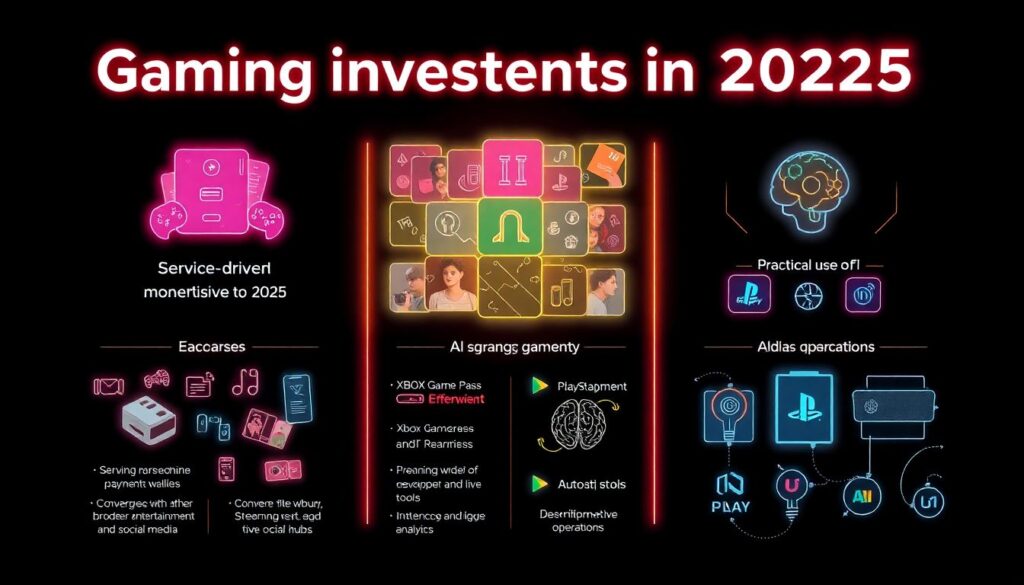
By 2025, three big trends dominate the discussion around gaming investments: service‑driven monetization, convergence with broader entertainment and social media, and the practical use of AI in development and live operations. Subscription services like Xbox Game Pass, PlayStation Plus, EA Play and various cloud offerings are now embedded in the market, but investors have learned the hard way that “Netflix for games” is not a magic money machine. The key question is whether subscriptions bring truly incremental revenue and broaden the audience, or whether they simply cannibalize full‑price sales. When you look at earnings reports, watch for how total engagement and spending per user respond to subscription growth, rather than assuming subs automatically equal higher margins.
Convergence is the second big theme. Many of the most resilient gaming businesses now behave more like cross‑media entertainment companies. Franchises jump between games, streaming shows, films, comics, and merchandising; fan communities span Reddit, TikTok, Discord, and in‑game events. This is where esports ties in: while early hype around competitive gaming revenue was overblown, stable ecosystems have emerged around titles like League of Legends, Counter‑Strike and certain mobile games. Instead of betting on individual teams, more investors now gain exposure via the top esports and gaming ETFs, which package publishers, hardware makers, and sometimes streaming platforms into a single trade, smoothing out the volatility of any one subsegment.
AI is the third—and easily the most hyped—trend of 2025. Behind the buzzwords, there are real operational uses: procedural content generation that speeds up level design, AI‑assisted art and localization, better matchmaking, dynamic difficulty balancing, and smarter in‑game economies. For investors, the nuance is that AI mostly improves costs and iteration speed rather than magically doubling revenue. A publisher that quietly shaves 10–15% off art and QA expenses will see margin benefits that compound over time, but it may not make headlines. When you evaluate AI stories in gaming equities, separate cost‑side improvements from speculative ideas like fully AI‑driven games, which are still experimental and often more marketing pitch than near‑term profit engine.
—
Practical approaches and examples of implementation
When people ask for a neat list of publicly traded video game companies to buy, they’re often hoping for a shortcut. In reality, the practical way to approach the sector is to decide what part of the value chain you want exposure to—platforms, publishers, indie developers, hardware, tools, esports, or diversified conglomerates—and then mix and match. For example, you might pair a console platform owner with a high‑quality publisher and a tools company that sells engines or analytics to many studios. That way, you capture multiple layers of the ecosystem, rather than betting on just one breakout franchise or one hardware cycle.
To make this more concrete, you can think in terms of a simple step‑by‑step process that you can revisit as the industry evolves:
1. Map the ecosystem you actually understand. Start with games, platforms, or devices you use or follow already. Read a few recent annual reports and earnings call transcripts from those companies to see how they describe their growth drivers, risks, and reliance on specific titles.
2. Check business model resilience. Look at the revenue mix between premium sales, in‑game spending, subscriptions, licensing and advertising. Companies with multiple strong franchises and recurring revenue streams tend to weather down cycles better than one‑hit wonders.
3. Evaluate capital allocation and M&A discipline. The last decade is littered with examples of overpaid acquisitions in gaming. Hunt for management teams that integrate studios without destroying culture and that are willing to walk away from overpriced deals, even under market pressure.
4. Stress‑test against platform and regulatory risk. If a publisher leans heavily on one mobile app store, one console, or one country’s regulations, imagine what happens if fees change or a key market tightens online gaming rules. Diversification across regions and platforms is a real asset.
5. Decide your vehicle: single stocks vs. ETFs. If you don’t have time to follow each company closely, using broad funds focused on the space can be more sensible than picking individual winners and losers.
Within that last step, ETFs are worth a closer look. Some of the top esports and gaming ETFs now hold a mix of large‑cap publishers, chipmakers, peripheral manufacturers, and game engine providers. They won’t perfectly mirror the performance of the hottest new mobile hit, but they offer a relatively straightforward way to gain broad exposure to the theme while reducing company‑specific risk. You can then layer a few targeted positions—say, one or two gaming sector stocks with high growth potential based on your research—on top of that ETF core if you’re comfortable accepting more volatility for a possible upside kicker.
—
Frequent misconceptions that trip up new investors

One of the most persistent myths is that the gaming industry is a simple “growth forever” story because younger generations game more than their parents did. While total time spent in interactive entertainment has indeed grown, that doesn’t mean every game, platform or stock will benefit equally. User attention is finite; if one breakout title soaks up a huge slice of global playtime, dozens of smaller games suffer. Likewise, macroeconomic slowdowns can push players toward free‑to‑play or deeply discounted titles, compressing monetization even if hours played stay high. Investing on the assumption that “everyone plays games, so this stock must go up” skips the hard work of understanding competition, pricing power and cost structures.
Another common misconception is that owning any gaming‑related stock gives you exposure to esports and live events. The reality is more nuanced. Not all publishers run profitable esports programs, and many treat them as marketing rather than a core revenue stream. Teams and tournament organizers often sit in separate corporate structures from game developers and publishers, with very different financial profiles. If you specifically want exposure to the competitive side of the industry, you need to look under the hood of each company or consider diversified vehicles that deliberately bundle this niche, rather than assuming the word “esports” in a press release automatically translates to earnings.
A third misunderstanding relates to valuation and hype cycles. During boom times—whether around mobile free‑to‑play, VR, “play‑to‑earn” crypto games, or metaverse pitches—certain stocks can be driven far beyond what their underlying cash flows justify. Later, when expectations reset, even fundamentally strong firms can see their share prices cut in half. That doesn’t mean the sector is broken; it means narrative and fundamentals often diverge. When you evaluate the best gaming stocks to invest in for your own portfolio, insisting on a margin of safety, scrutinizing price‑to‑earnings and price‑to‑free‑cash‑flow ratios, and comparing growth rates to other tech or media sectors can help you avoid overpaying just because a theme is fashionable.
—
Pulling it together for 2025 and beyond

Standing in 2025, gaming sits at the crossroads of technology, entertainment, and social interaction. New devices, cloud infrastructure, and AI tools will keep changing how games are built and played, but the investment logic stays surprisingly stable: durable IP, healthy engagement and monetization, diversified revenue streams, and disciplined capital allocation beat buzzwords over the long term. Whether you build your exposure through a broad fund, a careful selection from a personal list of publicly traded video game companies, or a blend of both, treating games like any other serious business—and not like a casino ticket—will serve you much better than chasing the latest hype cycle.