
A gamer’s guide to investment fees and commissions
Imagine every time you complete a quest, the game quietly skims 1–2% of your gold before it hits your inventory. You’d probably rage-quit.
That’s exactly what investment fees can do to your long‑term returns if you don’t know they’re there.
This guide translates investment fees and commissions into gamer language so you can treat your portfolio like a well‑optimized character build, not a default starter loadout.
—
Historical background: from “pay to play” to “freemium” trading
Old-school era: when every trade was a raid boss
Back in the 1990s and early 2000s, trading stocks was basically “hard mode”:
– Many US brokers charged $20–$50 per trade.
– You usually had to call a human broker (yes, on the phone) or use clunky software.
– Only people with serious cash bothered, because small trades got eaten by fees.
It was like MMOs before free-to-play: high entry cost, small player base.
Digital shift and the “fee war”
As the internet matured, online brokers started slicing commissions:
– Late 2000s: fees dropped closer to $7–$10 per trade at big online brokers.
– 2010s: new “discount” apps showed up with $5… then $0 commissions.
The real breakpoint was 2019, when several huge US brokers cut stock trading commissions to $0. That move hit like a meta-changing patch: once a few big players went zero, everyone else had to follow or bleed users.
By 2022–2024, industry data from US and European markets showed that:
– In the US, over 90% of retail stock trades by volume were done on zero‑commission platforms.
– In Europe, zero‑commission players expanded fast, especially for ETFs and US stocks access, though traditional brokers with fixed fees still hold a big share.
So on the surface, it looks like “trading is free now.”
Spoiler: it isn’t. The monetization just moved into other mechanics—like spreads, payment for order flow, and management fees.
—
Basic principles: reading the “fee tooltip” on your account
Main types of investment fees (translated for gamers)
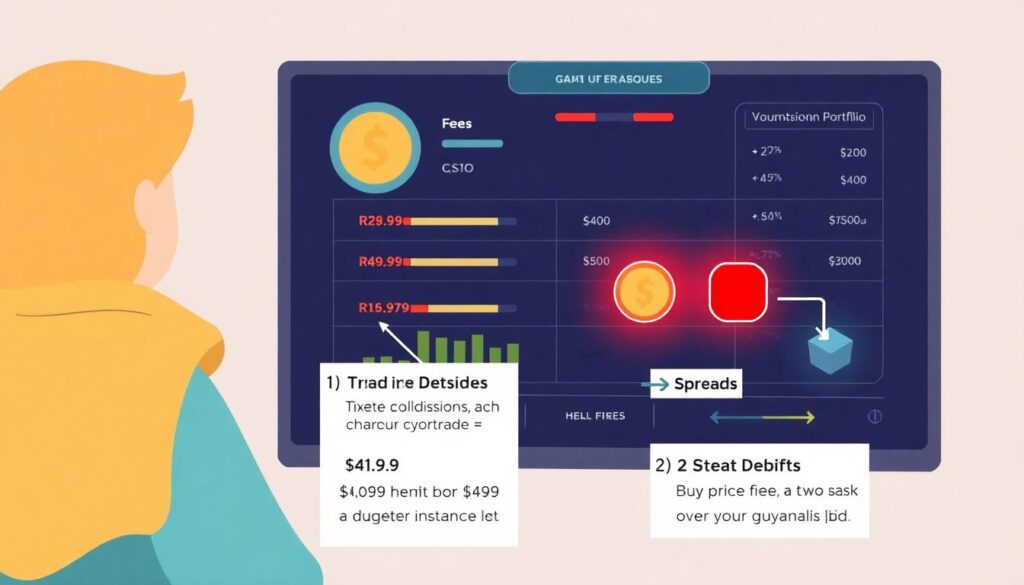
Think of fees as debuffs on your portfolio’s XP gain. The most common ones:
1. Trading commissions
A fixed price per trade — e.g., $4.99 each time you buy or sell. This is the classic “ticket fee” to enter an instance.
2. Spreads
The difference between the buy price (ask) and sell price (bid). Even if a platform claims commission free, you might be paying through wider spreads. It’s like a hidden vendor markup every time you trade.
3. Management fees / expense ratios (for funds & ETFs)
Annual % taken from fund assets. Example: a 0.20% expense ratio means 0.20% of the fund’s value is charged every year. Think of it as a passive drain aura on your gold stack.
4. Account / platform fees
Monthly or yearly fees just to use the service, or for “premium” features (research, data, extra markets). Similar to a game subscription.
5. FX fees and custody fees
– FX fee: you pay a % when converting your local currency to USD/EUR etc.
– Custody: a fee for holding certain assets, often with some legacy brokers.
These fees stack. Even small percentages can snowball over time, especially on long‑term ETF investing.
Why fees matter more than you think
Let’s say two players start with the same build:
– You both invest $5,000 per year for 20 years.
– Both get a 7% gross annual return.
– Player A pays 0.10% total annual fees, Player B pays 1.5% (not uncommon with pricey mutual funds or old-school brokers).
Rough ballpark over 20 years:
– Player A ends up with around $210k–$220k.
– Player B ends up closer to $170k–$180k.
That 1.4% difference in fees shaved tens of thousands off the final number — without you seeing a red “-fee” message pop up anywhere.
Recent trend check: 2022–2024
From 2022 to 2024, reports from major ETF providers and regulators showed:
– Average expense ratios for broad-market index ETFs in developed markets dropped closer to 0.05%–0.15% for the biggest funds.
– Higher-fee “thematic” and niche funds (AI, gaming, clean energy, etc.) often still charge 0.40%–0.80%+, and attract younger investors chasing hot trends.
– Retail trading volume on mobile apps kept increasing; several surveys in 2023–2024 suggested that more than half of new retail investors under 35 opened their first account on a smartphone-only platform.
So fees are going down where competition is brutal (broad ETFs, US stocks), but staying chunky where hype is high and users pay less attention to the fine print.
—
Examples: how fees show up in real “builds”
Example 1: Active trader vs. casual investor
Let’s compare two playstyles you might recognize from games:
– Active day-trader (likes to “speedrun” markets)
– Casual long-term investor (prefers “AFK farming” with ETFs)
Active trader scenario
– 10 trades per day, 20 trading days per month → ~200 trades/month.
– Broker A: charges $3 per trade.
– Broker B: $0 commissions, but slightly wider spreads.
At Broker A, 200 trades × $3 = $600 per month in visible commissions.
At Broker B, zero direct commissions, but you might effectively lose a bit on each trade through spreads. If you’re scalping tiny price moves, that hidden cost can be huge.
This is why online brokers with low commissions for active traders heavily advertise both “low or zero commissions” and “tight spreads.” As an active player, you must test both, not just trust the marketing banner.
Casual ETF investor scenario
You buy $500 worth of a global stock ETF every month, hold for decades, rarely sell.
– Whether the trade costs $0 or $3 barely matters long term.
– What really kills or boosts your returns is the ETF’s expense ratio and any FX / platform fee.
That’s why, for long-term players, it often makes more sense to look for cheap ETF investing platforms with low management fees than to obsess over who has a slightly better free-trade deal.
Example 2: “Commission-free” with a twist
A lot of apps push the “no commissions!” tagline. But “free” usually comes with one or more of these mechanics:
– Payment for order flow (PFOF) – your orders are sent to specific market makers who pay the broker for that flow. You get no direct bill, but your execution price might not always be the absolute best possible.
– Markup on FX – converting your currency to USD to buy US stocks might cost you 0.5–1% each time.
– Premium tiers – margin accounts, extended trading hours, research reports, or better execution might sit behind a paywall.
When you look at any commission free stock trading apps comparison, don’t just compare the “$0” labels. Compare the *total* cost of actually using the app with your playstyle over a year.
—
How to evaluate fees like a min-maxer
Step-by-step: turning the fee system into a readable HUD
Here’s a simple 5-step checklist to treat fees like item stats:
1. Define your playstyle
Are you going to:
– Trade daily or weekly (active)?
– Invest monthly and hold for years (passive)?
That decision changes which fees matter the most.
2. List all the fees you might pay
Check the broker’s fee page for:
– Commissions per trade
– ETF / fund expense ratios
– FX conversion fees
– Account / inactivity / withdrawal fees
3. Estimate your yearly pattern
Example: “I’ll invest $300 every month into 2 ETFs and rebalance once a year.” From this, calculate:
– How many trades per year
– How much FX you’ll do
– How much your portfolio might grow (rough estimate is fine)
4. Do a quick paper calculation
For each candidate broker, approximate:
– Annual trading commissions
– Annual FX costs (if any)
– Annual impact of expense ratios (0.1% vs 0.7% on your portfolio size)
5. Compare like you would compare gear stats
Don’t just chase one stat (“$0 trades”). Look at total DPS: after all fees, which option leaves you with the highest expected net return for your strategy?
This is basically the practical version of how to choose a broker with lowest investment fees. It’s less about hunting a single magic number and more about matching the platform to your personal “build.”
—
Historical trends in numbers: 2022–2024 snapshot
What changed in just three years
Between 2022 and 2024, several trends kept reshaping fees:
– Average US online trading commission for stocks stayed at or near $0 for most major retail brokers, after the 2019 “price war.”
– ETF fees kept drifting down, especially in big core index funds, where competition is fierce. Large providers frequently launched new ultra‑low‑fee products or cut existing fees to retain market share.
– Surveys across the US and Europe showed steady growth in first‑time investors aged 18–34, many coming from gaming/crypto backgrounds and prioritizing mobile UX and low minimums over deep research tools.
– Regulators paid more attention to how “free” trading is marketed, particularly around PFOF, leverage for retail clients, and risk disclosures.
The short version: visible fees (commissions) got hammered down, while invisible or less obvious costs (spreads, FX, complex product fees) became more important to understand.
—
Common misconceptions: fee myths gamers fall for
Myth 1: “If the app says zero commission, it’s free.”
In games, a “free” skin might actually be time‑gated or require a battle pass. Investing is similar:
– Spreads might be wider.
– FX conversion might quietly drain 0.5–1% on every cross‑currency trade.
– You might be pushed toward higher‑fee funds or complex products where the platform earns more.
Always look past the banner and into the fee breakdown.
Myth 2: “A 1–2% fee is small, I won’t notice it.”
A 1–2% fee per year on a single trade looks tiny. But across a whole portfolio, over decades, it’s like an XP penalty that compounds.
Historically, over long timeframes (20–30 years), fee differences of even 0.5–1% per year have been enough to separate top‑tier funds from mediocre ones when you look at actual money in your account.
Myth 3: “Higher fees mean better performance.”
In games, a legendary item usually beats common gear. In investing, the “legendary skin” often just means:
– Active management
– Fancy marketing
– Niche or thematic strategy
Across many markets and studies, low‑cost broad index funds have repeatedly outperformed a large chunk of high‑fee active funds over long periods. Paying more doesn’t guarantee better returns; it just guarantees higher costs.
Myth 4: “Best platform = the one everyone on Reddit uses.”
What’s best for a day-trading streamer might be terrible for your calm, long-term approach.
If you’re just starting, the best low fee online trading platforms for beginners for *you* are the ones that:
– Explain fees clearly
– Offer simple, diversified products (like basic ETFs)
– Match your country, tax rules, and currency
– Don’t push you into gambling behavior with excessive leverage or options you don’t understand
Reddit can be a good starting point, but treat it as chat, not gospel.
—
Putting it together: choosing your platform like choosing your game
Align the platform with your “genre”
– If you’re an active trader, you need:
– Rock-bottom commissions
– Tight spreads and good execution
– Robust charts and order types
This is where online brokers with low commissions for active traders really shine. They’re built for people who treat markets like a fast-paced competitive game.
– If you’re a long-term investor, you need:
– Low ETF expense ratios
– Reliable custody and simple interface
– Low FX and account fees
In this mode, you’ll care more about cheap ETF investing platforms with low management fees than about fancy trading tools.
Don’t forget comparisons and reviews—just read them critically
When you scroll through any commission free stock trading apps comparison or lists of the best low fee online trading platforms for beginners, keep a skeptic eye:
– Are they sponsored or paid rankings?
– Do they clearly mention spreads, FX, and ETF fees?
– Do they match your region and legal protections?
Your job is not just to find “what’s popular,” but to assemble the combination of broker + products where fees are minimized *for your exact strategy.*
—
Final thought: treat fees like damage over time
Fees are like a poison DOT on your portfolio: you don’t notice it tick by tick, but over years it seriously cuts your HP bar.
If you:
– Understand the main fee types,
– Match your platform to your playstyle, and
– Regularly “audit” your costs like you’d re-check a build after a major patch,
you’ll already be ahead of a huge chunk of new investors who never look at the fine print.
And just like in games, the players who quietly optimize and avoid unnecessary debuffs usually end up winning the long campaign.