
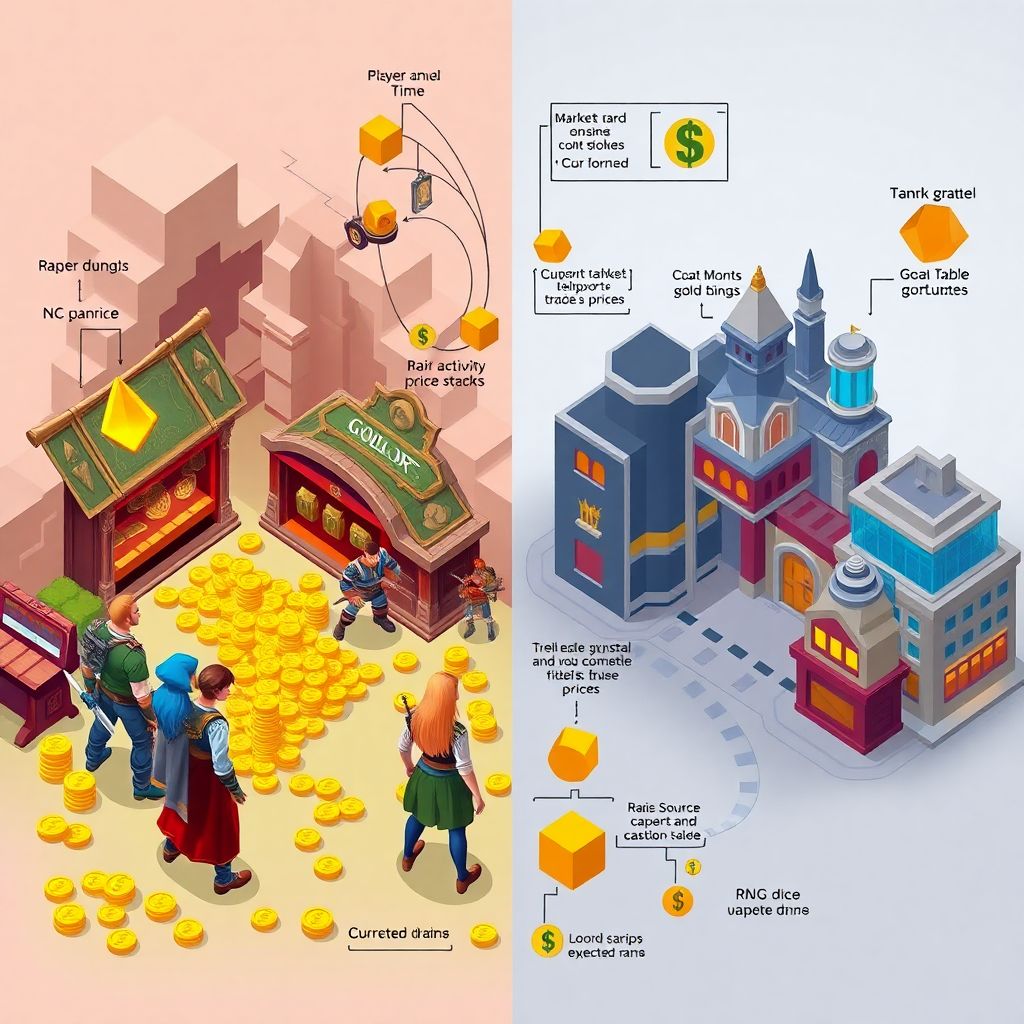
In‑Game Economies: What They Really Are
In‑game economies are simulated systems where virtual resources, currencies and items move between players, NPCs and game mechanisms according to predefined rules. Technically, it is a closed economic model with controlled issuance of currency, deterministic drop rates, and automated market-making via vendors or auction houses. You already understand core concepts like supply, demand and arbitrage every time you flip items on a marketplace or camp a rare spawn for profit. A simple text diagram looks like this: Player → Time → Activity (raid, farm, trade) → Rewards → Market (auction, barter) → Prices → Back to Player decisions. Once you see the loop, it becomes obvious that most game designers are effectively central banks plus regulators, tuning drop rates and gold sinks to stabilise this miniature economy.
Real Economies Through a Gamer Lens
Real economies operate on the same logic, but with far more noise, lag and human psychology. Instead of mobs and dungeons, you have employers, markets and regulations; instead of patch notes, you get tax reforms and interest-rate decisions. A government combines roles of game designer and publisher, adjusting money supply, rules of trade and risk controls. Companies behave like guilds competing for loot, except the loot is revenue and market share. If you map real life to a game loop, it looks like: Person → Time → Labour / Creativity → Income → Spending / Saving → Financial Markets → Prices and Returns → Back to Person’s choices. Thinking in loops makes it easier to see where your resources leak and where you can optimise the “build” of your financial life.
Core Mechanics: Loot Tables vs Income Streams
When you grind a raid boss, you implicitly calculate expected value: chance of a drop multiplied by item worth versus time spent. Real income streams work the same way. A salary is a stable, low-variance drop table: low RNG, predictable loot each month. Freelance gigs or sales commissions resemble rare spawns with higher upside but streaky outcomes. Passive income from investments acts like a persistent world buff, giving continuous stat bonuses without additional grind. Diagram in text: Time Invested → Source (job / side quest / capital) → Reward Distribution (fixed / variable / probabilistic) → Total Expected Value. Once a gamer recognises paychecks as just one conservative loot table, it becomes natural to diversify into side quests, market flips and long-term buffs that mirror in-game strategies.
Scarcity, Inflation and Item Sinks
Every MMORPG eventually fights inflation: too much gold, not enough sinks, and suddenly repair bills and teleport fees get buffed. Real economies face the same problem when money supply grows faster than real goods and services. Rent spikes and food prices feel like potions doubling in cost after a patch. In games, devs introduce mounts, cosmetics, enchants and taxes to drain excess currency; in reality, taxes, debt payments and lifestyle costs play that role. You can design your own controlled “gold sink” system: deliberately lock part of your cash into long-term savings or investing accounts, treating them as one-way portals. Diagram: Earnings → Liquid Wallet → Voluntary Sinks (investments, savings) + Involuntary Sinks (bills) → Residual Spending → Market Prices and perceived inflation.
Risk, RNG and Expected Value Outside Games
Gamers are unusually comfortable with RNG, which is exactly what most people fear in investing and careers. When you open loot boxes or roll for crit chance, you’re already doing probabilistic thinking. The trick is to transfer that literacy from pixels to money. Any risky decision — changing jobs, starting a side business, buying volatile assets — can be framed as a loot roll with defined drop rates and downside caps. Text diagram: Scenario → Probability → Payoff if Win → Loss if Fail → Expected Value. You wouldn’t spend all your gold on one 1% mount, so you also shouldn’t YOLO your entire savings on a single stock. Instead, you diversify “pulls” across multiple modest-risk opportunities, creating a build that balances burst potential with survivability.
From Gold Farming to Budgeting IRL
A budget is just a resource allocation strategy, similar to how you distribute gold between gear, consumables, mounts and flex cosmetics. Traditional spreadsheets feel like bad UI, so lean on your gamer instincts. Imagine your monthly income as dungeon loot that must be assigned to tank stats (rent, food), DPS output (education, tools), utility (health, insurance) and cosmetics (fun). Concept diagram: Monthly Loot Chest → Priority Allocation → Stat Impact on Future Loot Rate. Nonstandard twist: evaluate expenses by their Contribution to Future Drop Rate (CFDR). Coffee that keeps you productive might have higher CFDR than a random subscription. This mindset shifts budgeting from guilt-based restriction into build optimisation, which is naturally more engaging for people used to theorycrafting.
Turning Your Budget Into a Quest Log
Instead of one giant abstract goal like “save money”, break finances into quests with clear win conditions, difficulty ratings and rewards. Example structure: “Quest: Emergency Fund — Objective: reach 3 months of expenses — Progress: 40% — Reward: +30% resilience vs bad RNG.” Use bullet lists like a quest journal:
– Main quests: emergency fund, debt repayment, long-term investing
– Side quests: skill upgrades, certifications, health optimisation
– Cosmetic quests: travel, hobbies, gear upgrades
Each quest gets XP thresholds (financial milestones) and achievement badges for completion. You can even add “daily quests” such as cooking at home three times a week or doing a 15‑minute expense review. Turning money into a quest log makes progress visible and game-like, which is essentially manual gamification of personal finance apps without waiting for perfect software.
Using Apps Like HUDs and Add‑ons

Think of financial tools as UI mods that enhance your awareness of resource flows. The best personal finance apps for gamers should feel like damage meters and minimaps, surfacing real-time stats and trends instead of static reports. Look for budgeting apps that use game mechanics such as streaks, levels or virtual currencies for sticking to plans. Some developers already build systems where each saving action earns XP or unlocks cosmetic badges, reflecting the broader gamification of personal finance apps. Treat those apps like raid analysis tools: review your past “fights” with bills, discover where you overcast expensive spells (impulse buys), and respec accordingly. If existing software feels clunky, prototype your own overlay using simple scripts or no-code dashboards that ping you when spending crosses configured thresholds.
Leveling Up Your Investing Game
Investing often scares non-gamers because outcomes are delayed and interfaces are dry, but for gamers it can resemble long-term progression systems. Gamified investing platforms for beginners are essentially RPG launchers: they wrap complex mechanics (asset allocation, rebalancing, risk profiling) into quests, progress bars and tutorials. Map asset classes to archetypes: bonds as tanks (low damage, high durability), broad index funds as reliable DPS, high-risk ventures as glass cannons. Text diagram: Player Level (knowledge) → Gear Score (capital) → Dungeon Tier (asset risk) → Loot Table (expected returns) → XP Gain (learning and compounding). Instead of chasing flashy legendary drops (hot tips), prioritise consistent XP from diversified content, ensuring you don’t wipe your party — i.e., your future self and dependents — with one reckless pull.
Progression Systems for Long-Term Goals
Long financial goals, like retirement or buying a house, are equivalent to multi-year expansion arcs. Treat them as level caps rather than singular boss fights. Break them into tiers: Level 10: no high-interest debt; Level 20: six months of expenses saved; Level 30: investing a fixed percentage monthly; Level 40+: optional advanced content such as entrepreneurial projects. Bullet example of progression metrics:
– Power level: net worth trend over 12 months
– Gear upgrades: skillset, certifications, portfolio quality
– Raid readiness: ability to survive job loss or crisis
Money management courses for gamers can reinforce this framework, turning lectures into scripted campaigns with checkpoints, boss exams and loot-like rewards. The key is to bind progress not to one-off events but to continuous, scalable systems that keep generating passive XP via compounding.
Nonstandard Hacks Gamers Can Use

Gamers have unusual strengths: tolerance for grind, pattern recognition, and comfort with abstraction. Leverage them in nontraditional ways. First, run “seasonal resets” on your lifestyle: every 3–6 months, act as if a new league starts, wipe low-value subscriptions and habits, and rebuild only what passes a fresh meta-analysis. Second, design co‑op economies with trusted friends: share tools, bulk-buy resources, rotate expertise, similar to guild crafting. Third, prototype personal economic “builds” in sandbox mode: simulate drastic changes — moving cities, switching careers, starting a studio — in cheap, reversible experiments before committing. You can even use simple game engines or spreadsheets as simulators to stress-test these builds, treating your future finances like a complex but ultimately knowable game system.
Learning Path: From Casual to Theorycrafter
If you’ve ever read patch notes or optimised a DPS rotation, you already have the mindset needed for financial literacy. Start with low-friction tools: budgeting apps that use game mechanics to make tracking feel like dailies instead of chores. Complement them with short, targeted money management courses for gamers that explain interest, risk and taxes using raid metaphors and progression charts. Over time, upgrade your toolkit by integrating one or two of the best personal finance apps for gamers with several gamified investing platforms for beginners, so your whole loop — earning, spending, saving, and investing — is visible in one ecosystem. The endgame isn’t hoarding gold; it’s unlocking enough financial freedom that you can choose which “games” in life are worth playing and on what difficulty.