

Why Crypto Staking Makes Sense for Gamers
If you already grind ranked matches for hours, you’re basically built for long‑term strategies. Crypto staking for gamers taps into that same mindset: you lock (delegate) your gaming tokens to secure a blockchain network or a DeFi protocol, and in return you get periodic rewards, usually paid in the same token. Instead of letting assets sit idle in a wallet or on an exchange, you let them “work” while you aim for that next rank, turning your downtime and background holdings into a passive yield stream that compounds over time, assuming you manage risk correctly, track APR changes and avoid locking more than you can afford to lose in a volatile market environment.
Core Concepts in Gamer‑Friendly Language
What Staking Actually Is (No Buzzword Version)
At a technical level, staking is you helping run a proof‑of‑stake (PoS) or delegated proof‑of‑stake (DPoS) network by locking tokens with a validator or smart contract. In exchange, the protocol shares block rewards and transaction fees with you. From a gamer’s perspective, it’s like contributing resources to a clan’s shared base or guild hall: you don’t “spend” your items, but you commit them, and as long as they stay committed, you receive a slice of the guild’s income, adjusted by your share, validator performance and whether the network slashes misbehaving nodes, which can partially reduce your principal.
Why It Clicks Specifically for Gamers
Gamers already understand resource management, cooldowns and risk–reward trade‑offs. Staking is basically: accept a lockup or volatility risk now to gain more tokens later without extra grind. You can stack staking income with your in‑game economy: while you climb ladder or play events, your crypto stack is auto‑farming. The twist is that, unlike static loot, APRs fluctuate, token prices move and smart contracts can fail, so you need the same discipline you’d use for theorycraft builds: compare yields, check patch notes (protocol updates) and diversify across several assets instead of going all‑in on the latest hyped gaming token.
Step‑by‑Step: From Zero to Staking While You Queue
Step 1: Choose Your Staking Strategy Archetype
Before you look for the best gaming crypto staking platforms, decide how active you want to be. Think of it as picking a class build: tanky, balanced or glass‑cannon. A passive “set‑and‑forget” staker uses centralized exchanges or simple in‑wallet staking with low effort but less control. A min–max staker experiments with DeFi pools, on‑chain governance and yield optimization, monitoring multiple dashboards. A hybrid user keeps a safe core position in blue‑chip tokens while deploying a smaller “speculative” pool into experimental gaming ecosystems with higher APR, expecting both bigger upside and meaningful risk of drawdowns or contract exploits.
Step 2: Pick Your Gaming Tokens
The phrase earn passive income gaming crypto sounds awesome, but not every gaming token deserves your grind. Evaluate tokens like you’d judge a new live‑service title: does it have consistent updates, an actual player base and real utility? Check if the token is purely speculative or actually used for in‑game purchases, governance or access. Also look at tokenomics: emission schedule, max supply, unlock cliffs for team and investors. A game that prints tokens endlessly to “reward” users usually ends with heavy inflation and price dump, erasing even very tempting APRs when converted back to stable assets.
Step 3: Set Up Your Wallet and Security Layer
You need a non‑custodial wallet compatible with your chosen networks (MetaMask, Phantom, Keplr, etc.), ideally backed by a hardware wallet for significant amounts. Treat your seed phrase like root admin access: offline storage only, no screenshots, no cloud sync, no copy‑paste into chats. Turn on two‑factor authentication wherever possible and separate a “hot” wallet for experimental DeFi from a “cold” wallet for long‑term staking reserves. This mirrors how you’d separate a smurf account for risky plays from your main profile where you care about rank and long‑term cosmetic collections.
Step 4: Learn How to Stake Gaming Tokens for Rewards
On a PoS chain, how to stake gaming tokens for rewards usually involves a few basic actions: select the staking section in your wallet or platform, choose a validator or pool, specify an amount, confirm a transaction and wait for the next reward cycle. Rewards accrue per block, epoch or day depending on the chain. You can usually unstake, but many networks impose an unbonding period where coins are locked but not earning yield. Newcomers often overlook this, so don’t allocate funds you may need on short notice, especially if you’re planning to rotate into new game launches or NFT drops.
Step 5: Automate Around Your Gaming Habits
Instead of staring at charts, integrate staking into things you already do. For example, every time you sell in‑game skins or NFTs for crypto, automatically route a percentage into your staking wallet. Schedule a quick “economy check” once a week, the same way you review replays or patch notes: inspect APRs, verify that platforms are operational and move rewards into either compound staking or a stablecoin buffer. If your play schedule has weekly sessions, sync your finance maintenance with those slots, making passive income just another routine quest in your meta‑game.
Platforms: Where Gamers Can Actually Stake
Centralized vs On‑Chain Options
When you search for crypto staking for gamers, you’ll mostly find three buckets: centralized exchanges, native game platforms and DeFi protocols. Centralized venues are like “casual mode”: lower friction, custodial risk, less control. On‑chain staking via wallets and validators is “ranked mode”: more responsibility, transparent mechanics, better sovereignty. Native game or metaverse platforms sit in a middle zone, wrapping DeFi primitives into a gaming UI, but often tied to one ecosystem. For serious capital, on‑chain plus hardware wallet is usually superior, but you can start with small sizes on simpler apps.
- Centralized exchanges: easy UX, fewer settings, but require trusting a single company with custody and withdrawal policies.
- Non‑custodial wallets with staking modules: more secure if you manage keys correctly, full control over validator selection and network choice.
- DeFi yield platforms: highest customization, potentially higher APYs, but increased smart‑contract risk and complexity for newcomers.
Gaming‑Native and “Play to Earn” Angles
The rise of play to earn crypto staking games blurred the line between gameplay and DeFi. Some titles let you stake utility tokens, governance tokens or even NFTs to unlock boosts, access new modes or receive a share of platform fees. Others add “guild staking” where a group locks assets to sponsor scholars or community tournaments, sharing profit. The trick is to distinguish genuine value loops from circular tokenomics that just move coins between early and late users. If rewards depend purely on new entrants, not actual game activity or fees, you’re closer to a speculative pyramid than a sustainable ecosystem.
Non‑Obvious, “Gamer‑Brain” Strategies
Strategy 1: Rank‑Synced Risk Tiers
One unusual hack is to tie staking aggression to your in‑game rank progression. When you’re climbing and feeling sharp, allocate a slightly larger portion to higher‑risk, higher‑yield pools while keeping a core in conservative stakes. If you tilt, drop rank or notice you’re making emotional decisions, auto‑reduce exposure to experimental pools, shifting rewards to safer tokens or stablecoins. This uses your own performance as a psycho‑metric: instead of pretending you’re a rational trader 24/7, you admit your mindset fluctuates and let your “finance build” scale back when your gameplay performance suggests fatigue or stress.
Strategy 2: Clan‑Level Treasury and Shared Staking
Guilds, clans or esports teams can set up multi‑sig wallets as a shared treasury, staking part of pooled funds in diversified protocols. Rewards can fund servers, tournament entries or prize pools. To avoid drama, codify rules in advance: contribution ratios, withdrawal cooldowns, risk tiers allowed and which networks are whitelisted. Long‑term, this transforms a casual community into an on‑chain organization that owns its economy. For legal and tax reasons in some regions, this may touch DAO or corporate territory, so for serious amounts, someone in the group should study local regulations and potential reporting duties.
Strategy 3: “Loot Rotation” Yield Funnel
Many gamers flip cosmetics, NFTs or game accounts and let profits sit on exchanges. Instead, define a “loot rotation” rule set: every sale automatically splits into three buckets—stables for safety, blue‑chip staking for long‑term and a speculative tranche for new projects. You never need to time the market perfectly; you just enforce discipline. Over time, every clutch win in the marketplace feeds your income engine, similar to how a loot filter in ARPGs reduces noise and channels value toward your endgame build, keeping risk bounded while still leaving room for high‑variance plays.
Common Mistakes and How to Dodge Them
Overfocusing on APR and Ignoring Price Risk
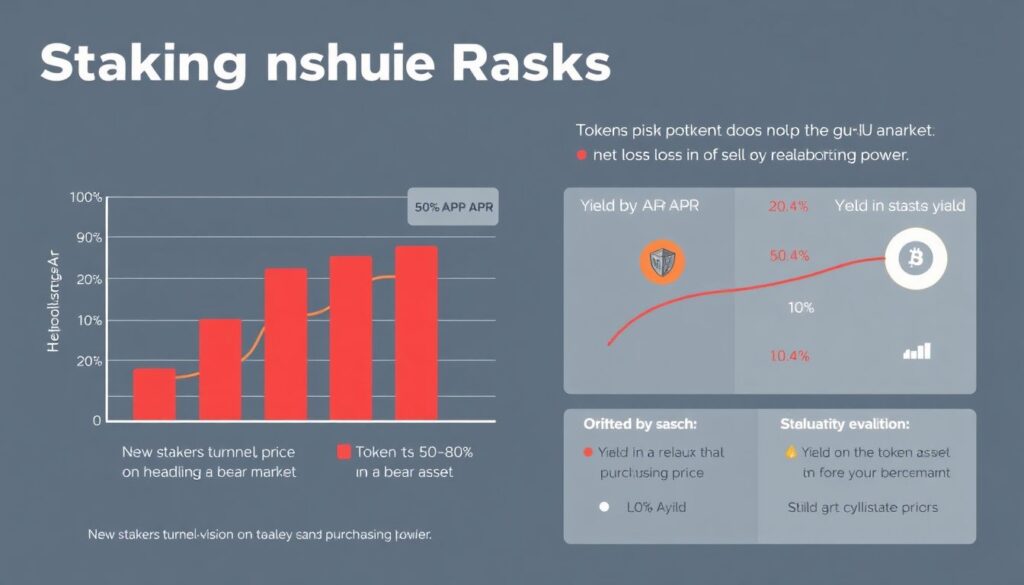
New stakers often tunnel‑vision on headline APR without modeling what happens if the token drops 50–80% in a bear cycle. A 60% APR on a token that halves in price still loses you real purchasing power. To avoid this, always evaluate yield in base asset and in a neutral benchmark (e.g., stablecoins). If a game token is purely narrative‑driven with little utility, cap its allocation. Treat highly volatile assets like “high DPS but paper armor” builds: fun to experiment with, but you don’t stack your entire loadout around them and expect consistent performance.
Ignoring Lockups and Unbonding Windows
Locking tokens for long periods can be fine if you truly believe in the project, but it becomes a trap if you need liquidity for life expenses or to rotate into better opportunities. Unbonding periods can last days or weeks, during which your assets are neither earning nor movable. Before staking, simulate worst‑case scenarios: if this token tanks or the meta shifts, can I live with missing the next big entry? If not, use flexible staking, liquid staking derivatives or avoid over‑allocating. Liquidity is a resource just as vital as damage or defense stats in any build.
Underestimating Security and Social Engineering
Most losses don’t come from sophisticated zero‑day exploits; they come from phishing, fake websites and malicious Discord links. As you explore various venues marketed as the best gaming crypto staking platforms, assume that some will be clones or traps. Verify URLs, bookmark official sites, use hardware wallets for confirmation and never sign random messages if you don’t understand what permissions they grant. If a dApp demands unlimited spending approval for all your tokens, consider creating a fresh wallet just for that protocol, limiting blast radius if anything goes wrong later.
- Never type your seed phrase into any website; wallets only use it on initial setup or recovery.
- Double‑check contract addresses from multiple independent sources before interacting on‑chain.
- Revoke outdated token allowances periodically using trusted tools to reduce exposure.
Beginner‑Friendly Tips That Still Respect Your Time
Start Ridiculously Small and Treat It as “Ranked Practice”
When you first experiment with crypto staking, send amounts so small that losing them would be annoying, not life‑changing. Use this phase to practice: delegate to a validator, claim rewards, undelegate and test bridging between networks. Log what you did and how long operations took. The goal is to build muscle memory, like grinding placements before you care about your visible rank. Once you’re comfortable with the flow and fees, gradually scale position sizes in a way that doesn’t trigger constant anxiety about short‑term price swings or protocol updates.
Document Your “Meta” Like Patch Notes
Gamers already think in terms of metas and patches; do the same for your staking stack. Maintain a simple text file or spreadsheet where you track assets, platforms, lockups, APR estimates and reasons for each decision. When narrative changes—new roadmap, tokenomics rework, major exploit—update the file like patch notes: what changed, which positions you’re nerfing (reducing) or buffing (adding). This keeps you from making random, emotion‑driven moves based on social media hype, and after a few months you’ll have a personal data set to refine your strategies instead of chasing every flashy new banner.
Use Staking to Enforce Long‑Term Thinking
Instead of viewing staking purely as a yield machine, treat it as a commitment device. By locking a portion of your gaming crypto, you make it harder to rage‑sell on panic or FOMO. Your “liquid” stack handles short‑term trading or NFT flips; your “staked” stack is your endgame build, tuned for years, not weeks. Over time, this mental separation helps you avoid one of the most common traps: turning every position into a day trade. Staking rewards become your “battle pass income,” arriving periodically whether you’re actively min‑maxing or simply enjoying casual sessions.
Bringing It All Together
For gamers, the idea to earn passive income gaming crypto isn’t some distant finance dream; it’s a natural extension of the meta‑game you’re already playing. You manage resources, track updates, optimize builds and learn from losses. Apply the same discipline to staking: pick solid networks, secure your wallets, diversify risk, ignore pure hype and let compound rewards work in the background. If you treat your portfolio like a long‑term account you genuinely care about, crypto staking slides neatly into your life: your tokens grind while you queue, and your ranked sessions become just one more input into a broader, carefully tuned economy you actually control.