
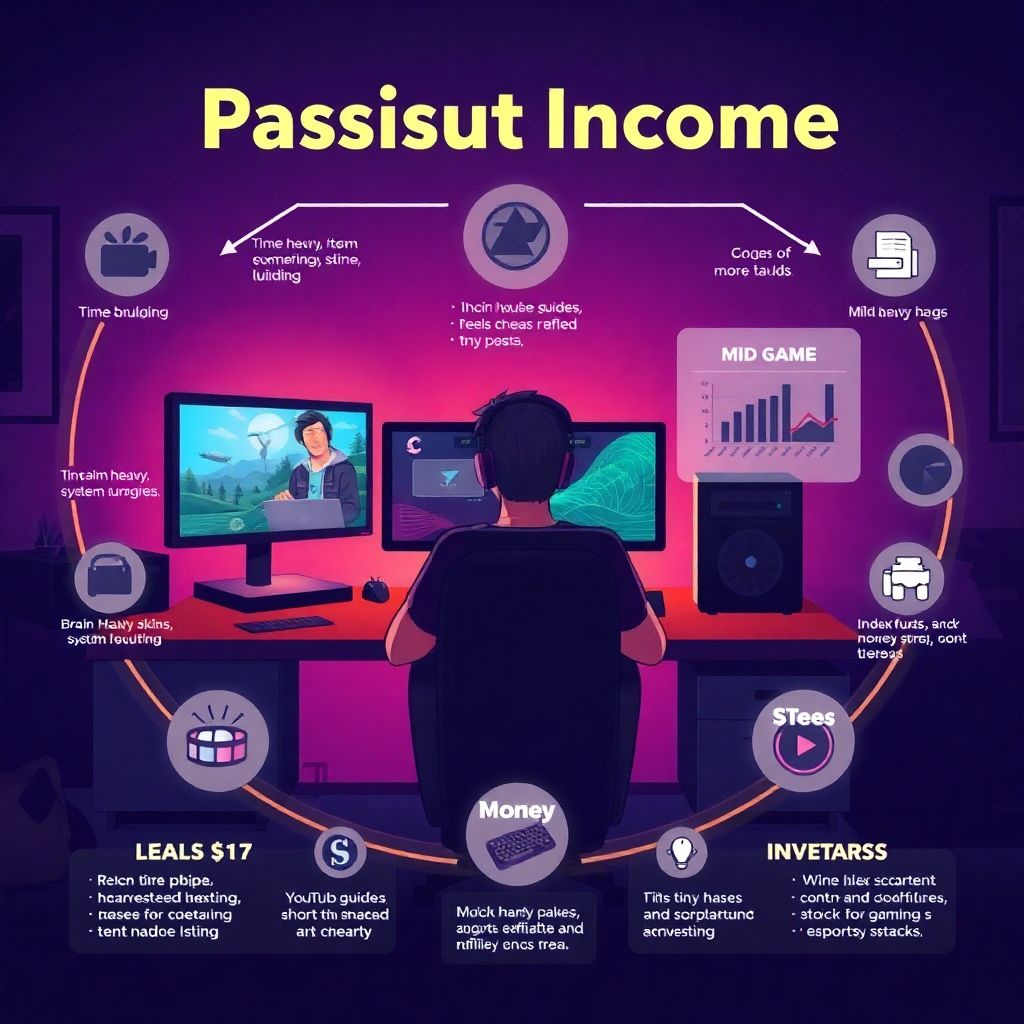
Why Passive Income Actually Makes Sense for Gamers
You already know how to grind, optimize builds, and think long-term. That’s exactly why many passive income ideas for gamers work so well: your gamer brain is already trained for strategy, patience, and incremental progress.
The whole point here isn’t to “get rich quick”. It’s to build small systems that make money while you’re:
– Waiting in queue
– Between matches
– On cooldown from ranked tilt
We’ll go step by step: starting with super-easy side hustles, moving toward more “investment” style setups, and comparing which approach fits different types of players.
—
Step 1: Decide What You’re Actually Optimizing For
Time vs. Money vs. Brainpower
Before diving into how to make money gaming passively, figure out your constraints:
– Are you broke but have time?
– Have a job but want something low-effort between games?
– Prefer to set up once and barely touch it?
Roughly, you have three main paths:
1. Time-heavy, money-light – small side hustles you do manually between matches
2. Brain-heavy, setup-focused – you build systems that keep working later
3. Money-heavy, low-effort – you invest cash into things that (ideally) grow on their own
We’ll compare options in each lane and I’ll point out common traps so you don’t waste months on something that never pays out.
—
Step 2: Low-Barrier Side Hustles You Can Do Between Matches
These are side hustles for gamers that pay real money, but don’t expect miracles. Think of them as “XP farms”, not boss drops.
1. In-Game Value: Skins, Items, and Currencies
If you already no-life a particular game, this is the most natural start.
Longer explanation:
– Some games have legit markets (Steam Community Market, certain MMOs, trading card games).
– You farm cosmetic items, rare drops, crafting materials, or in-game currency.
– You sell them for real money or store credit.
Short version: You’re turning your game knowledge into a tiny economy.
Pros:
– You’re already playing the game.
– Deep knowledge of meta and economy gives you an edge.
– Feels less like “work” and more like min-maxing.
Cons:
– Not every game allows real-money trading.
– Markets can crash; patches can nuke item values.
– Requires grinding; not fully passive.
Common mistakes:
– Going all-in on one item because “streamers talk about it”.
– Ignoring transaction fees and taxes.
– Violating ToS with shady third-party sites.
If you like optimization and flipping, this is a decent early-game tactic. Just treat it like trading, not gambling.
—
2. Micro-Gigs Between Matches (Surveys, Testing, Small Tasks)
Not sexy, but simple. These are small “click work” tasks:
– Short surveys
– App/website testing
– Micro-tasks like data labeling, transcribing tiny snippets
They’re some of the most basic ways for gamers to earn money between matches, because you can literally do them:
– In queue
– While spectating
– During breaks
Pros:
– Zero skills required.
– Fast start, no setup.
– Predictable: do X minutes, earn Y amount.
Cons:
– Pay is low.
– Can get super boring.
– Not scalable: you only earn when you click.
Tip for beginners:
Treat this as “seed money”. Use it to fund better, more scalable setups later (like a cheap mic, a domain name, or your first small investment).
—
Step 3: Semi-Passive Hustles Built Around Your Gaming
Here we shift from “pure time for money” to systems that can grow. They still need some effort, but not constantly.
3. Content That Works While You Sleep
If you’re already decent at a game or at least entertaining, you can create content that keeps paying long after upload.
Think:
– YouTube guides (“How to climb in X”, “Budget builds”, “Beginner mistakes”)
– Short-form clips (TikTok, Reels, Shorts)
– Written guides on a personal blog or platform
You play a match, record, later edit and upload. Over time, each video or article becomes a small “asset” that can:
– Get ad revenue
– Attract sponsorships or affiliates
– Build an audience you can monetize later
Pros:
– Content stacks over time like passive income “units”.
– One good guide can pay you for months or years.
– Fits easily between matches: capture now, edit later.
Cons:
– Slow start; first month or two may earn almost nothing.
– You need some editing and storytelling skills.
– Consistency matters; you can’t just vanish for 6 months.
Beginner advice:
– Ignore perfection. Aim for “not trash” and improve every 10 videos.
– Focus on search-friendly topics (e.g., “starter build for X class”) so people find you.
– Batch work: one gaming session → multiple videos or clips.
Compared to micro-gigs, this route starts slower but can beat them massively long-term if you stick with it.
—
4. Affiliate Links and Simple Monetization
Once you have any community at all—Discord, small stream, YouTube, Reddit presence—you can plug in simple monetization that doesn’t feel forced.
Examples:
– Links to gear you actually use (mouse, keyboard, controller)
– Game keys or subs from official partners
– In-game currency or skins from verified stores
You earn a cut if someone buys through your link. It’s one of the most misunderstood passive income ideas for gamers because people think you need 100k followers. You don’t. You just need:
– A specific niche (e.g., “budget Apex players”, “MMO healers”, “console CoD dads”)
– Honest recommendations
– Clear, non-spammy links
Pros:
– Very low maintenance.
– Can layer on top of content you already make.
– Can scale hard if your audience grows.
Cons:
– Requires some trust from your audience.
– Payouts can fluctuate.
– You must avoid shady products or you’ll burn your rep.
Mistake to avoid:
Dropping random affiliate links in every comment section or Discord. That’s how you get banned, not paid.
—
Step 4: Investing: When You’re Ready for “Gamer Capital”
Now to the heavier stuff: best investments for gamers to earn passive income. These are less about “do something between matches” and more “set it up, then only check between matches”.
5. Boring but Real: Index Funds and ETFs
This is the “long ranked grind” of money.
– You put money into broad market index funds/ETFs.
– They track a whole market (like S&P 500), not a single stock.
– Historically, they grow over the long run, with ups and downs.
This doesn’t feel “gamer-themed”, but it’s exactly what a lot of smart people do with extra cash.
Pros:
– Genuinely passive after setup.
– Diversified; less risky than YOLOing a single stock.
– Perfect for “I’ll check this once a week between matches”.
Cons:
– You need real money to start.
– No instant dopamine hit like a big skin drop.
– Value can go down short term.
Practical approach:
– Use a legitimate brokerage or investing app in your region.
– Start tiny; even $20–50 per month is fine.
– Set up auto-invest so it runs whether you remember or not.
Compared to flipping items in-game, this is slower but more stable and doesn’t depend on a game or meta staying relevant.
—
6. Gaming-Adjacent Investments (But Be Careful)
Some options sound “made for gamers” but are riskier:
– Esports org stocks or gaming companies
– Crypto gaming tokens / NFTs
– Digital collectibles and speculative in-game items
They can go insane in both directions: 10x gains or near-zero.
Pros:
– Emotionally exciting.
– You understand the space better than non-gamers.
– Potential for big upside if you’re early and right.
Cons:
– High risk; you can lose most or all of it.
– Heavy hype and FOMO.
– Hard to separate solid projects from pure marketing.
Golden rule:
Never put money here that you can’t afford to lose completely. Treat this like buying loot boxes, not like paying rent.
—
Step 5: Comparing Approaches – Which Path Fits You?
Let’s compare the main methods like different playstyles.
Grinder Type: “I Don’t Mind Repeating Tasks”
Best fits:
– Item/skin flipping
– In-game currency farming (if ToS allows)
– Micro-gigs and surveys
You’re trading time for money with low brain load. Great for students, unemployed periods, or times when you just want something simple to do while watching streams.
Trade-off:
Quicker first dollars, but hard to scale. You basically have a cap on income relative to time.
—
Strategist Type: “I Want Systems That Scale”
Best fits:
– YouTube/tutorial channels
– Short-form highlight reels
– Blogging or writing guides with affiliate links
You invest brainpower and effort up front building assets. Over time, your content + links form a web that earns while you do other stuff.
Trade-off:
Slow early game, strong late game. Looks like it’s “not working” for weeks, then starts to snowball.
—
Turtle Type: “I Just Want My Money to Work”
Best fits:
– Index funds, ETFs
– Long-term stock portfolios
– Very small slice in higher-risk gaming-related assets
You’re basically setting up future you for a better life, using money from jobs, side hustles, or gigs.
Trade-off:
You won’t feel the effect for a while. But 3–5 years down the road, this is the difference between “I wish I had started” and “I’m glad I did”.
—
Step 6: Step-by-Step Plan for Beginners
Here’s a simple route you can actually follow without burning out.
Phase 1: Quick Cash and Learning (1–3 months)
– Pick one micro-gig platform and earn a small consistent amount.
– Experiment with one in-game money angle (skins, currency, crafting) in a game you already play.
– Start tracking your time and earnings so you see what’s actually worth it.
Goal: Get your first $50–$100 online, just to prove it’s real.
—
Phase 2: Build Your First “Passive” Asset (3–6 months)
– Choose a content format: video guides, shorts, or written posts.
– Commit to a schedule you can actually follow (e.g., 1 guide per week, 3 clips per week).
– Add one or two honest affiliate links connected to that content.
Goal: Have at least 10–20 pieces of content live that can earn money without you touching them.
—
Phase 3: Turn Winnings into Investments (6+ months)
Once you’re making at least some side money:
– Open a legit investing account.
– Decide on a simple index fund or ETF.
– Auto-invest a fixed amount every month (from job + side hustles).
Goal: Convert active hustle money into long-term passive growth.
—
Step 7: Common Mistakes That Wipe Out Gamer Income
Short list of traps to avoid:
– Chasing hype only. Buying whatever your favorite streamer shills without research.
– Ignoring terms of service. One ban can kill months of grinding.
– Overinvesting in gear too early. You don’t need a $300 mic for your first 10 viewers.
– Burnout from over-grinding. 8 hours of work + 6 hours of streaming + ranked grind = guaranteed collapse.
– No tracking. If you don’t know which hustle actually pays, you can’t improve.
Instead, think like a player learning a new game: start small, test, iterate, and don’t tilt when something fails.
—
Final Thoughts: Designing Your Own “Income Build”
There isn’t one perfect method for how to make money gaming passively. Instead, think in builds:
– Early game: quick hustles and low-skill tasks to get initial gold.
– Mid game: content and systems that can earn while you play or sleep.
– Late game: investments that slowly stack in the background for years.
Pick one or two methods that match your personality and time, level them up like talents, and keep adjusting as you learn. The same mindset that helps you climb ranked—experimentation, patience, analysis—can slowly turn your gaming time into something that actually pays off outside the lobby screen.