

Why “Investment Builds” Make Sense for Gamers in 2025

If you’ve ever spent an evening theory‑crafting a Diablo build, fine‑tuning a League runes page, or optimizing a loadout in Destiny, you’re already closer to investing than you think. A beginner investment portfolio is basically a character build for your real‑world money: you choose stats (risk vs. safety), gear (types of assets), and a strategy (aggressive, balanced, defensive).
In 2025, the barrier to entry is lower than ever. Fractional shares, zero‑commission trading, and intuitive mobile apps mean you can start with the equivalent of a battle pass budget. The real challenge is not “how to start investing with little money”, but how to avoid turning your portfolio into a casino mini‑game. That’s where simple, structured “investment builds” come in.
—
From Tulip Mania to Trading Apps: A Short Historical Context
Early “Meta”: Speculation Before Investing
Investing is old; speculation is even older. In the 1600s, Dutch merchants went all‑in on tulip bulbs, pushing prices so high that one bulb could cost more than a house. It ended the way any broken meta does: a brutal crash. No risk management, no diversification, just hype and FOMO.
Fast‑forward to the 1920s in the U.S. Stocks became a mainstream obsession. People borrowed to buy shares, assuming prices only go up. When reality hit in 1929, the crash triggered the Great Depression. Out of that disaster came serious regulation and the early building blocks of what we now see as normal investing: disclosure rules, stock exchanges with oversight, and mutual funds designed for regular people.
From Mutual Funds to Index Funds
In the 1970s, economist John Bogle introduced index funds: instead of picking individual stocks, you buy a “bundle” that tracks a whole market index, like the S&P 500. That was the original “simple investment strategy for beginners”: own everything, keep fees tiny, stay invested.
As PCs spread in the 80s and 90s, online brokers appeared. In the 2000s, exchange‑traded funds (ETFs) made it even easier to buy broad market baskets. The 2010s and early 2020s added mobile apps, robo‑advisors, and social trading. Sometimes that blurred the line between investing and gambling—especially during the meme‑stock spikes of 2021.
By 2025, you can open an account in minutes, buy a diversified ETF with a few taps, and automate contributions. But the old human bugs—greed, fear, impatience—are still there. That’s why simple, rules‑based beginner builds matter more than ever.
—
Core Principles: Turning Game Logic into Money Logic
1. Think in Seasons, Not Matches
Long term investing for beginners is about time scale. If you judge your progress like a single ranked match, every loss feels catastrophic. Instead, treat investing like a multi‑season progression system: the goal is to steadily level up your net worth over years, not win one lucky trade.
Historically, broad stock markets have grown over decades despite wars, crises, and recessions. Short‑term charts are noisy; long‑term charts trend upward. Your edge as a beginner isn’t predicting the next move—it’s staying in the game longer than most players.
2. Asset Allocation = Stat Distribution
Asset allocation is how you split your money among different asset classes:
– Stocks (equities): higher potential returns, higher volatility.
– Bonds (fixed income): lower returns, more stability and income.
– Cash or cash‑like: very stable, but loses value against inflation over time.
For a gamer, think of it as your build:
– More stocks = glass cannon (higher damage, squishier to market swings).
– More bonds = tankier build (less damage, more stability).
– Cash = sitting at base: safe, but not pushing objectives.
The best beginner investment portfolio is usually not 100% in one thing, but a mix matched to your risk tolerance and time horizon.
3. Diversification: Don’t One‑Trick a Single Stock
Diversification means you don’t bet everything on one company, one sector, or one country. Even legendary companies can fall out of meta—just look at old tech giants that dominated in 2000 and are irrelevant now.
Index funds and ETFs are essentially “loot boxes” where you know the expected contents: hundreds or thousands of different securities. Instead of guessing which single stock will win, you buy the whole field and let the winners carry you over time.
—
Beginner “Investment Builds” for Gamers
Build 1: The Ultra‑Simple “One‑ETF” Loadout
If you want something brutally simple:
– 100% in a global stock market ETF or a total market ETF.
This is the “single weapon, high skill‑ceiling” build. Implementation examples (not recommendations, just illustrations):
– A low‑cost ETF tracking the global stock market.
– A broad U.S. total market ETF if you live in or trust the U.S. market.
Why it works:
– Instant diversification across thousands of stocks.
– One position to monitor.
– Very low fees if you pick mainstream index ETFs.
Downside: When markets drop, this build takes the full hit. You need the emotional resilience to stay invested during drawdowns.
Build 2: The Balanced “Tank‑DPS Hybrid”
If pure stocks feel too volatile, a classic beginner build mixes stocks and bonds:
– 60–80% in a broad stock ETF.
– 20–40% in a broad bond ETF.
For example:
– 70% global or total stock market ETF.
– 30% investment‑grade bond ETF.
This reduces the size of your drawdowns in big crashes, at the cost of slightly lower long‑run returns. For many new investors, the smoother ride is worth it, because they’re less likely to panic‑sell.
Build 3: The Gradual Skill Tree (Age‑Adjusted)
A common rule of thumb: hold a percentage in stocks equal to 100 (or 110) minus your age. It’s not perfect, but it’s a starting point:
– At 25: maybe 80–90% stocks, 10–20% bonds.
– At 40: closer to 60–70% stocks, 30–40% bonds.
You can implement this using a single “target date” or “lifecycle” fund that auto‑adjusts for you over time. It’s like an auto‑leveling build that gradually shifts points from attack to defense as you approach retirement.
—
How to Start Investing with Little Money in 2025
Step 1: Pick Your Platform Like You Pick a Game Launcher
Before worrying about the best beginner investment portfolio, you need a place to hold it. In 2025, the best online investment platforms for beginners typically share a few traits:
– Low or zero commissions on ETFs and stocks.
– Option to buy fractional shares.
– Simple, clean interface, not overloaded with day‑trading gimmicks.
– Easy automated deposits and recurring purchases.
Look for regulated brokers in your country, check their fees, and avoid platforms that gamify trading with constant confetti and prompts to leverage up. You want a tool, not a slot machine.
Step 2: Start Tiny, But Start Now
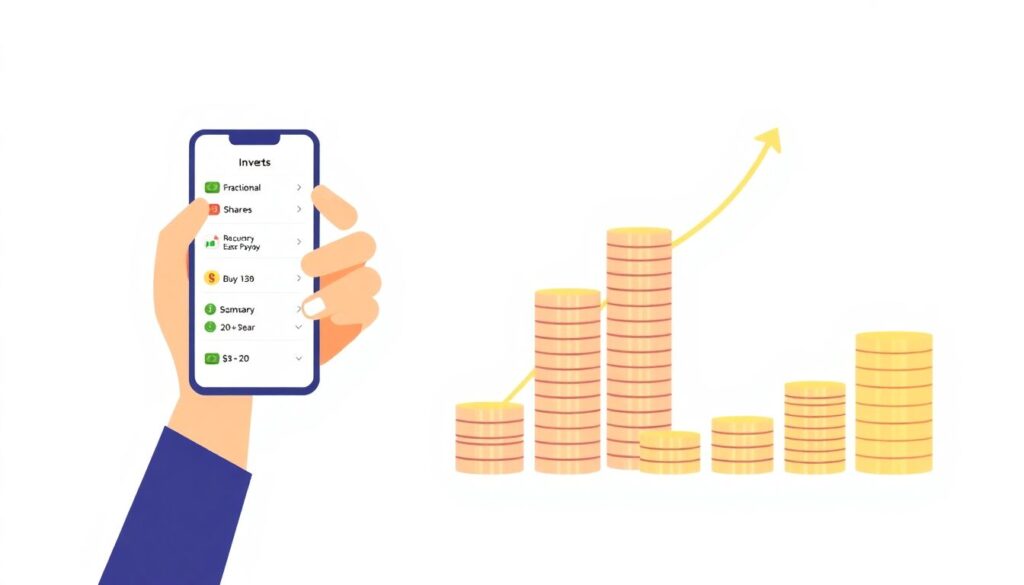
You don’t need thousands to begin. Many brokers let you:
– Invest $5–$20 per trade using fractional shares.
– Set up recurring buys each payday.
The math is surprisingly powerful. A small, steady monthly investment into a diversified ETF can grow significantly over 20+ years, thanks to compounding. The key is not the first deposit size; it’s how early and how consistently you start.
Step 3: Automate Like a Daily Quest
Set up automatic contributions so money moves from your bank to your investment account every month, and then straight into your chosen ETF(s). That way:
– You don’t have to time the market.
– You avoid forgetting or procrastinating.
– You treat investing like a subscription to your future self.
Dollar‑cost averaging—investing a fixed amount at regular intervals—naturally buys more shares when prices are low and fewer when prices are high, smoothing out your entry price over time.
—
Practical Examples: Translating Theory into Actions
Example Loadouts for Different “Player Types”
Not financial advice—just conceptual blueprints you can adapt.
1. The Student/Junior Dev (Very Long Time Horizon)
– Goal: Long‑term wealth building, max growth.
– Possible build:
– 90% global or total stock market ETF
– 10% bond or cash‑like ETF
2. The Mid‑Career Player (More Responsibilities)
– Goal: Growth + some stability.
– Possible build:
– 70% stock ETF(s)
– 30% bond ETF(s)
3. The Cautious Newcomer (Hates Big Swings)
– Goal: Learn the ropes, avoid panic.
– Possible build:
– 50–60% stock ETFs
– 40–50% bond or conservative ETFs
The “best beginner investment portfolio” for you is the one you can actually stick with through both green and red markets. Psychological fit beats theoretical optimization.
What a Simple Monthly Routine Might Look Like
– Your paycheck arrives.
– A fixed percentage (say 10%) auto‑transfers to your broker.
– Broker auto‑buys your pre‑chosen ETF(s) based on your target percentages.
– Once a quarter, you log in for 10 minutes:
– Check if allocations drifted too far from your target (e.g., stocks grew from 70% to 78%).
– Rebalance if necessary by buying more of the underweight asset, or selling a bit of the overweight one.
That’s it. No constant news watching, no chart staring. Just a repeatable pattern.
—
Common Misconceptions That Punish Beginners
“I’ll Start When I Have Real Money”
Waiting until you “have more” is how a lot of people lose their most valuable resource: time. Starting with tiny amounts creates habits and gets compounding working. The difference between starting at 22 vs. 32 is enormous over a 30‑ to 40‑year horizon.
“I Can Outplay the Market with Enough Research”
In competitive online games, better skill and game knowledge significantly raise your win rate. In investing, the competition is hedge funds with teams of PhDs, AI models, and real‑time data. Passive index funds exist because most professionals, on average and after fees, fail to consistently beat the market.
For most people, trying to day‑trade or pick hot stocks is like queueing into top‑tier ranked play with starter gear and expecting to dominate.
“Index Funds Are Boring, I Want Action”
Yes, they’re boring—like a solid, reliable build that quietly wins over a long match instead of landing flashy plays. If you truly want a “fun” sandbox for speculation, you can:
– Keep 90–95% in a boring, diversified core.
– Use 5–10% as a “play money” allocation for individual stocks, crypto, or other high‑risk bets.
Just be honest with yourself about which part is investing and which part is entertainment.
“I’m Too Late; the Market’s Already High”
Every generation thinks they’re late. If you look at history, markets hit “all‑time highs” frequently on the way up. Yes, buying right before a crash hurts, but if your plan is multi‑decade, even bad initial timing tends to get washed out by time in the market, especially when you’re adding new money regularly.
—
Simple Investment Strategies for Beginners: Checklist
To wrap everything into a short, actionable list:
– Define your time horizon and risk tolerance (how long and how volatile you can handle).
– Choose a basic asset allocation (e.g., 70% stocks / 30% bonds).
– Pick low‑cost, broad index ETFs that match that allocation.
– Open an account with a reputable, low‑fee broker that supports fractional shares.
– Automate monthly deposits and purchases.
– Rebalance occasionally, not obsessively.
– Avoid leverage, options, and complex products until you truly understand them.
In other words, design a clear, boring, rules‑based build and stick with it. The complexity can scale later, the same way you move from newbie guides to advanced min‑maxing in any deep game.
—
Final Thoughts: Play the Long Game
Investing in 2025 is simultaneously easier and more dangerous: tools are better, but distractions and temptations are everywhere. If you think like a gamer, you actually have an edge: you understand grind, delayed gratification, and incremental progress.
Treat your beginner investment build like a long‑running save file. Protect it, feed it regularly, and don’t delete it in a moment of tilt. If you do that, simple portfolios can quietly carry you toward goals that no in‑game currency can buy.