
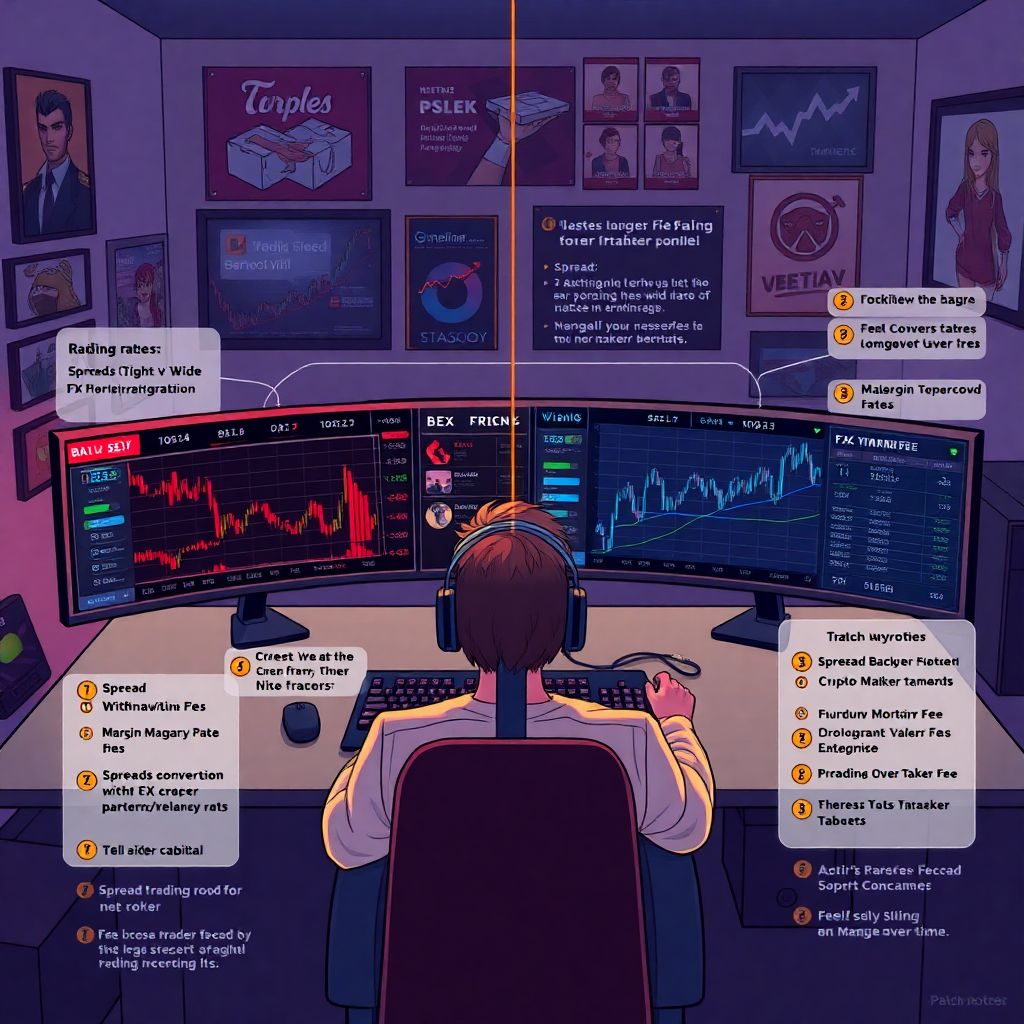
Why gamers should care about fees and spreads

If you’re used to grinding RPGs or min-maxing in MOBAs, you already think like an investor; you just call it “optimization”. In markets, though, optimization starts with costs. Every spread, commission and hidden fee is like passive damage over time, slowly draining your HP bar (capital) even when trades “look” profitable. This guide translates finance jargon into gamer logic, so you can read a fee screen like patch notes, spot nerfs to your returns early, and avoid walking into a pay‑to‑win trap disguised as a slick trading app.
—
Step 1: Decode “fees” and “spreads” like game mechanics
At the most basic level, the spread is the gap between the buy and sell price. Think of it as the difference between a vendor’s buying and selling prices in an MMO auction house: the wider it is, the more you lose just for entering the trade. Fees are additional charges: fixed commissions per trade, percentage cuts, overnight financing, and even withdrawal costs. Pros treat them as hard stats in a build; they check how each platform taxes every action and calculate the break‑even point before clicking “Buy”.
—
Step 2: Map out all fee types before picking a platform
Don’t stop at “commission-free” banners. Expert traders look at the entire fee tree, not just the main node. You want to list: trading commission, spread, FX conversion fees, deposit/withdrawal charges, inactivity fees, margin/financing rates, and any “premium account” upsells. As one portfolio manager puts it, “If a platform can’t show you total costs in one clean overview, assume there’s a reason.” Approach it like reading patch notes: hidden nerfs usually live in the small print, and those are the ones that hurt long-term players.
—
Step 3: Evaluate spreads like ping and latency
For active traders, tight spreads are as crucial as low ping in a shooter. A scalper or day trader paying wide spreads bleeds value on every entry and exit. To evaluate spreads properly, check them during different market sessions, just like you’d test server lag at peak and off‑peak hours. Experts recommend comparing at least three platforms on the same instrument, at the same time of day; if one broker’s quotes consistently look “laggy” (wider spreads) compared to others, that’s effectively a silent tax on your strategy.
—
Step 4: Compare platforms – not just interfaces
Many beginners pick the shiniest UI or the app pushed hardest by influencers, but pros start from costs. When people talk about best low fee online trading platforms, they mean brokers that keep both explicit and implicit costs under control without crippling functionality. Treat each platform like a different class in an RPG: one might have cheap stock trading but overpriced crypto, another low forex spreads but nasty withdrawal fees. Your task is to match your “playstyle” – long‑term, swing, day trading – with the cost profile that fits it.
—
Step 5: Zero-commission isn’t really free – here’s why
Zero-fee marketing sounds like “free loot boxes”: technically true, practically expensive. In a zero commission stock trading apps comparison, experts check three things: average spread versus competitors, the quality of execution (do you get good prices, or constant slippage?), and monetization models like payment for order flow. A trading psychologist notes, “Zero commission makes people overtrade, because every click feels free.” Your defense is to track how much each order actually costs you, including worse prices, instead of trusting the “0” on the fee line.
—
Step 6: Choosing a broker based on your strategy
The core question is how to choose a broker based on fees and spreads without overcomplicating it. Long‑term investors who trade rarely can live with slightly wider spreads if custody fees are zero and ETFs are cheap. High‑frequency traders need razor‑thin spreads, even if there’s a small commission. Crypto degen? You care more about maker/taker fees and funding rates. Pros advise writing down your expected trade frequency and average position size, then simulating total yearly costs on each platform before you open a real‑money account.
—
Step 7: Forex – where spreads are your main boss fight
In FX, spreads are often the primary cost, so comparing forex brokers with lowest spreads and commissions is not optional; it’s your difficulty selection. But “lowest” on a marketing banner means little without context. Experts recommend checking average spreads over a month, not just “from 0.0 pips” claims, and verifying whether low spreads are conditional on high account tiers, large deposits, or extra subscription fees. Don’t forget commissions per lot: a broker can show a tiny spread but claw it back with hefty per‑trade charges.
—
Step 8: Crypto exchanges – fee ladders and hidden traps
On crypto, cost structures turn into full skill trees. The crypto exchanges with lowest trading fees often use tiered pricing: trade more volume and your fees drop. Professionals scrutinize maker/taker fees, funding on perpetual futures, and even withdrawal and network costs. A quant trader’s advice: “Always read the fee schedule as if you’re designing a bot. Line by line, scenario by scenario.” Also check how often they change fees; frequent, opaque updates are a red flag, the financial equivalent of live‑service games constantly rebundling microtransactions.
—
Step 9: Run the numbers – quick “DPS” calculation for costs
Gamers understand DPS; translate that into “cost per month” or “cost per trade”. Build a simple spreadsheet or use a note app: number of trades per month, average trade size, spread in percentage, plus any flat fees. Calculate: spread cost × number of trades + commissions + account fees. Experts insist you do this for at least two platforms side by side; often, a broker that feels “a bit more expensive” on commission wins once you factor in tighter spreads and lower FX costs. Data beats impressions every time.
—
Step 10: Common mistakes beginners make (and how to dodge them)
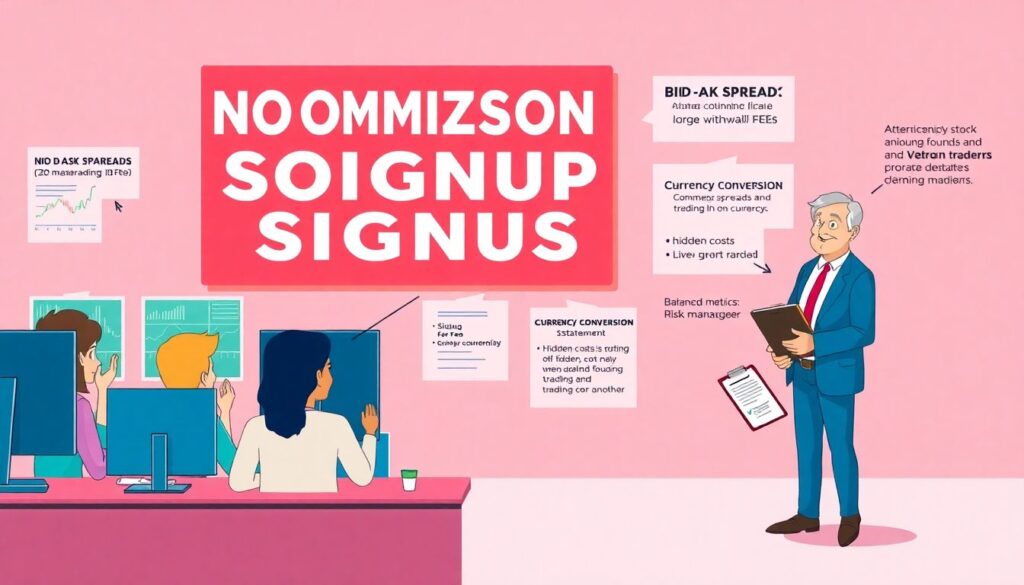
New traders routinely tunnel-vision on one flashy metric. They obsess over “no commission” and ignore spreads, or chase signup bonuses while missing huge withdrawal fees. Another frequent mistake is ignoring currency conversion costs when funding in one currency and trading in another. A veteran risk manager compares this to ignoring elemental resistances: “You’re not wiped by one big hit; you’re eroded by constant small ones.” Build a checklist: spread, commission, FX, account fees, funding, and withdrawals. If any field is unclear, that’s a warning, not a minor detail.
—
Step 11: Expert tips for gamers turning into investors
Seasoned pros who also game often recommend treating your first months as “early access” instead of a full release. Start with a small account, log every trade with its real cost, and review weekly, like patch notes for your own behavior. Use demo accounts to test execution quality and spreads across platforms in parallel. One hedge‑fund analyst suggests a specific rule: “Don’t sign with any broker until you’ve read their full fee schedule twice and explained it out loud as if teaching a friend.” If you can’t explain it, you’re not ready.
—
Step 12: Building your long-term “meta” around low costs
In most competitive games, the meta eventually favors consistent low‑risk plays over flashy one‑shots. Markets are similar: minimizing friction from fees and spreads is a quiet edge that compounds. Pick platforms with transparent pricing, verify real spreads at your trading hours, and revisit your cost assumptions every few months, especially after big platform updates. Think of costs as permanent debuffs: you can’t remove them, but you can reduce their impact. Once you lock in a low‑cost setup, every strategy you run on top instantly becomes more viable.