
Why loss harvesting still matters when markets feel expensive
Tax loss harvesting sounds dry until you see what it does in cash terms. Think of it as using the bad parts of your portfolio to subsidize the good ones. When you sell a position at a loss, lock that loss in the tax system, and then reinvest the cash, you’re not just cutting your losers — you’re manufacturing a tax asset. Smart tax loss harvesting strategies focus less on “dumping bad stocks” and more on systematically converting volatility into deductible losses, while keeping your market exposure almost unchanged. Done right, you smooth out after‑tax returns over the full cycle instead of trying to outguess the next correction or rally, and this matters even more in 2025 with higher dispersion between winners and laggards inside the same sectors.
Most investors intuitively harvest losses only after a crash. The smarter play is to treat it as routine maintenance, not emergency surgery.
How tax-efficient harvesting actually works under the hood
At a technical level, loss harvesting sits inside a broader toolkit of tax efficient investing strategies. You realize a capital loss by selling an asset below its tax cost basis, then use that realized loss to offset realized capital gains and, in many systems, a slice of ordinary income. The crucial point is that the tax code cares about the sale, not about your economic exposure. So you can often sell ETF A, crystallize the loss, and immediately buy ETF B that tracks a very similar — but not “substantially identical” — index. Your portfolio risk profile barely moves, but your tax position changes dramatically. Over time this process creates a “loss carryforward bank” that can be deployed against future gains from rebalancing, diversification, or concentrated position sales, lowering your effective tax drag without changing your headline strategy.
This “two layers” view — investments and tax ledger — is the mental model professionals use.
Comparing common approaches to harvesting investment losses
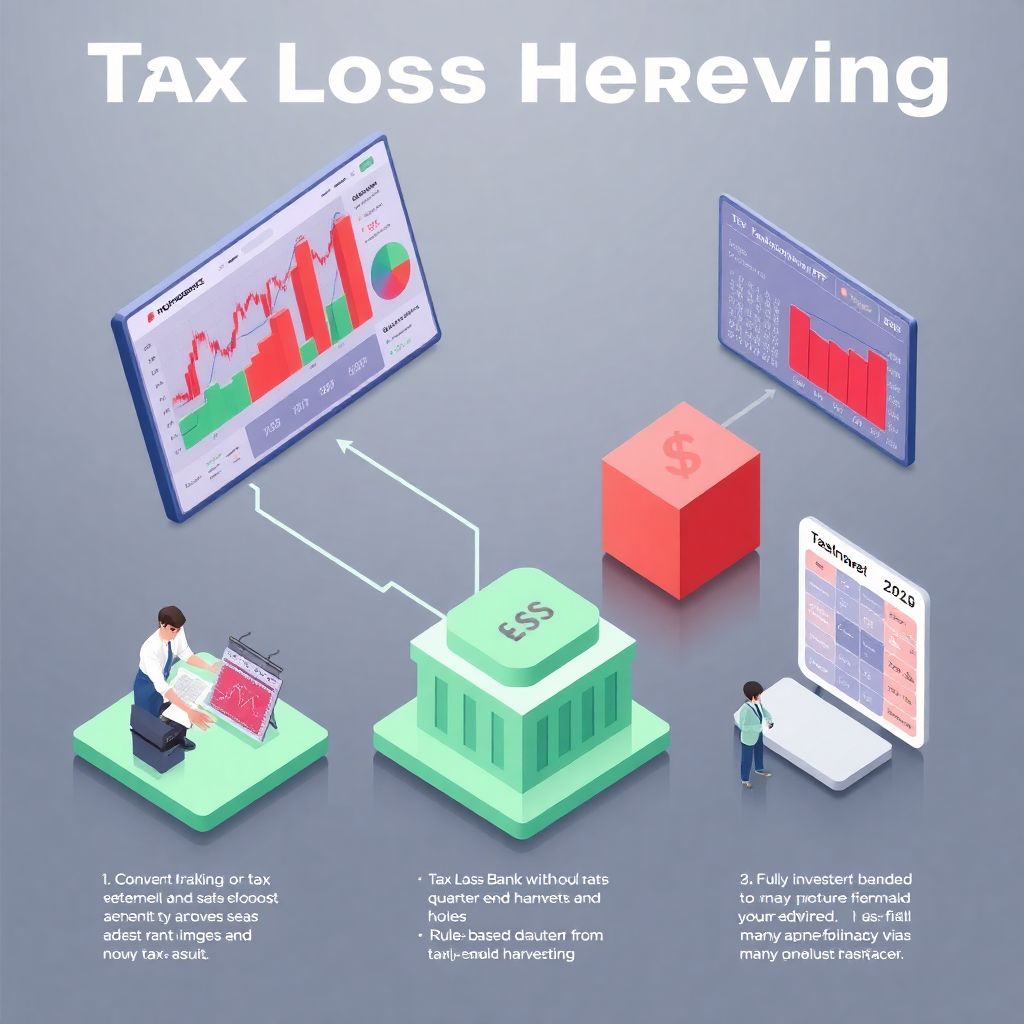
There are three broad styles in practice. The first is manual, ad‑hoc harvesting, where an investor or advisor periodically scans the portfolio for red ink and selectively sells. The second is rules‑based periodic harvesting, for example at quarter‑end, using loss thresholds, minimum holding periods, and risk constraints. The third is fully automated, where algorithms scan daily and execute micro‑trades. Each approach targets the same goal — how to use investment losses to reduce taxes while staying invested — but they differ sharply in complexity, behavioral stress, and tracking error. Manual harvesting relies heavily on human attention and is easy to neglect during busy or euphoric markets. Rules‑based systems add discipline and transparency, while automation pushes frequency and precision, sometimes at the cost of higher transaction volumes and the psychological discomfort of “always trading”.
Short version: more structure usually means better tax outcomes, as long as you control frictions.
Case study: the “once‑a‑year” executive
A tech executive with a seven‑figure taxable portfolio used to “do taxes” every March with her accountant. In 2021 she had large gains from RSU sales, but almost no realized losses, despite plenty of underwater growth stocks. A retrospective analysis showed that if she had applied a quarterly rules‑based harvesting protocol — selling any position with at least a 7% unrealized loss and rotating to a similar ETF — she would have generated roughly 2.2% of portfolio value in usable capital losses over two years. That would have nearly neutralized the tax bill from trimming her concentrated employer stock. The investment risk profile would have stayed within her current policy limits, but the lack of structure meant she simply never got around to monetizing those paper losses in time.
Her takeaway: habit beats intention in tax planning.
Pros and cons of manual versus automated strategies

Manual loss harvesting shines when an experienced tax advisor for investment loss strategies is closely involved and the portfolio is relatively simple. Humans can incorporate nuanced constraints: upcoming liquidity needs, employer blackout periods, or specific wash‑sale risks tied to employee stock purchase plans. However, the downside is time pressure and inconsistency; opportunities often appear in short, volatile windows, and people get distracted. Automated and semi‑automated systems, including some of the best tax loss harvesting software on the market, systematically scan for opportunities, model wash‑sale implications, and back‑test tracking error before placing orders. They can identify small, incremental losses that humans might ignore. On the flip side, they can generate a high volume of trades, raising spreads and operational complexity, and sometimes they swap into replacement securities that are technically compliant but not ideal from a factor exposure standpoint, subtly drifting the portfolio away from its original design.
Put bluntly, software is relentless; humans are contextual. The best setups blend both.
Case study: the robo‑advisor versus the bespoke SMA
Consider two investors with similar $500k taxable equity portfolios in 2022–2024. Investor A used a robo‑advisor with built‑in automated harvesting. Investor B held a custom separately managed account run by a boutique firm that did quarterly, advisor‑driven harvesting. The robo generated about 1.8 times more realized losses, especially in choppy sideways markets, but also produced hundreds of small trades and a growing list of legacy positions. The SMA generated fewer but larger loss events, kept the holdings list cleaner, and actively coordinated with the client’s external real‑estate gains. After fees and trading costs, the robo still delivered a modestly better after‑tax result for a pure equity benchmark, while the SMA added value by integrating other asset classes and long‑term planning. The lesson: automation dominates at the micro level, but coordination with your broader financial life can outweigh raw harvesting volume.
Neither route is automatically “better”; it depends what problem you’re actually solving.
Choosing replacement securities without triggering wash sales
The legal minefield around “substantially identical” securities is where practical skill matters. For individual stocks, the safest path is usually to rotate into sector or factor ETFs after realizing a loss, restoring beta exposure while stepping back from idiosyncratic risk. For ETFs and mutual funds, professionals design “swap pairs”: for example, harvesting losses in an S&P 500 ETF and rotating into a broad US large‑cap ETF with slightly different construction rules. Advanced tax loss harvesting strategies go further by pre‑defining replacement maps for each core holding, stress‑testing them for tracking error across multiple regimes, and documenting the policy so it survives staff turnover. The aim is to maintain risk continuity while side‑stepping wash sale rules, and then, after the 30‑day window, optionally rotating back into the original instrument if it remains optimal from a strategic perspective.
Ignoring this design work is how investors accidentally nullify their own tax benefits.
Case study: when the wash sale rule bites
A DIY investor sold a losing S&P 500 index fund in November, then set a dividend reinvestment plan on a nearly identical ETF he already owned. The small December DRIP purchase triggered a wash sale that disallowed part of his harvested loss and rolled it into basis instead. The dollar amount wasn’t catastrophic, but it erased much of the intended tax benefit for that year. A simple fix — suspending DRIPs and automatic contributions in overlapping funds during the 30‑day window — would have preserved the deduction. This kind of operational oversight is exactly what software and process checklists are designed to prevent, illustrating that even sophisticated portfolios can stumble on apparently minor administrative details.
In harvesting, the boring controls often save more tax than clever trade ideas.
Technology stack: software, data, and workflow in 2025
In 2025, the frontier isn’t just “do we harvest losses?” but “how tightly is harvesting integrated into the full portfolio workflow?” The best tax loss harvesting software now ingests intraday pricing, tax‑lot level histories, and client‑specific tax parameters to prioritize trades. It ranks potential loss trades by after‑tax benefit net of estimated spread and fees, and models the impact on factor exposures and tracking error. Some systems plug directly into custodians to execute with smart order routing, while simultaneously flagging interactions with options, derivatives, and multi‑currency positions. On the advisor side, dashboards unify realized and unrealized gains, loss carryforwards, and projected tax scenarios, making it easier to coordinate with CPAs before year‑end rather than after. The technology is moving from “nice add‑on” to core infrastructure for any firm managing significant taxable wealth.
But the sophistication only pays off if humans actually use the insights in real time.
How advisors are using automation in real practice

A multi‑family office managing several hundred taxable accounts rebuilt its rebalancing engine around tax‑aware algorithms. Instead of rebalancing purely on drift thresholds, the system looks for pairs of underweight and overweight positions where realizing a loss on one can partially fund gains on another. Over two years, this tax‑aware rebalancing cut realized net gains by about 40% compared with the old process, without materially changing risk metrics. Advisors then layered in individual client constraints: charitable gifting plans, expected liquidity events, even state‑specific tax quirks. The result was a hybrid workflow where machines propose the tax‑optimized trades, and humans veto or tweak them based on relationship knowledge. This is where tax efficient investing strategies become tangible: coordinated, repeatable, and tailored, rather than one‑off “tax tricks” at year‑end.
Clients noticed not the algorithms, but the smoother, more predictable tax bills.
Practical guidelines for choosing your strategy
Selecting an approach starts with constraints: portfolio size, complexity, time, and tolerance for admin. For portfolios under roughly six figures with a small number of ETFs, a good robo‑advisor with automated loss harvesting is usually sufficient. As complexity grows — multiple accounts, legacy stock positions, private deals — the case for a dedicated tax advisor for investment loss strategies and more configurable tools becomes stronger. Above certain thresholds, separate accounts with tax‑aware indexing can justify their extra fee via more granular control of tax lots and custom benchmarks. Regardless of scale, foundational habits matter: avoid frequent short‑term gains unless compensated by large expected alpha, document a standard harvesting policy, and line it up with your broader financial plan. The goal is to have a default path that works well even in years when you’re too busy to think about taxes.
In other words, treat tax management as part of portfolio design, not a patch after the fact.
Red flags and common mistakes to avoid

Several patterns repeatedly destroy value. One is overtrading: chasing tiny losses without regard to spreads, commissions, and slippage. Another is “harvesting for sport” while simultaneously realizing large, avoidable gains elsewhere, leading to a noisy but unproductive tax ledger. A subtle but serious mistake is allowing loss harvesting to hijack the investment thesis — ending up with a patchwork of replacement funds that bear little resemblance to the original strategy. Finally, failing to coordinate across accounts means harvesting in a taxable account while an IRA or 401(k) is buying the same security, potentially complicating wash sale analysis and undermining the net benefit. Keeping an integrated view of exposures and tax positions, preferably with unified software or at least disciplined spreadsheets, is essential if you want the tactics to translate into sustained after‑tax outperformance.
Tax alpha is fragile when it’s not grounded in process.
Key trends in tax-loss harvesting for 2025 and beyond
Looking ahead, three developments are reshaping how to use investment losses to reduce taxes. First, direct indexing platforms are moving down‑market, letting smaller accounts hold hundreds of individual securities instead of a single ETF, vastly increasing the raw material for loss harvesting. Second, regulatory and political focus on high‑net‑worth tax strategies is intensifying, making documentation, consistency, and substance even more critical — what once passed as “clever” may soon need to be justified under closer scrutiny. Third, AI‑driven analytics are starting to forecast which holdings are most likely to generate harvestable losses without impairing long‑term factor exposures, adding a predictive layer on top of reactive selling. Combined, these shifts push practitioners toward more integrated, data‑rich, and compliance‑aware frameworks, where tax and investment decisions are truly co‑designed rather than loosely stitched together at year‑end.
The edge will belong to those who can operationalize that integration, not just talk about it.
Bringing it all together
Smart tax loss harvesting is less about clever trades and more about system design: clear rules, good data, suitable tools, and coordination with your broader financial life. Whether you lean on automation, a human advisor, or both, the aim is the same: convert volatility into a repeatable source of tax alpha while keeping your risk exposures aligned with your goals. Real cases show that disciplined, systematic approaches can materially soften tax bills from concentrated stock positions, business exits, and ordinary rebalancing — but also that sloppiness with wash sales and ad‑hoc decisions can quickly erode those gains. If you treat your tax ledger as an asset to be managed, not just a reporting requirement, you’ll be far better positioned to navigate whatever markets 2025 and beyond decide to throw at your portfolio.