
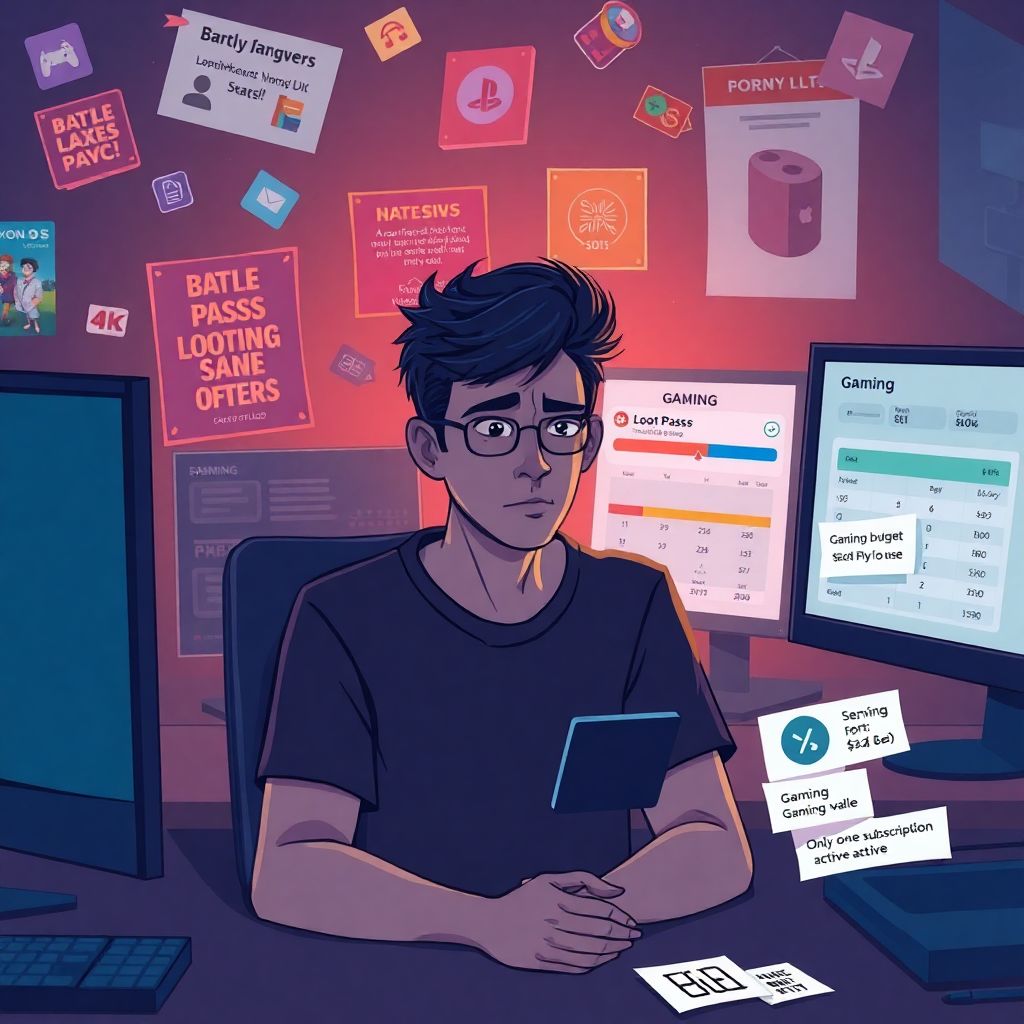
Why money stress hits gamers so hard
If thinking about your bank balance right after buying a new game pass makes your stomach twist, you’re not alone. Financial anxiety for gamers is a real thing: you’ve got constant sales, battle passes, loot boxes, “limited-time” skins, DLCs, and a giant pile of games you still haven’t finished. Your brain gets spammed with offers; your wallet gets thinned out.
Historically, gaming was simple: you paid once for a cartridge or a disc, played it for months, and that was it. No battle pass, no cosmetic bundles, no “premium currency” with weird exchange rates. Now the industry runs on microtransactions and subscriptions, and the entire system is designed to keep you spending “just a bit more.” Financial stress is almost built-in, especially if you’re juggling studies, rent, or a low-paying job.
Step zero: define what “healthy spending” on games means for you
Before talking about budgets and apps, you need a personal rulebook. Not a generic “never spend money on games” thing, but your own definition of what feels okay and what feels scary.
Ask yourself three quick questions:
– If I keep spending on games the way I do now for a full year, what will hurt the most: debt, savings, or relationships?
– When I buy games or in‑game items, do I feel excited, neutral, or guilty afterward?
– If a friend sent me my game spending history, would I feel comfortable seeing it?
If the honest answer is “I’d be embarrassed” or “I don’t even want to know,” that’s financial anxiety talking. Your goal isn’t total restriction; it’s to get to a place where you can say: “Yeah, I spend money on games—but it’s planned, controlled, and I’m cool with it.”
Basic principles: treat gaming like a hobby, not like oxygen
First core idea: gaming is a hobby, and hobbies get a budget, not a blank check. People happily budget for gym memberships, guitar lessons, or travel. Games are the same kind of joy, just digital. When you frame it this way, it becomes much easier to give it limits without feeling punished.
Here are a few ground rules that keep anxiety down:
– Your essentials (housing, food, bills, debt, basic savings) go first.
– Gaming gets a fixed monthly amount, just like any other hobby.
– If you hit your limit for the month, you stop. Not because you “can’t,” but because you decided future‑you matters.
This simple mental shift—“I’m choosing a limit” instead of “I’m being restricted”—already calms some of that panicky feeling around money.
Using numbers to kill the scary unknown
Anxiety loves vagueness. “I’m probably spending way too much” feels terrible. “I spent $96 on games in the last 30 days” may sting, but it’s clear, and clear is fixable.
Do this tiny, slightly painful exercise:
1. Check your bank / PayPal / card history for the last 3 months.
2. Filter or scan for game stores and platforms: Steam, PlayStation, Xbox, Nintendo, Epic, mobile stores, subscriptions, in‑game purchases.
3. Add it all up. Divide by 3. That’s your current monthly average.
Now compare that number with what you *wish* you were spending. If your ideal is $40 a month, but you’re at $120, you’ve found the gap. That gap is exactly where your financial anxiety is coming from.
Practical budgeting for gamers (with real-world tools)
You don’t need a finance degree. You need a system that fits the way you already live online. That’s where online budgeting tools for gamers can be genuinely useful: anything that lets you tag expenses as “Gaming” and see them in one place is worth your time.
A practical setup might look like this:
– Pick any general budgeting app or even a simple spreadsheet.
– Create a category called “Gaming” (include subscriptions, DLCs, skins, everything).
– Decide on a monthly cap—for example, 5–10% of your income after essentials.
– Turn on alerts when you’re close to that cap.
If you like more automation, you can look for the best financial planning app for gamers *for you*—not necessarily something marketed at gamers, but whatever app your brain actually understands and doesn’t ignore. The best one is the one you open at least once a week.
Concrete tactics: how to manage gaming expenses and save money
Let’s get super practical. You already know “I should spend less.” That’s useless advice on its own. Here’s how to actually do it in a way that doesn’t make your life miserable.
Try these:
– Have a separate “gaming wallet”: a prepaid card, a digital wallet, or even cash if you buy gift cards. When it’s empty, that’s it for the month.
– Buy in “seasons,” not randomly. For example, only buy new games during big sale periods (summer / winter sales, Black Friday, etc.).
– Use wishlists aggressively. When something goes on sale, ask: “Would I still want this if it weren’t discounted?”
– Wait 48 hours before big purchases. If after 2 days you don’t care anymore, you just saved money.
None of this requires perfection. If you slip once, that doesn’t ruin the whole system; it just means you adjust next month.
Subscriptions, bundles, and not drowning in “deals”
Subscriptions are sneaky. $10 here, $15 there, plus “just one more” game pass—and suddenly you’re paying more per month than a full-price game.
Affordable gaming subscriptions and deals can be smart if they replace random buying, not sit on top of it. For example:
– One rotating subscription: keep only one active at a time (Game Pass, PS Plus, etc.). Pause or cancel when you’re not using it.
– Finish‑first rule: don’t subscribe to a second service until you’ve either finished or consciously dropped 2–3 games from the current one.
– Set a “subscription review day” once every 2–3 months: cancel anything you haven’t touched.
Think of subscriptions like gym memberships. Paying for them does nothing; using them is what counts.
Fast wins: tips to stop overspending on video games
If your anxiety is already sky-high, start with quick wins—small actions that lower the damage right away without requiring a huge life change.
Here are some easy ones:
– Unlink your main credit card from platforms and use a capped payment method.
– Turn off one‑click or “fast” purchasing wherever possible.
– Disable or limit in‑game purchase pop‑ups if the game allows it.
– Mute marketing emails from stores that constantly push “last chance!” sales.
These are like putting friction on a slippery slope. You make impulsive spending just annoying enough that your brain has time to think.
Game your own brain: use habits, not willpower
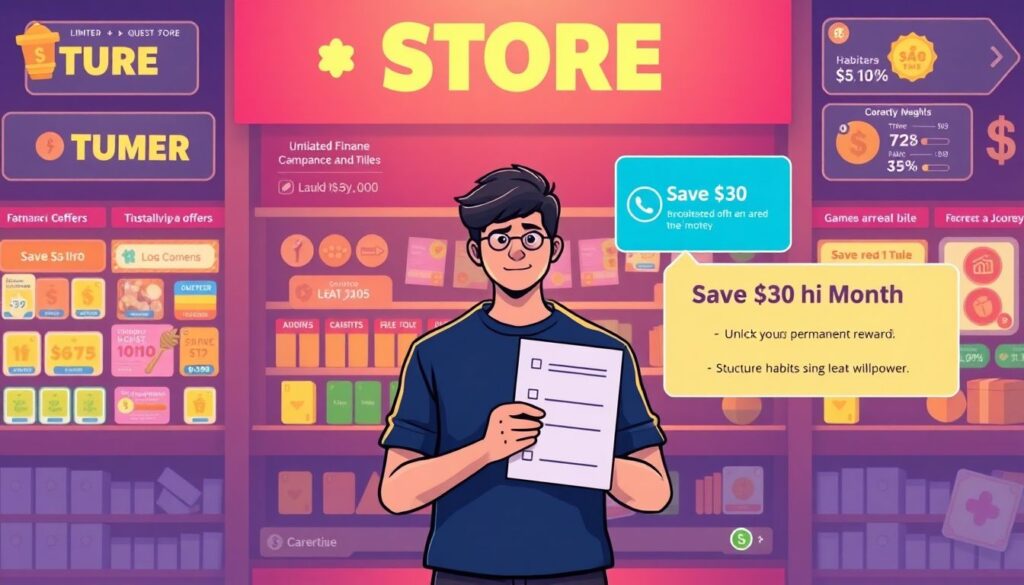
Relying on “I’ll just be stronger next time” rarely works, especially when store UIs, limited-time offers, and FOMO are designed to wear you down. Habits and rules beat raw willpower every time.
You can “gamify” your own money behavior:
– Treat saving like a quest: “Save $30 this month = unlock permission to buy one new game next month.”
– Track streaks: “No unplanned purchases this week” gets you a small non-monetary reward—an extra play session, a guilt‑free lazy evening, whatever feels good.
– Use clear triggers: “I only open the store after I’ve checked my budget app today.”
This flips the script: instead of feeling like the game is farming *you*, you’re the one running the system.
Real-life scenarios and how to handle them
Let’s walk through a few typical situations.
Scenario 1: The “flash sale panic”
You see a game at 80% off for the next 12 hours. Your brain screams: “I’ll never see this price again.”
Practical response:
– Ask: “Would I have bought this at full price last month?” If not, it’s a fake urgency.
– Check your monthly gaming limit. If buying it means going over, put it on your wishlist and revisit next month.
– Remind yourself: there will *always* be another sale. The industry runs on them.
Scenario 2: Friends all buying the same game
Your group is jumping into a new co‑op title, but it doesn’t fit your budget this month.
Practical response:
– Be honest: “I’m skipping this one for now; it’s not in my budget this month.” You’ll be surprised how many people respect that.
– Ask if they plan to keep playing long‑term. If it’s just a temporary hype wave, you might not be missing much.
– Plan ahead: set aside money next month specifically for that game if you still want it.
Scenario 3: “I already spent too much, so whatever” spiral
You go over budget early in the month, feel like you failed, and start buying more because “the month is ruined anyway.”
Practical response:
– Treat it like a game run, not a permanent stat loss. You wiped this run; next run starts *now*, not next month.
– Shrink the time frame: aim to have the *next 7 days* under control. Don’t wait for a new calendar month.
– Write down what triggered the overspend—sale, stress, boredom—and plan one change for next time.
Digital tools that don’t feel like homework
Many budget apps feel like doing taxes every day. You want tools that fit into your life the way games do: quick, visual, and not boring.
Here’s how to keep it light:
– Use simple tags: “Gaming,” “Food,” “Rent,” instead of 50 categories.
– Check your budget during loading screens or queue times. Two birds, one stone.
– Set one key metric on your home screen: “Gaming spending this month: $X / $Y limit.”
Some apps even let you set custom alerts, so you can get a notification like: “Yo, you’ve hit 80% of your gaming budget and it’s only the 12th.” That one message can stop a lot of regret purchases.
Handling guilt and shame without beating yourself up
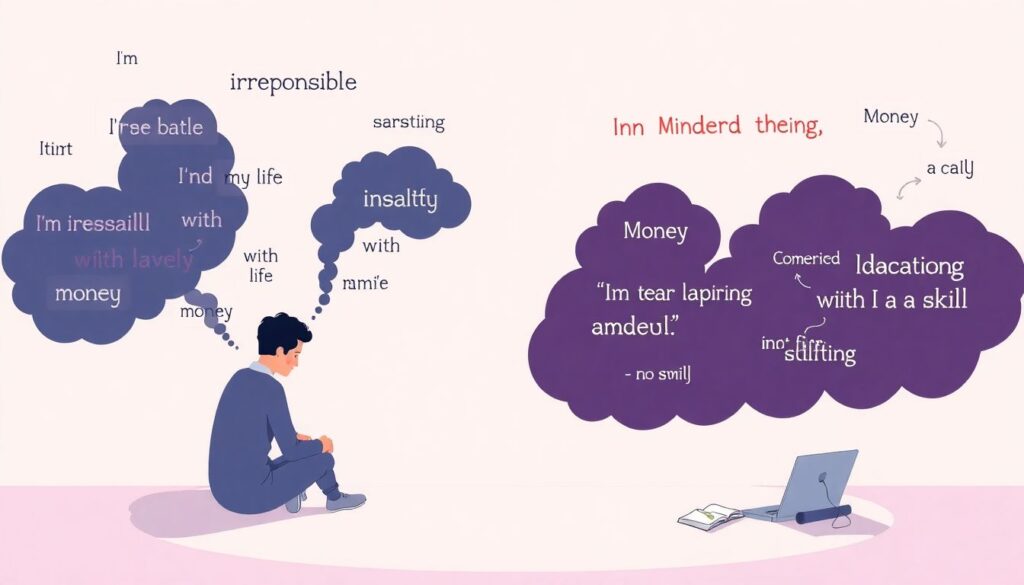
A big chunk of financial anxiety isn’t about numbers; it’s about *feelings*: “I’m irresponsible,” “I’m bad with money,” “I’m wasting my life.” Those thoughts push you into avoidance—and avoidance makes the problem worse.
A more useful mindset:
– “I’m learning a skill.” Money management is a skill, not a personality trait.
– “Past me made those purchases; current me is changing the system.”
– “Small improvements count.” Cutting $20 this month *is* progress, even if the overall spending still feels high.
If your anxiety is tied to deeper stuff—like debt, family pressure, or job instability—it can really help to talk to someone neutral: a counselor, a financial coach, even a support forum. You’re not the only one dealing with this, even if it feels that way.
Common misconceptions about money and gaming
There are a few myths that keep people stuck.
Misconception 1: “If I had more money, I wouldn’t stress about this.”
In reality, people with much higher incomes also overspend on games and feel anxious. Without a system, more money just means bigger numbers.
Misconception 2: “Real adults don’t spend on games.”
Adults spend on all kinds of hobbies: bikes, coffee gear, concerts, collectibles. Games are just a modern hobby. The difference between healthy and unhealthy isn’t *what* you buy, it’s *whether your other needs are handled*.
Misconception 3: “Budgeting will kill my fun.”
Actually, knowing that your bills, savings, and gaming budget are covered can make gaming *more* enjoyable. You’re not low‑key panicking in the background; you’re just playing.
Misconception 4: “I’m either fully disciplined or totally out of control.”
Real life is in the middle. You’ll have good months and messy months. The goal is not 0 mistakes; the goal is better averages over time.
Putting it all together: a simple 30‑day plan
To make this practical, here’s a no‑nonsense plan you can start this week:
– Day 1–3:
– Check your last 3 months of game spending.
– Decide on a realistic monthly cap.
– Create a “Gaming” category in your chosen app or spreadsheet.
– Day 4–10:
– Set up a separate payment method just for games.
– Unlink your main card from major platforms.
– Turn off purchase pop‑ups and marketing emails where possible.
– Day 11–20:
– Use a 48‑hour rule for any purchase over a set amount (e.g., $15).
– Track *only* your gaming expenses—don’t overwhelm yourself with everything at once.
– Day 21–30:
– Review: did you stay close to your limit? Where did temptation hit hardest?
– Adjust your limit up or down slightly based on what felt sustainable.
– Pick one change for next month: fewer subscriptions, fewer impulse buys, or fewer “just because it’s on sale” purchases.
Over a couple of months, this practical, low-drama approach will do more for your financial anxiety than any extreme “no spending ever” challenge. You’re not trying to quit gaming; you’re trying to make sure money stress doesn’t ruin it.