
Why venture funding matters so much in games
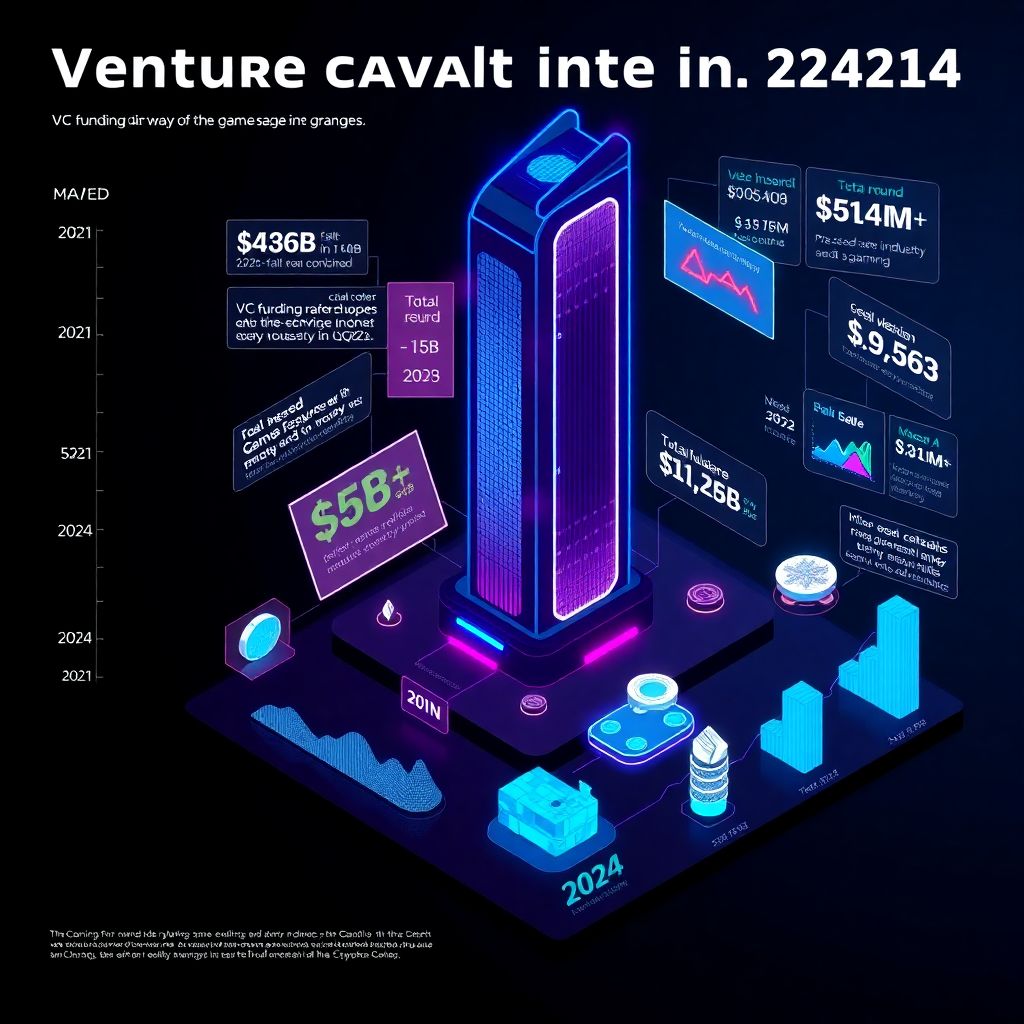
Over the last decade, games turned from a “hit‑driven entertainment niche” into a mainstream software business that rivals film and music combined. That shift changed how studios are financed. Big publishers still matter, but a huge chunk of innovation now comes from small teams backed by venture capital. Between 2022 and 2024, VC money for games cooled off from the 2021 bubble, yet it’s still serious: according to Drake Star and PitchBook, game‑focused VC rounds went from roughly $13–14B in 2022, down to about $5B in 2023, with ~$4B already deployed by Q3 2024. Understanding how and why this money moves is no longer “nice to know” — it directly affects how you build, pitch and scale any ambitious gaming project.
Venture capital funding for gaming startups isn’t just about “getting a bag of cash”.
It’s about buying time: time to iterate on prototypes, time to build cross‑platform tech, time to grow a live‑ops team before revenue catches up. On the investor side, it’s about owning a piece of potential breakout hits, tools, or platforms that may define the next decade of interactive entertainment. Once you see this mutual trade clearly — risk and equity exchanged for time and upside — your decisions on when (and whether) to chase VC become much more rational.
The current state of VC in the gaming industry (2022–2024)
Funding cycle: from euphoria to discipline
The peak hype wave ended in 2021–early 2022, when anything that mentioned “metaverse” or “web3 gaming” could raise at a wild valuation. In 2022, the broader games deal volume (M&A + VC + public markets) still hit around $51B, but the quality of deals already started to diverge. By 2023, rising interest rates plus crypto‑winter pulled the brakes: VC funding into game content and technology slid to roughly one‑third of 2022 levels, and many generalist funds quietly stepped back. However, the correction did not kill game industry investment opportunities; it filtered them. Studios with strong retention metrics, clear user acquisition strategies, and realistic burn rates still closed rounds, often at cleaner terms than in the hype years.
By 2024, the market got noticeably more rational.
Average seed rounds became smaller but more focused, often $1–3M instead of the $4–6M “mega‑seed” norms of 2021. Series A rounds for gaming platforms, tools, and infrastructure remained healthier than for pure content studios, especially if they served cross‑platform or UGC ecosystems. Importantly, a lot of capital rotated from speculative blockchain titles into pragmatic plays: backend services, user acquisition tooling, creator economy platforms, and mobile studios with proven monetisation. In other words, the money didn’t vanish; it moved to teams that can demonstrate a path to sustainable revenue instead of purely narrative‑driven promises.
What exactly are investors betting on?
Most serious gaming industry venture capital firms now think in “stacks”, not single titles. At the bottom, you have infrastructure (game engines, multiplayer backends, payment, anti‑cheat, analytics). Above that, you see UGC and platforms (modding ecosystems, creator tools, virtual economies). On top, you still have content studios building precision‑targeted experiences, from mid‑core mobile to AA/indie PC and console. Since 2022, the largest VC checks increasingly go into those lower layers of the stack, because the exit potential is bigger: a tool that powers 100 games is more attractive than a single game that may or may not hit. Still, strong content plays get funded when they align with clear distribution or community advantages: think deep genre expertise, unique IP, or existing creator networks built over years.
Content‑focused founders often underestimate how investors map this stack.
If you pitch your studio purely as “we’re making a cool co‑op roguelike”, you’re asking them to accept hit risk with no structural hedge. When instead you frame your work as “we’re building a co‑op roguelike for an underserved, well‑defined niche, using a live‑ops framework we can reuse across multiple titles”, you’re suddenly speaking the same language: reusable tech, portfolio thesis, and compounding know‑how. That’s exactly what investors mean by repeatable value creation, and in a post‑2022 environment, it’s often the difference between “nice prototype” and a term sheet.
Key players: who actually writes the checks?
Types of investors in gaming
Behind phrases like “video game startup investors list” hides a surprisingly diverse cast of characters. You’ve got specialist gaming funds (e.g., Griffin Gaming Partners, Makers Fund, Play Ventures, BITKRAFT), corporate venture arms of big publishers and platforms (Tencent, NetEase, Sony, Embracer‑backed funds), generalist tech VCs that sometimes lead or follow (a16z, Index, Lightspeed), and finally angels and syndicates made up of ex‑founders and senior execs from well‑known studios. Over 2022–2024, specialist funds consistently dominated early‑stage games deals: in some quarters, they accounted for 60–70% of disclosed seed and Series A rounds in games globally. Generalist VCs remained more selective, usually coming in when a studio or platform already showed strong traction.
For a founder, the type of investor matters at least as much as the size of the check.
A specialist game VC can help with production milestones, mid‑core metrics benchmarks, or live‑ops hiring in a way most generalist funds simply can’t. Corporate venture arms often bring distribution or IP access but may move slower and care more about strategic fit than financial multiples. Angels and small syndicates are usually fastest and most flexible, great for pre‑seed and bridging rounds — yet they rarely support a full funding roadmap alone. When you plan how to get VC funding for a game studio beyond the prototype phase, think in stages: angels and grants to reach a strong vertical slice, then specialist VC for seed/Series A, and potentially a corporate investor when scaling or co‑developing a flagship IP.
Technical detail: who invests at which stage
Pre‑seed / concept (typical 2022–2024 ranges):
Checks of $100k–$1M, often from angels, small syndicates, or micro‑funds. Milestone: fun, replayable prototype and a credible core team.
Seed:
Rounds of $1–3M (occasionally up to $5M) led by gaming industry venture capital firms or strong angels. Milestone: vertical slice, early playtest data (retention D1/D7), and a content roadmap.
Series A and beyond:
From $5–20M+, usually with institutional VCs and sometimes corporate investors. Milestones: proven LTV>CAC, stable live‑ops, growing community, or clear B2B SaaS metrics if you’re building tools.
Remember: these are ranges, not rules. Exceptional teams or hot niches can fall outside them, especially in regions with different cost structures.
Why do VCs like (and fear) games?
The upside: hits, ecosystems, and outsized retention
From an investor’s perspective, games have three giant attractions. First, the upside of a breakout hit is enormous. Just a few examples: *Genshin Impact* reportedly passed $3B in mobile revenue in less than two years; *PUBG* and *Fortnite* turned into multi‑billion‑dollar franchises. Second, successful games create ecosystems that are very hard to disrupt: players invest not only money but identity, time, and social ties. That’s why investors love platforms like Roblox or tools like Unity and Unreal — once integrated into a production pipeline or a creator’s life, churn is low. Finally, games are at the frontier of tech, from real‑time rendering to networking and AI; they often foreshadow broader consumer behaviour, which makes them strategically valuable beyond short‑term returns.
The flip side is brutal hit‑driven risk.
A polished, expensive game can still flop on launch week, wiped out by visibility issues or a slightly better competitor. Development cycles are long, and costs can easily creep: traditional PC/console AA projects in the West often land in the $5–15M range, while even “indie‑looking” mobile titles with solid live‑ops can burn $300–700k before global launch. For VC funds that promise liquidity to their backers within 7–10 years, this uncertainty is scary. That’s why many funds now favour studios that either build smaller, faster‑iterated titles or combine content with tech: for instance, a studio that also develops internal user acquisition tooling they can later spin out into a B2B product if needed.
Technical detail: risk modeling from an investor lens
When a VC partner looks at a game studio, they often run a mental model along these lines:
– Portfolio logic: “If our fund is $200M, we need at least 2–3 companies to plausibly return $100M+ each.”
– Outcome odds: “Can this studio reasonably produce a hit with $100–300M exit potential (M&A or IPO)?”
– Time to data: “How fast will we see hard metrics: retention, ARPDAU, LTV, or enterprise contracts if it’s tools?”
– Resilience: “If the first game fails, is there reusable tech, IP, or community to try again without starting from zero?”
Your job as a founder is to make these answers as concrete and positive as possible.
What exactly does venture money change for a studio?
Speed, risk and product scope
VC funding lets you trade dilution for acceleration. Instead of three friends hacking a prototype over nights and weekends, you can hire senior engineers, dedicated artists, and a live‑ops lead in the first year. That means more content, better polish, and faster iteration. It also means a higher monthly burn: it’s not unusual for a 12–15 person seed‑stage team in the US or Western Europe to burn $150–300k/month once fully staffed, especially post‑2022 with rising salaries. This burn rate can be rational — if it buys you a clear shot at a scalable launch or fast B2B adoption. But if you don’t align scope with funding, you just increase the chance of running out of runway with a half‑finished product.
The trick is to use capital to reduce risk, not amplify it.
Instead of betting everything on a giant one‑shot launch, many funded studios now adopt “laddered validation”: start with a tightly scoped core loop, run closed alphas and betas, track your metrics, then expand content and marketing only when you hit concrete KPIs (e.g., D1>35%, D7>15% for certain mobile genres). Venture capital funding for gaming startups works best when every $1 you raise clearly buys a measurable reduction in uncertainty — better data, better community insights, or reusable tools — rather than simply more assets or features tacked on.
Technical detail: setting milestones for a funded studio
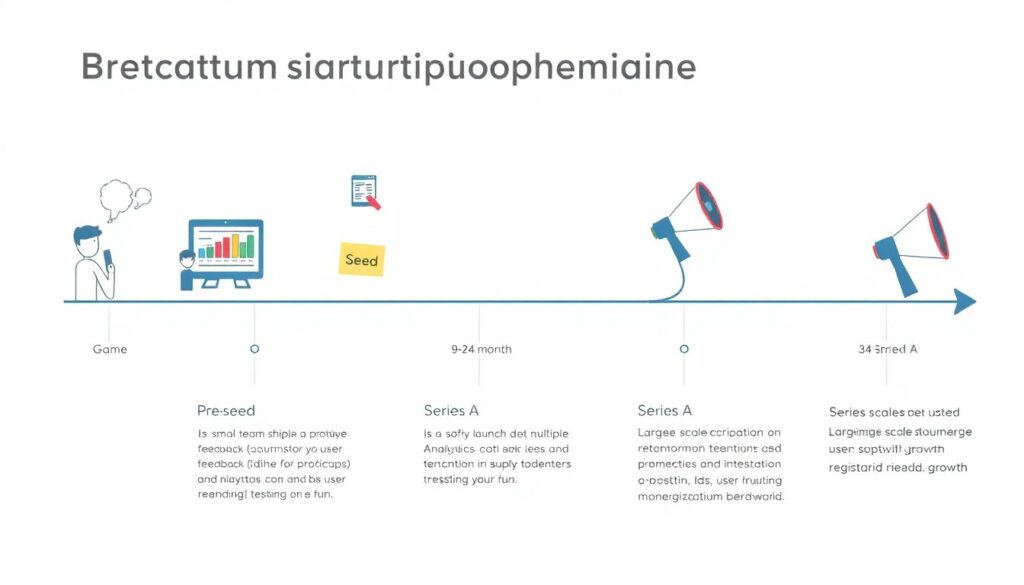
A practical milestone chain might look like this:
– Pre‑seed (0–9 months): Ship a prototype, collect qualitative feedback, validate “fun”.
– Seed (9–24 months): Reach soft launch, instrument analytics, iterate to target retention and monetisation benchmarks.
– Series A (24–36 months): Scale UA, regional launches, or B2B sales. Document repeatable processes.
– Post‑A (36+ months): Portfolio strategy (second game, expansion pack, or tooling spin‑off), prepare for strategic M&A talks if relevant.
When investors see this kind of roadmap, they can map capital to risk more comfortably, which makes a yes more likely.
How to get VC funding for a game studio in 2024–2025
What investors actually look for now
Pitch decks that worked in 2021 — “big vision, some art, lots of metaverse talk” — now fall flat. Between 2022 and 2024, the bar shifted from “promising idea” to “credible execution path plus data”. For pre‑seed, that might be a small but compelling vertical slice and a founding team that shipped meaningful titles before. For seed and beyond, investors expect at least early numbers: retention curves, session length, core monetisation scaffolding. They will also check how your scope matches your raise: if you’re asking for $5M to build a single premium indie game on PC with no expansion or tools strategy, you will face hard questions.
Storytelling still matters, but grounded storytelling.
Show a clear audience (who plays your game, on which platforms, and why now), a sharp competitive landscape (which titles you’re replacing in a player’s daily routine), and a pragmatic marketing plan (influencers, community, performance UA, platform deals). Connect these to a realistic budget and team plan for at least 18–24 months of runway. The clearer this map, the easier it is for investors to see where their capital fits. If your studio also builds internal tools that have potential beyond your own games, highlight that too — many funds have explicit theses around cross‑studio platforms and love the optionality.
Practical steps to approach investors
In practice, finding the right investors is half the game. Most serious funds now publish their focus areas, portfolio, and often a light version of their “video game startup investors list” on their websites or blogs. Use that: build a short‑list of 15–30 funds and angels that actually invest in your niche (mobile mid‑core, co‑op PC, UGC platforms, infra, etc.) and stage (pre‑seed vs Series B). Warm intros still dramatically outperform cold emails, so mine your network: ex‑colleagues, accelerators, game jams, conferences like GDC or Gamescom. Even one friendly angel or advisor can unlock multiple tier‑1 intros.
Keep your first contact concise.
A tight 8–12 slide deck plus a short gameplay video or live demo link beats a 40‑page PDF every time. For early‑stage, show the core loop as quickly as possible; for later‑stage, lead with metrics. After 2022’s correction, funds became much more selective with time: partners may skim your deck in 3–5 minutes before deciding whether to take a meeting. That’s why clarity and focus are a direct competitive advantage — and why you should test your deck on a few “friendly” investors or mentors first, then refine before you hit your A‑list targets.
Real‑world examples and patterns
Case patterns from the last 3 years
Consider three anonymised but typical stories pulled from 2022–2024 deal patterns. A European co‑op survival game studio raised $2.5M seed around a polished demo plus a Discord community of 30k highly engaged players; they showed waitlists, wishlist data, and early influencer interest, giving investors confidence. A mobile mid‑core team in Southeast Asia closed $4M by leveraging past experience scaling a top‑grossing title and showing strong soft‑launch metrics (D1 ~40%, D7 ~18%) in one test market. Meanwhile, a tools startup building machine‑assisted level design for Unreal raised a $10M Series A, anchored by contracts with three known AA/AAA studios. In all three cases, the common factor wasn’t “metaverse magic” — it was tangible proof that each dollar of marketing or development could translate into durable value.
You’ll also notice what’s missing: overreliance on crypto tokenomics or vague metaverse land sales.
Projects that raised big rounds on token speculation in 2021 struggled badly by 2023, as player interest and token prices fell. Investors learned from this; by 2024, most reputable gaming industry venture capital firms required a real game loop and fun factor before touching any “web3 gaming” pitch, and they heavily discounted financial projections based on secondary token trading. If your project touches blockchain or any hypey tech, anchor your pitch in timeless fundamentals: solid gameplay, real ownership benefits, and compliance with evolving regulations, not just short‑term financial engineering.
Technical sidebars: metrics and modeling that win pitches
Technical detail: key metrics VCs care about
For live or soft‑launched games, investors will scrutinise:
– Retention: D1, D7, D30 — broken down by cohort and acquisition channel.
– Monetisation: ARPDAU, payer conversion, average revenue per paying user (ARPPU).
– Acquisition: CPI, ROAS, and the payback period on marketing spend.
– Engagement: Session length, frequency, churn; community growth (Discord, Steam wishlists, etc.).
For tools/platforms:
– Revenue quality: Recurring vs one‑time, expansion revenue, churn.
– Usage: DAU/MAU among dev teams, projects per customer, integration depth.
Having this data clean, visualised, and benchmarked against genre norms is a quiet but powerful signal of maturity.
Technical detail: modelling runway and use of funds
Your financial model doesn’t need to be perfect, but it must be coherent. A solid 24‑month plan usually includes:
– Headcount plan: Who you hire, when, and at what cost, including benefits and overhead.
– Production roadmap: Clear phases with rough cost attached (pre‑production, vertical slice, alpha, beta, launch).
– Marketing budget: Test markets, creator campaigns, launch bursts, tools.
– Buffer: At least 20–30% of the raise reserved for surprises and slip.
Investors know any plan will change; they’re checking whether you understand your own cost drivers and can react when reality hits.
Where the next wave of opportunities lies
Emerging themes for 2025 and beyond
Looking at 2022–2024 trends, several game industry investment opportunities are clearly forming for the coming years. UGC‑heavy ecosystems (Roblox, Fortnite Creative, user‑generated modding platforms) are spawning new creator tools, discovery engines, and monetisation layers ripe for funding. AI‑assisted content creation is moving from “toy” to workflow — VCs are eyeing startups that weave AI into pipelines without breaking pipelines or IP law. Regional expansion is another theme: studios in Latin America, MENA, Eastern Europe, and Southeast Asia raised more rounds as their cost advantage and local publishing knowledge became too strong to ignore. Finally, B2B services that help studios adapt to privacy‑driven ad changes (post‑IDFA user acquisition, probabilistic attribution) are getting real traction.
None of this means money will be easy.
The 2021 era of FOMO term sheets is over. But funds still need to deploy capital, and games remain one of the stickiest digital products humans use. If you can blend a sharp understanding of your audience with disciplined production and a transparent relationship with investors, you’re entering the market at a healthier time: valuations are saner, competition for talent is less insane than during the lockdown boom, and expectations are more grounded. For founders who treat VC as a tool — not a trophy — the next few years may actually be the best window in a decade to build something durable in games.