
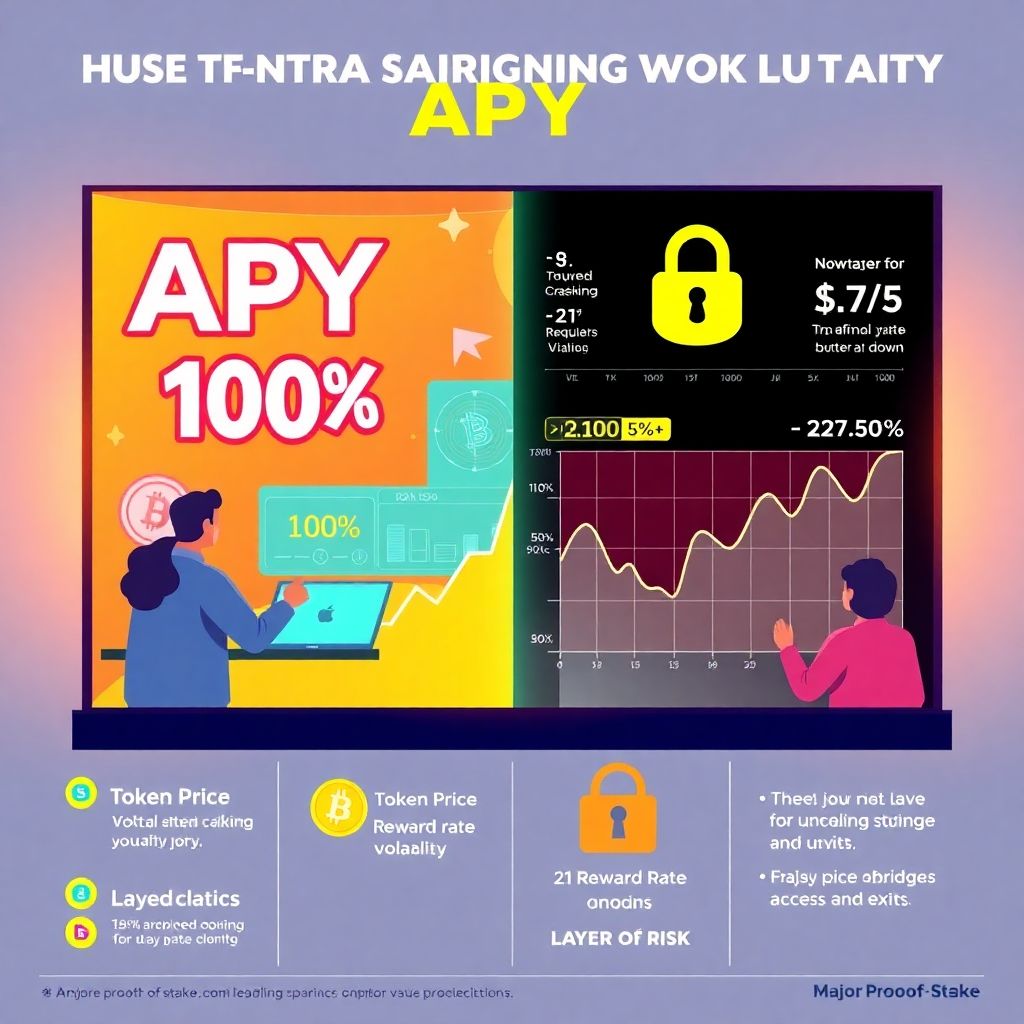
Why staking volatility matters more than the APY banner
If you’ve been around crypto for more than a week, you’ve seen it: flashy staking offers with 12%, 20%, sometimes even 100%+ APY. On the surface it looks like free money. But the part most people underestimate is not the APY — it’s the volatility around that APY and the token price itself.
Staking isn’t just “deposit and forget”. It changes *how* you take risk, *when* you can exit, and *what* can blow up your returns. Understanding staking volatility is the difference between a nice stream of passive income and watching a “high-yield” position bleed out while you’re locked in.
Let’s break this down in a practical, no-nonsense way.
—
Case study: +20% APY, –70% portfolio
The “good APY, bad outcome” scenario
Imagine this very typical situation:
– You stake a mid-cap token with 20% APY.
– Lockup (unbonding) period: 21 days.
– Token looks strong, community is hyped, you go in with $10,000.
For a while everything looks fine. You’re collecting rewards, dashboard numbers are climbing, life is good.
Then the market rolls over.
– In 3 weeks the token drops 50%.
– You finally decide to exit and hit “unstake”.
– During the 21‑day unbonding period the token dumps another 40%.
By the time you can sell, your $10,000 is closer to $3,000–$3,500, even including staking rewards. That 20% APY never had a chance to save you from a 70%+ price drawdown.
This is staking volatility in practice:
you’re not just exposed to price swings — you’re forced to *sit through* them because your capital is partially or fully locked.
—
Another real case: “safest” chain, unexpected risk

An investor stakes a large amount of a major proof‑of‑stake coin (think ETH, SOL, ADA‑level, not a meme). The logic is simple: “This is one of the safest crypto coins for staking income, I’m just collecting yield.”
Then a network incident hits:
– Validators go offline.
– Slashing events occur for some validators.
– Rewards turn negative or near zero for a period.
– Token price drops in response to the drama.
Even though the chain “survives”, the investor ends up with:
– A smaller balance due to slashing.
– Lower future rewards because the protocol adjusts.
– A token that’s down 30–40% from the time of staking.
The chain wasn’t a scam and it wasn’t a tiny altcoin. The risk came from validator performance + protocol design + market reaction, not just “is this project legit?”.
—
What actually drives staking volatility
It’s not just price movement
When people think volatility, they usually mean token price going up and down. For staking, there are *three* volatility layers:
1. Token price
– Standard crypto volatility: bear markets, bull runs, sudden crashes.
2. Reward rate volatility
– APY is often dynamic, not fixed.
– Changes in total tokens staked, inflation schedules, governance decisions, or fee revenue all move your yield up or down.
3. Access volatility (liquidity constraints)
– Lockups and unbonding periods.
– Liquidity risk in liquid staking tokens (discounts vs spot, depeg events).
– Exchange or protocol outages when you want to exit.
You can have:
– Stable-ish price but falling rewards.
– Great rewards but huge slippage when you try to sell.
– Good APY and good token… but you can’t exit for 21–180 days while the macro picture changes.
That’s why “high yield crypto staking with low risk” is almost always marketing shorthand. The actual risk is a combination of price swings, protocol behavior and your ability to exit quickly.
—
Staking vs just holding: where does volatility hurt more?
You’ll often see debates like: *crypto staking vs holding which is more profitable?* The honest answer is: it depends on your time horizon and how the token behaves in your portfolio.
Staking can be more profitable when:
– You’re genuinely long‑term on the asset (multi‑year).
– You’re using reasonably safe infrastructure.
– You don’t need instant liquidity.
– The token economics are sound (no insane inflation, actual demand).
Holding can be better when:
– You trade around levels often.
– You want the option to cut losses quickly.
– You’re unsure about the long‑term viability of the project.
– Market conditions are uncertain and you expect fast regime changes.
The problem isn’t that staking is “worse” than holding. The problem is that many investors mix a *trader’s mindset* (“I’ll exit when the trend breaks”) with a *staker’s constraints* (21‑day unbonding) — and that mismatch is where volatility wrecks them.
—
How to manage staking risk and volatility without overcomplicating things
First step: define what “loss” actually means to you
Are you measuring your results in:
– Dollars (or your local fiat)?
– BTC / ETH terms?
– Just in number of tokens you hold?
If your real goal is to grow your stack of a base asset like ETH, a 40% dollar drawdown in a bear market might be acceptable if you’re significantly increasing your token count at a low price and have a long horizon.
If you care about *dollar value now*, locking in a highly volatile token with a long unbonding period can be reckless, no matter what the APY is.
—
Simple, practical rules that already reduce 80% of the risk
You don’t need a PhD in finance. Apply these basic constraints:
– Don’t stake more than you’re willing to hold through a 70–80% drawdown in the underlying token.
– Prefer shorter unbonding periods unless you’re extremely confident in the asset and macro environment.
– Avoid chasing *the* highest APY; target sustainable yields on assets with genuine usage (fees, ecosystem, devs).
If you’re using the best crypto staking platforms for investors (large, reputable exchanges or battle‑tested DeFi protocols), remember: they reduce some operational risk, but they cannot protect you from market volatility or protocol‑level risk.
—
Non‑obvious solutions: hedging your staked positions
Hedge with derivatives (for advanced users)
One underrated move: stake the asset, hedge the price.
Example:
– You stake 10 ETH via a liquid staking protocol and receive a liquid staking token (LST).
– You open a short ETH perpetual futures position of similar size on a derivatives exchange.
If done right:
– Staking yields you ETH‑denominated rewards.
– The short hedge offsets major USD price moves.
– You’re more exposed to “yield + basis” than raw price volatility.
This is not risk‑free:
– Funding rates can eat into your yield.
– Liquidation risk if the position is sized or managed poorly.
– Counterparty risk on the exchange.
But as a non‑obvious solution, it’s a powerful way to turn volatile staking into something closer to a “yield strategy” rather than a pure directional bet.
—
Rebalancing between staked and liquid
Another underused tactic: dynamic allocation.
Instead of staking 100% of your position forever, you can:
– Stake, say, 50–70%.
– Keep the rest liquid for:
– Buying dips.
– Cutting exposure if macro worsens.
– Taking profits in rallies.
Then you rebalance occasionally:
– If the asset rallies hard, you *unstake a bit* into strength and bank some profits (after unbonding).
– If the asset dumps but you still believe in it, you can increase stake at lower prices, improving your long‑term yield on cost.
This softens volatility’s psychological impact and gives you room to maneuver instead of being completely locked.
—
Alternative methods to classic staking
1. Liquid staking instead of bonded staking
Liquid staking gives you a token (like stETH, rETH, etc.) representing your staked position. You earn rewards but can still move or trade that token.
Pros:
– Much better liquidity; easier to exit.
– Can be used in DeFi for extra yield.
Cons:
– Extra smart contract risk.
– LST can trade at a discount in panic markets.
– Complex setups if you start leveraging it everywhere.
So it reduces some volatility pain (being locked) but adds other risks (depeg, protocol exploits).
—
2. Using staking ETFs / managed products
More platforms are rolling out structured products or “staking funds” that:
– Hold a basket of staked assets.
– Rebalance automatically.
– Sometimes hedge or manage risk behind the scenes.
They can be useful if you:
– Don’t have time to research validators, protocols, slashing risks.
– Want exposure to staking income but diversified across multiple chains.
You’re outsourcing part of your volatility management to professionals — but you’re also adding management fees and platform risk.
—
3. “Pseudo‑staking”: yield from less volatile sources
If you like the idea of yield but hate being locked into volatile tokens, consider:
– Using stablecoin yield strategies (money‑market tokens, on‑chain T‑bill wrappers, reputable lending markets).
– Providing liquidity to large, stable pairs (e.g., ETH–stETH) with low impermanent loss.
These are not risk‑free either, but sometimes they offer a more predictable risk/return profile than staking an ultra‑volatile altcoin just because the APY looks juicy.
—
How to pick staking assets with volatility in mind
What to actually look at before staking
When you evaluate whether something belongs in your staking portfolio, go beyond “what’s the APY?” and check:
– Token economics
– Inflation schedule.
– Emission decay (does the APY collapse as more people stake?).
– Real demand (fees, ecosystem use, not just speculation).
– Validator / protocol risk
– Centralization (few big validators vs many smaller ones).
– Historical slashing events.
– Client diversity and track record.
– Market structure
– Average daily volume and liquidity on major exchanges.
– How the token behaved in past drawdowns.
– Correlation with BTC/ETH and macro news.
For conservative investors searching for the safest crypto coins for staking income, large‑cap, high‑liquidity L1s and L2s with real usage and transparent tokenomics tend to be a better starting point than obscure high‑APY farms.
—
Professional “lifehacks” for handling staking volatility
1. Treat APY as a *scenario*, not a promise
Pros don’t take the APY number at face value. They mentally discount it:
– If APY is 8%, they model:
– 4–6% as “likely”.
– 0–3% as “bear scenario”.
– 8–10% as “bull case”.
Then they decide if the worst‑case still makes sense, given the token’s risk profile. If it only looks good in the rosiest scenario, they pass.
—
2. Use time diversification, not just price diversification
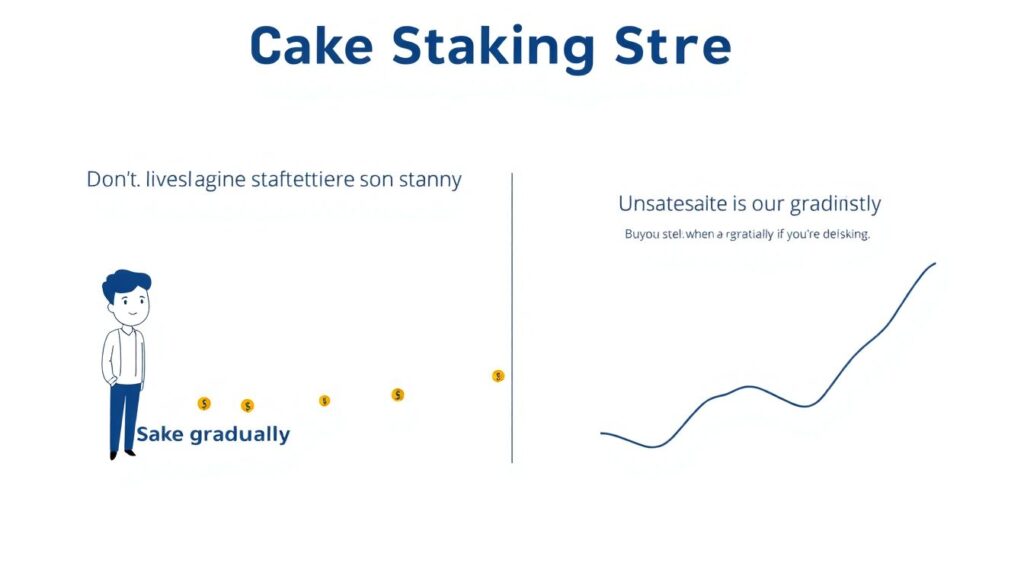
Instead of staking everything on day one:
– Stake gradually over weeks or months.
– Unstake gradually if you’re de‑risking.
This way, you’re not making one big timing decision in a highly volatile asset; you’re smoothing your entry and exit across multiple market conditions.
—
3. Separate “income layer” and “speculative layer”
A useful mental model:
– Income layer
– Large‑cap, high‑liquidity, relatively lower‑risk assets.
– Conservative staking setups (native or large liquid staking providers).
– Goal: consistent yield, low operational drama.
– Speculative layer
– Smaller caps, experimental protocols, higher APY.
– Smaller allocation, actively monitored.
– Goal: asymmetric upside, but safe to write off if it blows up.
This keeps volatility segmented. Your core staking income doesn’t get nuked because one experimental farm disappeared overnight.
—
4. Always leave some dry powder
Pros rarely go 100% all‑in staked. They keep:
– Some base asset liquid for opportunities.
– Some stablecoins for real‑world needs or market crashes.
This dramatically reduces the *emotional* impact of volatility. It’s easier to ride through a 50% slide in a staked asset when you know you still have liquid capital on the side.
—
How to actually get started (without blowing yourself up)
A simple, pragmatic roadmap
If you’re just getting serious about staking:
1. Pick 1–2 major assets you already believe in long‑term.
Don’t add new coins *just* because they have staking.
2. Start small and liquid.
– Test with a modest amount.
– Prefer liquid staking or short unbonding periods at first.
3. Choose infrastructure with a safety track record.
When looking at the best crypto staking platforms for investors, prioritize:
– Security audits and public track records.
– Transparency around slashing coverage, governance and fees.
– Actual usage and liquidity of any derivative tokens.
4. Define clear rules before you stake.
– Maximum % of portfolio in any one staked asset.
– Conditions under which you’ll begin to unstake (macro signals, token breaking key levels, project fundamentals changing).
5. Reassess quarterly, not daily.
Staking is a medium‑to‑long‑term play. If you’re checking APY every hour, chances are you’re mixing trader instincts with an investor strategy.
—
Bottom line: staking is a risk *shifter*, not a risk eraser
Staking doesn’t magically make an asset safer. It:
– Locks in some of your decisions.
– Changes *when* you can react to volatility.
– Adds protocol and validator risk on top of price risk.
– Rewards you for taking those extra constraints — in the form of yield.
If you understand how to manage staking risk and volatility, staking can be a powerful tool: it can smooth long‑term returns, increase your token stack, and make drawdowns more tolerable over multi‑year horizons.
But if you treat it like a savings account with a fat interest rate, you’re stepping into a leveraged version of the same market volatility — just with fewer exits available when things go wrong.
Use it deliberately. Size it conservatively. And always ask yourself before clicking “stake”:
> “If this token drops 70% and I’m locked for weeks, will I still sleep at night?”
If the honest answer is no, adjust the allocation or skip the stake. Volatility won’t disappear just because there’s an APY attached to it.