

You probably don’t need another generic “set SMART goals” article. You need a clear, usable system that tells you what to aim for, how to hit it, and how not to burn out or give up halfway. That’s exactly what this framework is about: a practical way to set achievable financial targets and actually reach them.
Below — real cases, non-obvious tricks, alternative approaches, and a few pro-level shortcuts you can steal right away.
—
Why most people fail at financial targets (and why it’s not about willpower)
Most beginners don’t fail because they’re lazy. They fail because their entire setup is wrong.
Here are the three most common beginner mistakes I see over and over:
– Setting numbers that sound nice, not numbers grounded in reality
– Trying to change five things at once (debt, investing, business, savings)
– Confusing “wish lists” with actual financial targets and getting frustrated when nothing moves
If you’ve ever thought, “I’ll just save more this year” or “I’ll invest aggressively and retire early,” but didn’t back it with real math, timeframes, and constraints — you weren’t doing goal-setting. You were daydreaming.
To fix this, you need a personal financial planning framework that forces you to translate vague desires into specific, testable actions.
—
Step 1: Turn vague wishes into measurable constraints
Before we get into how to set realistic financial goals, you need to know your constraints. Think of them as the rules of the game you’re playing.
Short paragraph:
No constraints = fantasy. Constraints = strategy.
Longer breakdown. Start with four numbers:
– Net income per month (after tax, after everything)
– Fixed costs per month (rent, utilities, minimum debt payments, basic groceries, transport)
– Variable lifestyle spending (eating out, subscriptions, clothes, hobbies)
– Existing obligations (loans, upcoming big payments, family support, etc.)
Now do this:
1. Subtract fixed costs from net income.
2. From what’s left, subtract the *minimum* you realistically need for variable expenses.
3. The rest is your maximum possible monthly “change budget” — the amount you can redirect to savings, debt paydown, investing, or building a buffer.
Most people skip this step and jump straight into “I want to save $1,000/month,” even though their change budget is $350. That’s the first way beginners quietly sabotage themselves.
—
Step 2: Decide what “success” means this year (not in your entire life)
This is where many financial goal setting strategies for individuals go off the rails. People try to solve retirement, housing, debt, and income all in a single year. That’s not a plan; that’s a stress recipe.
Short version:
Pick one primary target and one supporting target per 12-month cycle. That’s it.
Example structure:
– Primary target: Build a 3‑month emergency fund
– Supporting target: Pay down $2,000 of high-interest credit card debt
Or:
– Primary target: Increase monthly investable cash flow by $500
– Supporting target: Learn and implement a basic long-term investing plan
The “ultimate framework” starts with restraint: fewer goals, more focus, clearer wins.
—
Step 3: Translate the yearly target into monthly and weekly moves
Let’s make this very mechanical. A reliable step by step guide to achieving financial goals always breaks down big numbers into small, boring ones.
Say your primary target is:
“Save $6,000 in 12 months.”
– Yearly view: $6,000
– Monthly view: $500
– Weekly view: about $115
Now add constraints:
– Your change budget from Step 1 was $380/month.
– Therefore, $500/month is impossible *right now* without changing either:
– Income
– Fixed costs
– Lifestyle spending
This is where realism kicks in. Instead of giving up or forcing a number that will break in month two, you adjust your target or environment:
– New target: $4,500 saved in a year = $375/month (fit within your current budget), *or*
– New rule: Cut $125/month in subscriptions/impulse buys to free up room for the $500/month target.
The key: targets bend to math, not the other way around.
—
Real case: How Anton stopped “failing” at saving every month
Anton, 29, had been trying to save $800/month for years and “always failing.” After we walked through his numbers, his change budget was $460/month. The goal was doomed from day one.
We rebuilt his plan like this:
– Primary target: Emergency fund of $3,000 in 8 months
– Max monthly realistically available: $460
– New monthly saving target: $375, leaving a little buffer
– Supporting target: Cut two biggest leaks (ride-hailing and eating out)
Result:
– He hit $3,050 by month 8.
– He didn’t feel constantly deprived, because the target matched his math.
– The feeling of “I always fail” disappeared and was replaced with “Okay, this is just a process.”
The main lesson for you: if your targets keep breaking, they’re probably mathematically impossible under your current conditions, not proof that you “have no discipline.”
—
Step 4: Decide *what type* of goal you’re actually setting
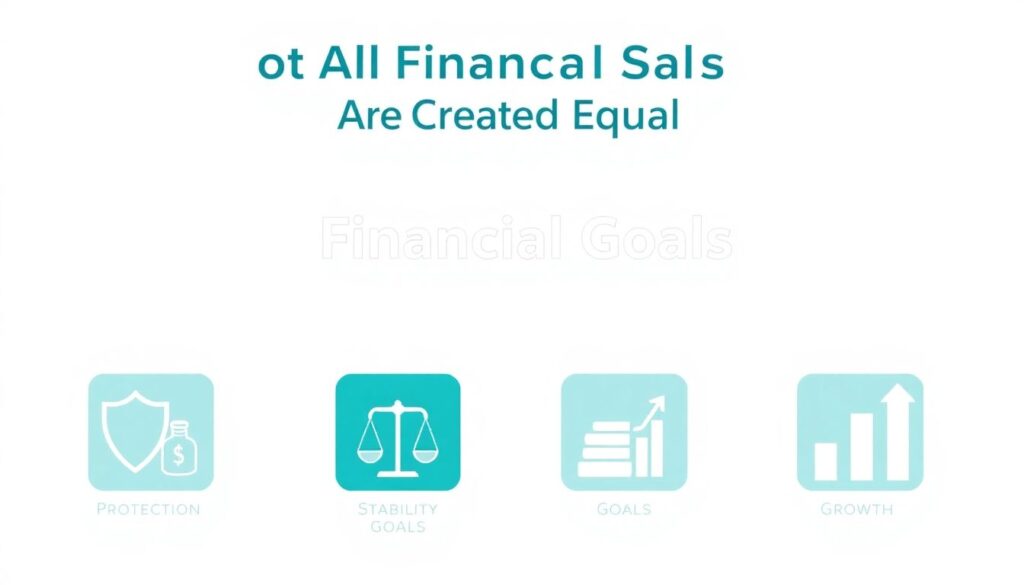
Not all financial goals are created equal. A solid personal financial planning framework separates them into four types:
1. Protection goals – emergency fund, insurance, avoiding catastrophic loss
2. Stability goals – debt reduction, smoothing cash flow, eliminating chaos
3. Growth goals – investing, career income growth, side hustles
4. Lifestyle goals – travel, housing upgrades, major purchases, time freedom
Short paragraph:
Beginners mix them all up, and then wonder why nothing moves.
If your finances are shaky, but you’re focused mainly on aggressive investing (growth) while ignoring high-interest debt (stability) and having no buffer (protection), you’re building a skyscraper on sand.
Typically, the most robust order is:
1. Basic protection
2. Basic stability
3. Predictable growth
4. Optional lifestyle upgrades
That’s the backbone of this ultimate framework.
—
Mistakes beginners keep repeating (and what to do instead)
Let’s outline the classic traps.
Mistake 1: Goal inspired by social media, not by your numbers
Copying someone’s “I saved $10,000 in 6 months!” story without seeing their income, rent, or circumstances.
Fix: Start from your constraints, then tune ambition, not the other way around.
Mistake 2: Confusing tools with strategy
People download apps, open brokerage accounts, and think that equals progress. Tools are not a plan.
Fix: First define what success looks like in numbers and dates, then pick the best tools for setting financial targets and tracking them.
Mistake 3: Zero margin for bad months
Plans that only work if “nothing goes wrong” die quickly.
Fix: Build a 10–20% slack into your monthly targets so you can absorb life happening.
Mistake 4: No feedback loop
Set-and-forget goals with no weekly or monthly review.
Fix: Schedule a 20‑minute “money check-in” every week — non-negotiable.
—
Non-obvious solutions: Make goals adjustable, not brittle
Here’s one twist most generic advice ignores: the goal can change — the direction shouldn’t.
Short version:
Lock in your direction (e.g., “I’m moving toward safety and out of high-interest debt”), but allow the speed (monthly contributions, deadlines) to adapt.
Non-obvious moves that help:
– Use range-based targets: “Save between $300 and $400/month” instead of exactly $350. It gives psychological space while preserving direction.
– Build levels: Minimum, target, and stretch.
– Minimum: I must at least save $200/month.
– Target: I aim to save $300/month.
– Stretch: If a bonus comes in, I’ll push to $450/month.
This flexibility keeps you engaged even when months don’t go as planned, instead of throwing the entire plan away after a single failure.
—
Alternative methods: When classic budgeting doesn’t work for you
Not everyone clicks with the standard monthly budget spreadsheet. That’s fine — there are alternative methods that still fit within a solid personal financial planning framework.
Here are three:
– The “Pay Yourself First” method
You auto-move your chosen target amount to savings/investing the day your income lands. You only “budget” what’s left. This is great if you hate tracking every little expense.
– Bucket system
You create separate accounts (or sub-accounts) for “Essentials,” “Goals,” and “Fun.” You move fixed amounts there regularly. No detailed categorization needed — just don’t steal between buckets.
– Seasonal budgets
Instead of rigid monthly rules, you plan in 3‑month blocks (quarters). This works well if your income fluctuates or you have seasonal work. Targets are set per quarter, then broken down loosely by month.
The ultimate goal isn’t to follow one ideal method. It’s to pick an approach you will actually maintain for more than three months.
—
Tools that help (and how not to misuse them)
The best tools for setting financial targets are the ones that:
– Show you your numbers clearly
– Make it easy to update and track
– Don’t overwhelm you with features you’ll never use
A few tool categories to consider:
– Simple spreadsheets – Google Sheets or Excel with 2–3 key tabs: Income, Expenses, Goals. No need for fancy templates at the start.
– Budgeting apps – Apps that categorize spending and show monthly summaries can be useful if you struggle to see where your money goes.
– Automation tools – Bank rules, recurring transfers, auto-investing — tools that enforce your decisions without asking for daily willpower.
But here’s the pro-level rule:
The tool must answer one question every month: “Am I on track for my targets, and why or why not?”
If your app doesn’t help you answer that, you’re just collecting data, not making decisions.
—
Pro tips: How professionals structure targets to avoid burnout

People who manage money professionally know one thing very well: systems beat motivation. Here are some practical “pro” habits you can borrow:
– Default decisions
Decide once, apply many times. Example: “Every raise, 50% goes to investments, 50% to lifestyle.” You don’t debate every pay bump — the rule is already there.
– Goal stacking
Complete one small but visible target before moving on to the next. For example, first close a small debt, then redirect that exact payment to savings. The quick win fuels momentum.
– Separate “wealth engine” from “fun money”
Long-term investments and safety funds stay in accounts that are slightly harder to touch. Daily spending and fun money are kept in easier-access accounts. This friction is intentional.
– Quarterly recalibration
Every three months, professionals review:
– What worked
– What broke
– What must change in the plan
You can do the same: adjust targets, not abandon them.
—
A simple weekly and monthly routine you can copy
To make this a real step by step guide to achieving financial goals, here’s a lightweight routine.
Weekly (15–20 minutes):
– Check balances on:
– Main account
– Goal accounts (savings, debt, investments)
– Ask:
– Did I move money toward my primary target this week?
– If not, what’s the smallest catch-up move I can make before Sunday?
Monthly (30–40 minutes):
– Update real numbers vs. your targets for:
– Savings
– Debt
– Investments
– Check: Are you ahead, on track, or behind?
– If behind:
– Decide: shrink the target slightly *or* adjust behavior (cut spending, boost income)
– Don’t just “hope next month will be better”
This rhythm turns your plan into a living system instead of a forgotten document.
—
Real case: Non-obvious win by changing goal *type*, not amount
Maria wanted to “invest aggressively” and kept trying to push $600/month into stocks while carrying $9,000 of credit card debt at 19% interest. Emotionally, investing felt more exciting than debt payoff.
We reframed:
– Protection first: Tiny $1,000 cash buffer so she wouldn’t keep falling back on credit cards.
– Stability second: Extra $400/month to kill the high-interest debt faster.
– Growth third: A modest $150/month into a simple diversified fund.
Same total monthly effort, but rearranged goal *types*. In 14 months:
– Credit card debt = gone
– Cash buffer = solid
– Investments = growing
The non-obvious solution was not “save more” or “invest differently,” but change the order of priorities.
—
How to set realistic financial goals that actually feel motivating
To wrap it all into a single approach:
– Start from constraints, not fantasies.
– Choose one primary and one supporting target for the year.
– Translate annual numbers into realistic monthly and weekly moves.
– Classify your goals: protection, stability, growth, lifestyle.
– Pick tools that highlight “on track / off track” in seconds.
– Build flexibility with ranges and minimum/target/stretch levels.
– Review weekly and monthly; recalibrate quarterly.
If you’re wondering which financial goal setting strategies for individuals work best, it’s usually the one you’re willing to track consistently, even when you’re tired, busy, or discouraged.
Your job isn’t to be perfect. Your job is to design a system where doing the right thing becomes the default, and backsliding is just a signal to adjust the numbers — not a reason to quit.
You now have the skeleton of an ultimate framework for setting achievable financial targets. The next move is simple: pick *one* goal, run it through these steps today, and let the numbers, not your mood, decide what’s realistic.