

Understanding why liquidity risk still blindsides crypto traders
Why liquidity is your hidden counterparty
In traditional finance you usually worry about credit risk first, but in crypto markets liquidity is often the invisible counterparty that actually decides your P&L. When we talk about crypto liquidity risk, we mean the chance that you cannot enter or exit positions near the quoted price without moving the market against yourself. Between 2022 and 2024, according to data from Kaiko and CCData, average spot depth on top pairs fell by roughly 30–40% during stress days, while intraday spreads widened up to 5–10x on mid‑cap coins. If you size positions only off chart patterns and ignore order book depth, you are effectively betting that someone will always be there to take the other side. That assumption worked in the 2021 bull run; it failed spectacularly once volatility and regulation fears kicked in.
What changed in 2022–2024
From late 2022 to 2024 the structure of liquidity in crypto shifted more than most retail traders noticed. After the FTX collapse in November 2022, global spot volumes dropped by more than 50% over the next six months, and several large crypto market liquidity providers either exited or sharply cut their books because of counterparty and regulatory risk. Even in 2024, when Bitcoin ETF flows pushed BTC to new highs, depth concentrated on a few venues and a handful of pairs, while altcoin liquidity remained thin: many top‑200 tokens traded less than 1–2 million USD of real daily volume. That means a single mid‑sized order can still move prices by several percent. Understanding this backdrop is the first step in any serious discussion of crypto liquidity risk management strategies, because you can only control the risks you actually see.
Real cases that expose how liquidity risk really behaves
FTX, Luna and the myth of “blue‑chip” depth
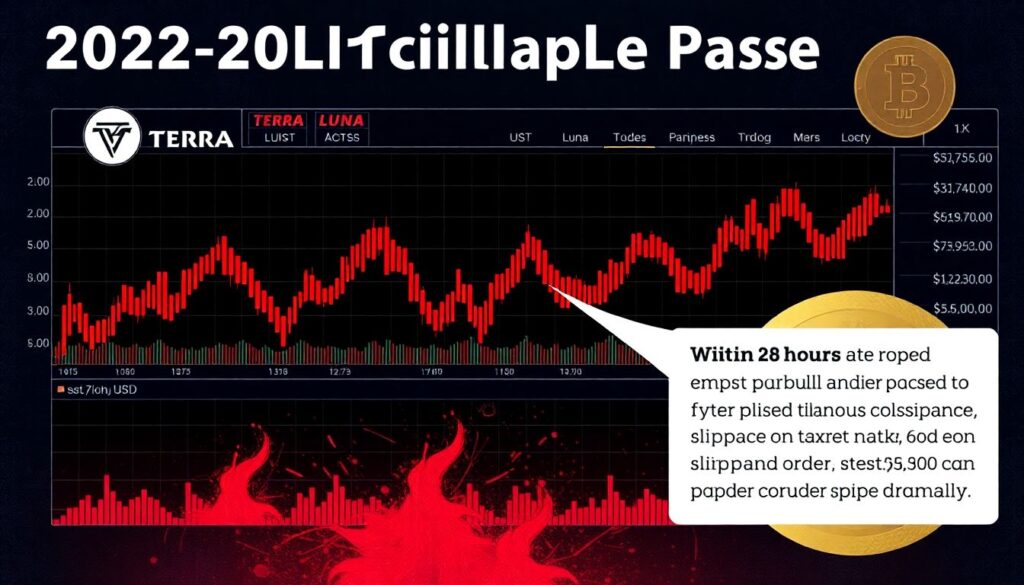
The 2022 Terra/Luna collapse is a textbook illustration of crypto liquidity risk in action. On paper Luna was one of the most traded coins; in practice, as the peg started breaking, order books emptied faster than prices could update. Within 48 hours, slippage on market orders over 50,000 USD went from under 0.5% to double‑digit percentages, effectively trapping anyone who sized positions based on historical liquidity. A similar pattern played out around the FTX bankruptcy: coins heavily listed on that venue saw their effective spreads and depth deteriorate even on other exchanges, because a major source of inventory vanished. If you had assumed “top‑10 market cap equals safe liquidity,” your models would have been off by an order of magnitude.
DeFi liquidity dry‑ups and the “TVL illusion”
On the DeFi side, 2023 and 2024 gave us quieter but very instructive examples. During several sharp rate‑change weeks in 2023, total value locked in major AMMs barely moved, yet realized slippage exploded as LPs rebalanced out of volatile pools and into stablecoin or LST strategies. In one highly traded ETH‑alt pair, on‑chain depth within 1% of mid‑price shrank by more than 60% intraday while dashboards still showed “healthy” TVL. This gap between visible TVL and actual executable size is precisely where many traders underestimate crypto liquidity risk. If your dashboards focus only on aggregate capital while ignoring concentration of LP positions and fee tiers, you can be trading into a pool that is much thinner than it pretends to be, especially during macro news or protocol‑specific shocks.
Non‑obvious ways to measure and anticipate liquidity stress
Reading the order book like a risk professional
Most people glance at bid‑ask spreads and call it a day, but serious crypto liquidity risk assessment tools go further. Instead of just looking at Level‑1 quotes, you should monitor cumulative depth across several price bands, the distribution of iceberg orders, and how quickly liquidity replenishes after a test trade. A simple yet powerful trick is to run small ping orders at different times of day and record the slippage profile; over a few weeks you will map out when each pair is structurally fragile. Between 2022 and 2024, quantitative desks increasingly shifted to “liquidity‑aware sizing,” where trade size is capped as a function of real‑time depth, not just portfolio risk limits. That single discipline change can cut realized slippage by 30–50% on mid‑caps without touching your alpha model.
Using latency and quote‑staleness as early warnings
Another underused indicator is quote‑staleness: how long the best bid and ask stay unchanged during volatile periods. When crypto market liquidity providers are confident, they update quotes rapidly and keep tight spreads even into news. When they are nervous, spreads widen and quotes become sticky because market‑makers are trying not to get picked off. You can track this with lightweight scripts or existing analytics platforms and treat rising quote‑staleness as an early warning of liquidity stress. From 2023 onward, several professional desks started feeding such microstructure metrics into their risk engines, automatically slowing down execution or switching to passive orders when staleness crosses a threshold. This is not glamorous, but it turns opaque order books into a readable risk dashboard you can act on intraday.
Alternative methods of accessing and managing liquidity
Routing beyond a single exchange
Relying on one venue, even among the best crypto exchanges with high liquidity, is a dated habit that keeps blowing up portfolios during regime shifts. Between 2022 and 2024, concentration risk became painfully clear as different platforms faced localized outages, regulatory news or banking issues. A more robust approach is to treat venues as interchangeable pipes and design your setup around smart order routing. Even if you trade manually, you can operate several accounts and compare effective prices, including fees and slippage, before hitting the button. Algorithmic traders go further by aggregating books from CEXes and DEXes in real time, splitting large orders across venues to minimize footprint. This approach does not eliminate crypto liquidity risk, but it makes you less dependent on any single weak link in the market structure.
Using derivatives and RFQ venues as liquidity valves
An overlooked alternative source of liquidity is the combination of derivatives markets and request‑for‑quote (RFQ) platforms. In stressed environments, perpetual futures on liquid venues often maintain tighter spreads and deeper books than spot pairs, because arbitrageurs and basis traders flock there. Some professional desks will hedge the price risk via perps while unwinding spot inventory gradually, using RFQ chats with market‑makers for larger clips. RFQ venues, which grew strongly from 2022 to 2024 on both centralized and on‑chain rails, let you negotiate size and price privately instead of slamming the public book. Integrating these channels into your crypto liquidity risk management strategies gives you additional “valves” to release risk when public liquidity is clearly insufficient for your intended trade size or speed.
Lifehacks for professionals who live with liquidity risk
Designing execution around volatility regimes
Professional traders treat liquidity as regime‑dependent, not static. Historical data from 2022–2024 shows that during high‑volatility weeks, intraday depth often halves while spreads double, but the pattern is not uniform across time zones and venues. A practical lifehack is to build a simple regime classifier based on realized volatility and funding rates, and link your execution style to each regime. In quiet markets you can be more aggressive with market orders; in stressed regimes you automatically switch to iceberg and TWAP orders with strict participation caps. Some desks overlay this with news calendars so that exposure and trade size gradually shrink ahead of known catalysts. Over time this creates a playbook where your reaction to liquidity shifts is encoded, not improvised in panic.
Turning tooling and data into a genuine edge
The last edge is not a secret indicator but disciplined use of data and tools. Even if you are not a quant shop, you can still piggyback on professional‑grade crypto liquidity risk assessment tools offered by analytics vendors and exchanges themselves. Focus on metrics such as realized slippage versus modelled slippage, effective spread paid, and share of volume executed passively versus aggressively. Track these over rolling windows and treat deterioration as a risk event, not just “cost of doing business.” Many funds between 2022 and 2024 found that simply enforcing hard limits on daily slippage and venue exposure improved net performance more than tweaking entry signals. In a market where directional edges decay fast, the way you manage liquidity often defines whether your strategy survives the next stress cycle or becomes another anecdote from the 2020s.